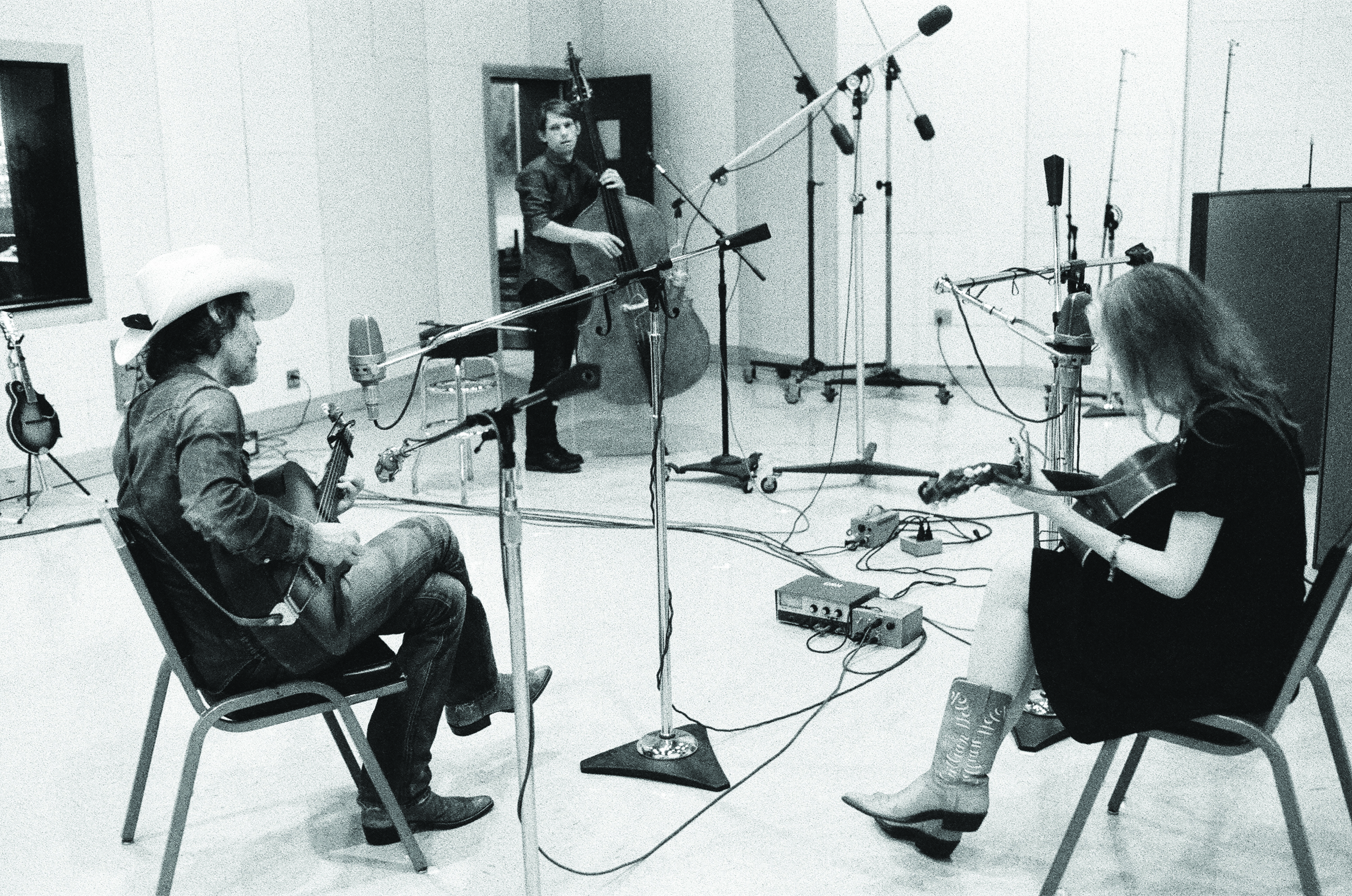
To those not well versed in the Rawlings-Welch world, it can be a little difficult at first to grasp exactly how they shape and divide their dynamic, but it’s actually rather simple: they always play and write together, but when Welch sings, it’s billed as Gillian Welch, or the “duet,” as they refer to it. When Rawlings sings, it’s “The Machine.” He is not her backing band, nor is she his. Before Nashville Obsolete, any songs that ended up as Machine tracks were just written to be written – this time, they were written specifically for Rawlings.
“Dave Rawlings Machine as a concept is more an indicator of the fact that I am going to be singing lead vocals as it is anything else,” he says. “I didn’t want someone to see a track that said ‘Gillian Welch’ and hit a button and hear me singing.” Some of those Gillian Welch records have become gold standards in the modern folk revival, garnering Grammy nods, becoming touchstones that modern Americana artists look to when writing their own tradition-rooted compositions.
Rawlings, however, is a different man to many people, which is a unique spot for someone so beloved and so respected within the musical community. To some, he’s a guitar aficionado, renowned producer and Welch’s essential partner. To many, perhaps, he’s the guy in Gillian Welch’s band. To others, he’s simply the person Ryan Adams mentions on the first song of Heartbreaker, “(Argument With David Rawlings Concerning Morrissey),” which is actually not really a song at all but 37 seconds of chatter between Rawlings, who worked on the record, and Adams.
“I’m totally okay with being that guy,” he says. “Like, ‘you’re David Rawlings? From the Argument?’ I’m like, ‘yeah!’”
Turns out, there was no right answer in the argument, anyway. “Somehow, people have decided that it was about [the Morrissey track] ‘Suedehead.’ But we were actually having an argument about ‘Hairdresser On Fire,’ which turns out is on both Viva Hate and Bona Drag. So we were both right.”
There are also two other Dave Rawlings’ of note: the businessman, and the producer. As the latter, he most recently was responsible for Dawes’ fourth LP, All Your Favorite Bands, which was recorded at Woodland Studios. Before that, he’d produced for Old Crow Medicine Show, as well as Robyn Hitchock’s Spooked, in addition to several duet records. Dawes had been seeking someone to help them capture a sound more authentic to their concert performances and Rawlings, a longtime friend, seemed a smart choice: he records analog himself, with few modern bells or whistles.
“Dave is one of the most knowledgeable and musical people I’ve ever met,” Dawes’ Taylor Goldsmith says. “How he does it — live to tape, analog — that’s something that we’ve only dabbled with for other records, but that always ends up being where we sound best. We wanted someone to really be able to go there with us, and Dave was the perfect guy.”
“I just record things live,” Rawlings says, shrugging. “That’s the way I know how to play records. I’m not saying there aren’t better ways, but I do it the way I know how to do it.”
That style is exactly what got him thinking about the phrase “Nashville obsolete” which became the album title. Rawlings and Welch share such a love for life’s older things – aside from just music – that they even joked about opening up a shop in the basement of Woodland Studios where they could sell “obsolete” goods like typewriter ribbons and buggy whips.
“We are forever searching for things that are obsolete,” he says. “Obsolescence ends up being something that comes up a lot, and probably more as the years go on. We thought it could be funny to send out a catalogue like they used to, with a motto: if you don’t need it, we’ve got it!”
When Welch and Rawlings started out making their music steeped deeply in the folk tradition, it could be said that what they were doing was obsolete, too. The duo met at Berklee College of Music when both were students – Welch came from the University of California, Santa Cruz to Boston to focus more intently on songwriting, and met Rawlings, studying guitar, in the hallway. They were waiting to audition for a country band, having both been enamored by the vintage greats of the genre: the Stanley Brothers, Bill Monroe, the Blue Sky Boys. Both moved to Nashville after they left Massachusetts, to chase the muse of those very artists.
While Welch was born in New York and eventually raised in Los Angeles to entertainer parents, who adopted her as a newborn, Rawlings grew up in suburban Rhode Island, taking up the guitar as a teenager. His first entry point was Neil Young, whom he covered in a talent show with a local friend – listen closely to Nashville Obsolete, and you’ll hear quite a few subtle nods to ol’ Shakey, particularly on “Short Haired Women Blues”: a harvest moon and some crazy, wild ponies.