
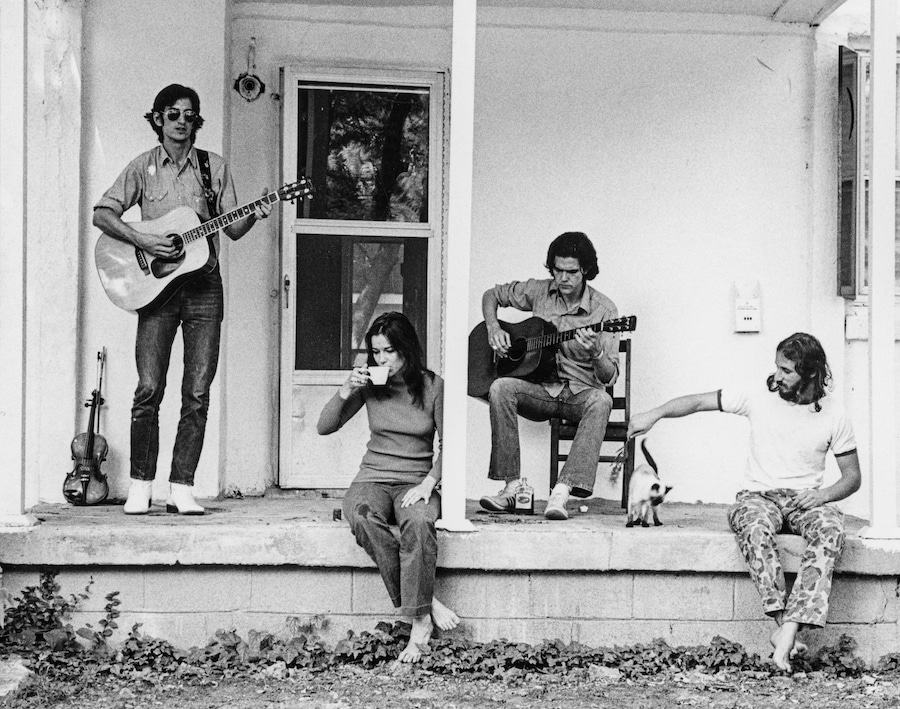
As the weather got colder, Crowell decided he needed a roof over his head. He found a job busing tables at the TGI Friday’s restaurant on Elliston Place and moved to an old house with a wraparound porch on Acklen Avenue in Hillsboro Village, an artistic and bohemian neighborhood on the south side of Vanderbilt University. His roommates were fellow Texan Richard Dobson and “Skinny” Dennis Sanchez, the six-foot-seven, 125-pound upright bass player who had played with Guy in a string band in Los Angeles and followed Guy to Nashville. Sanchez’s height was a symptom of Marfan syndrome, a genetic disorder of the connective tissue that sometimes includes heart valve and aorta defects. Crowell worked the evening shift until 2:00 a.m. Word got around that the house on Acklen was an all-night hang. After the bars closed, the porch became the stage and the Crowell-Dobson-Sanchez house was the place to be for late-night picking parties.
Crowell came home from work one early morning and found Guy Clark passed out in his bed. “Skinny Dennis and I shared a bedroom with two little twin beds. I walked in and saw these long legs and pair of cowboy boots hanging off the end of my bed and I went, ‘Okay. That’s cool,’” Crowell says. “Then I went and met Susanna. My first conversation was with her. She was flirting with me, in the way Susanna used to flirt. She’s teasing me, the fresh-faced kid. She was funny. We became instant friends. We talked about painting. I don’t know if I was at all interested in painting, but I lied and said I was. I was ten years from getting interested in painting, but, ‘Of course, yeah, I love painting. Van Gogh?’ I knew that name. I think I [had] heard [of ] Rembrandt.”
Crowell’s roommate Richard Dobson tended bar at Bishop’s Pub, a place where songwriters were welcome to pass the hat and play for tips, burgers, and beer. Dobson had moved to Nashville after reading a story about Kristofferson in the New York Times magazine. Mutual friends suggested he look up Guy Clark.
“I called up Guy. He’s very courtly on the phone and said, ‘Who do you know?’ I mentioned three or four people,” Dobson says. “Then I mentioned a fellow named Frank Davis, who is an engineer, artist, all-around beloved Houston character. When I said ‘Frank Davis’, Guy said, ‘Oh, why don’t you come on over?’ So I did, and he said, ‘Let me see what you got.’ I played this song called ‘Baby, Ride Easy.’ He said, ‘Oh, I like that.’ He arranged a Nashville demo session, and he demoed the song for me. He also pointed out a place where I could probably find a rooming house on West End, and that worked out for me. He just took me in. Guy and Susanna are a pretty striking couple, and they were just really good to me.”
Owned by Tim Bishop, Bishop’s stood at West End and Thirty-Second avenues. At the time, West End, Hillsboro Village, Centennial Park, and Elliston Place neighborhoods operated as the nerve center for artists, songwriters, hippies, and performers.
Two characters who called themselves Girl George and Arizona Star came up as part of the street scene around the West End. George and Star had moved to Nashville from San Francisco on the advice of Kris Kristofferson, who told them they would be a perfect fit in the creative landscape of Music City. George wore high boots, a sword, and a Prince Valiant costume. Star floated through the park in billowing hippie tunics. Together they sang, danced, and entertained all around Centennial Park, West End, and Elliston Place.
Elliston Place, known as the rock block, held several hangouts: TGI Friday’s, where Crowell worked alongside another aspiring songwriter, Marshall Chapman; the Gold Rush, a dive where musicians could find cheap eats and score some dope; and the Exit/In. Young songwriters worked their way up from playing Bishop’s Pub to headlining at the Exit/In. Although he had only been in town for a year, Guy had a big enough following to play the Exit/In. He was the heart of the bohemian scene.
Crowell describes the hierarchal order of their community:
Mickey Newbury had a place on the lake, a houseboat on the lake. You rarely saw Newbury, but when you did, it was like a visit from the king. And then there was Townes, who was this satellite, who revolved around Guy and Susanna. Townes was a version of the Wandering Troubadour or the Ramblin’ Jack character. When Townes came into town he would generally be kicking heroin. Word would get around that Townes is coming into town and then we’d all gather around at Amy Martin’s carriage house in Hillsboro Village. The first day or so, we’d all wait downstairs while Townes was upstairs at Amy’s place. We’d all be out sitting around a picnic table with guitars in hand waiting for Townes to come down—waiting for him to get over the jones and junk. That was just a movable feast, to quote Hemingway.
These characters orbited Guy. Guy was the sun, and there were a lot of planets spinning around him. Maybe Susanna was the sun sometimes and Guy was the moon, and then Guy was the sun and Susanna was the moon, and rest of these artists, in some form of development, would orbit around Guy. He was the curator of the street characters, the great artists like Newbury and Townes. People just followed Guy around. He invited me to hang and pay attention and sometimes would tell me “Just shut up and learn.”
Guy didn’t think of himself as a mentor, but he was a barometer for excellence, and the other songwriters looked up to him. Crowell, Sanchez, Dobson, Bobby David, Steve Young, Steve Runkle, and Harlan White were just a few of the writers who gathered around Guy.
“He sat me down and played Dylan Thomas reading poetry,” Crowell says. “He said, ‘Hey, man, listen to this. Our songs have to be able to speak with the eloquence of Dylan Thomas.’ Now, that’s setting the bar at the right place. Guy has the jeweler’s eye. At four a.m. when the smoke clears and the chemistry is just right, he can identify what is true, real, and what is potentially museum-quality art. Most everybody I knew wanted to be around that. I certainly did because I wanted to learn. People have said that Guy is my mentor, and Guy bristles at that. He wasn’t a mentor to me. He didn’t have that self-important thing that ‘I’m going to mentor you and teach you something, young man,’ but it was more like, ‘Hey, man, we’re hanging. You know some good songs; let me hear ’em.’”