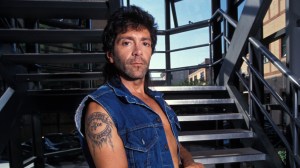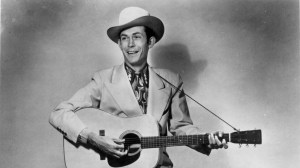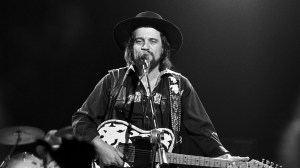
On this day (November 15) in 2018, Roy Clark, 85, died from complications of pneumonia at his home in Tulsa, Oklahoma. Co-hosting the beloved country music variety show Hee Haw alongside Buck Owens, he brought country music into the homes of 30 million viewers each week for more than 20 years.
Also a seasoned country music performer, Clark also released dozens of albums throughout his five-decade career, scoring multiple hits including “The Tips of My Fingers,” “Yesterday, When I Was Young”, “Come Live with Me”, and “Somewhere Between Love and Tomorrow.” He snagged back-to-back Entertainer of the Year honors from the Academy of Country Music in 1972 and 1973, taking home the same prize from the Country Music Association in the latter year.
Videos by American Songwriter
Today, we’re taking a trip through the remarkable career of Roy Clark in honor of the eighth anniversary of his passing.
Roy Clark’s Musical Beginnings
Born April 15, 1933, to two amateur musicians in Meherrin, Virginia, Roy Linwood Clark had a song in his heart from the day he entered this world.
“Because my dad and uncles played music around our house, I’d say I’d been listening to music since I was in a crib – but we couldn’t afford a crib!” Clark said in a 2016 interview. “My dad did whatever it took to raise a family of five – and still found time to make the music he loved. If I had the ‘get up and go’ that my father had, I’d have been a big star years and years ago.”
The family eventually settled in Washington, D.C., where Hester Clark found work at the Washington Navy Yard. Like his father, Roy Clark learned to play guitar, fiddle, and banjo. By age 14, he was backing up his father at local dances.
Within a few years, he had two National Banjo Championships under his belt, with his second win earning him an appearance at the Grand Ole Opry. At 17, Clark briefly pursued a boxing career, winning 15 fights in a row before deciding music was his true passion.
His Singing Career
Initially touring with acts like rockabilly star Wanda Jackson, Roy Clark eventually landed a solo deal with Capitol Records in 1960. Two years later, he released his first solo album, The Lightning Fingers of Roy Clark, in 1962.
He scored his first Top 10 hit with his version of Bill Anderson’s “The Tips Of My Fingers” in 1963. None of the singles he released with Capitol ever gained the same traction, and he switched to Dot Records in 1968.
The following year, he reached the top 10 again with a cover of Charles Aznavour’s “Yesterday, When I Was Young”. This kicked off a string of Top 10 hits for Clark in the 1970s, including “I Never Picked Cotton” (1970), “Thank God and Greyhound” (1970), “The Lawrence Welk — Hee Haw Counter-Revolution Polka” (1972), “Come Live with Me” (1973), “Somewhere Between Love and Tomorrow” (1973), “Honeymoon Feelin’” (1974), and “If I Had It to Do All Over Again” (1976).
In 1976, he became one of the first American artists to perform in the Soviet Union.
He Never Thought “Hee Haw” Would Succeed
In 1969, Roy Clark debuted alongside Buck Owens as co-hosts of the syndicated sketch comedy program Hee Haw.
In a 2015 op-ed for The Huffington Post, Clark admitted he accepted the job with reluctance. “We assumed people would forget about it after its run of 12 episodes on CBS was over and hopefully also forgive me in the process,” he wrote.
Instead, the show aired until 1997, with Clark at the helm for nearly 300 episodes. He sang with Owens, Grandpa Jones, and Kenny Price in the Hee Haw Gospel Quartet, as well as joining guitarist Chet Atkins, pianist Floyd Cramer, mandolin player Jethro Burns, saxophonist Boots Randolph, fiddler Johnny Gimble, harmonica player Charlie McCoy, and trumpet player Danny Davis in the show’s Million Dollar Band.
Clark called his time with Hee Haw “the icing on the cake” of his nearly seven-decade career.
[RELATED: 3 CMA Winners From 1973 We Still Can’t Get Enough of Today]
“I am most proud of how Hee Haw did its part to help pave the way for country music to burst from its regional roots to remarkable worldwide popularity,” he wrote.
Featured image by Fotos International/Getty Images
-
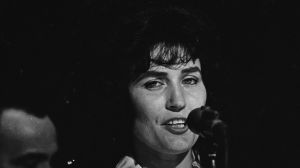
American country singer and songwriter Loretta Lynn performs on stage at the Grand Ole Opry, Nashville, Tennessee, early 1960s. (Photo by Graphic House/Getty Images) -
AUSTIN, TEXAS – AUGUST 28: Todd Snider performs in support of Robert Earl Keen's 2022 Final Tour, "I’m Comin’ Home: 41 Years On The Road" at ACL Live on August 28, 2022 in Austin, Texas. (Photo by Rick Kern/WireImage) -

American musician Gretchen Peters performs onstage, Columbia, South Carolina, September 24, 1995. (Photo by Paul Natkin/Getty Images) -
Hervé Villechaize, Buddy Killen and George Jones at the 16th Annual Academy of Country Music Awards on April 30, 1981 at the Shrine Auditorium in Los Angeles, California. Credit: (Photo by Ralph Dominquez / MediaPunch via Getty Images) -
Musician Woody Guthrie poses for a portrait with his guitar that has a sitcker on it that reads "This Machine Kills Fascists" on it circa 1942. (Photo by Michael Ochs Archives/Getty Images)