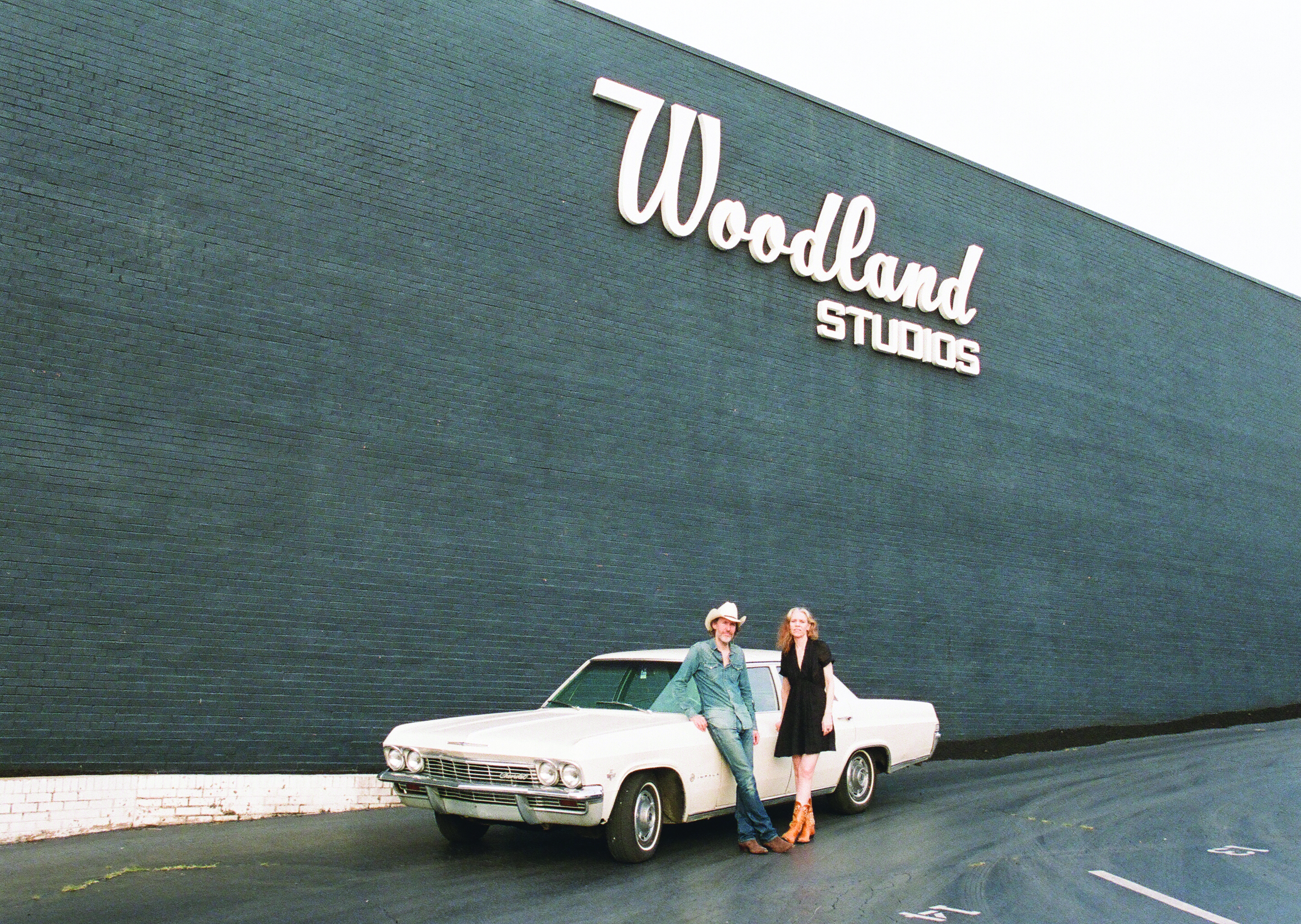
Rawlings says its all a result of some smart and calculated early choices: keeping the Gillian Welch project insular, and having the knowledge to control certain things, like holding on to masters and even buying the early ones back from Interscope, which housed their first label.
“It all comes back to the amount of touring we did as two people in a car,”he says. “We were making about enough money to have another two people, but we didn’t. So we were able to buy recording equipment, the beginnings of a studio. We’d come home and buy a couple pieces, slowly.”
One choice Rawlings has made on Nashville Obsolete is to, once again, not make it a complete showboat for his guitar playing, something that scores of his admirers have been wanting for years – because his style, which hovers between flatpicking and improvisational jazz, is a singular one. He plays a quirky, unusual instrument – a 1935 Epiphone Olympic archtop acoustic, which looks almost like a giant, stretched out violin, which he holds with the neck up at nearly a 45-degree angle, pushed out from his body as if it’s a magnet he can’t shake. His plucks are thick and complicated, but also delightfully sparse at times, too.
“I feel a little bad,” he says, “because I feel like there are people who are fans of my guitar playing, and I don’t want to let them down.”
“I’m always delighted when Dave takes off on a solo because he brings us on this great ride that’s compelling and yet full of surprises,” says Sara Watkins, who recruited Rawlings and Welch to play on her self-titled solo debut. “At a show, it can feel like the audience was watching a story unfold. It’s exciting when you sense Dave has sort of played himself into a corner and you can feel the whole audience tensing up, routing for him. No one is sure how he’ll get himself out of this fix he’d gotten himself into. But then he breaks out of that tight spot and you can’t help but cheer and celebrate.”
Goldsmith echoes the sentiment. “There are a lot of Dave Rawlings imitators out there. You have to be a real individual for that to happen.”
The afternoon light has shifted, and Welch comes back out onto the porch. Rawlings strides back inside, but Welch is not smiling.
“I’m in a bit of a surly mood,” she says. She had recently been asked to write the speech for Townes Van Zandt’s induction into the Austin City Limits hall of fame, which she worked on during the entire drive to Texas for the presentation. Just now, her management informed her that it had been cut to “like 25 percent” for the television broadcast. Welch is not used to having others control and edit her work – and thankfully so. But she does point out that now, with The Machine, she’ll be the one taking a slightly less starring role in the game of public perception.
“People didn’t understand how much of a band Gillian Welch was, and [Rawlings] endured it with great stoicism,” she says. “Now I’m on the stoic end of that. Some are like, ‘Oh, Dave wrote the songs.’ No, it’s the same thing. Only he is singing them. Now it’s my turn to be on the quiet end. We’ll see how well I endure it. I don’t know if I’m as stoic as he is!” She laughs, that surly mood seemingly relaxing away.
The first Dave Rawlings Machine album, Friend Of A Friend, came out in 2009, and it felt a little bit more like a sampler than an intentionally-composed LP. There are several covers, like of his friend and collaborator Conor Oberst’s “Method Acting,” as well as Ryan Adams and Old Crow Medicine Show tracks he co-wrote. But it doesn’t exactly tell a concrete story like Nashville Obsolete.
“This record, in my mind, is a little more like Dave’s first record, truly,” Welch agrees. “Friend Of A Friend is like an introductory composite. This is Dave’s first record,” she repeats, clapping her hands, as if that makes the statement official.
“I feel like this record wants to be understood,” she adds. “Hopefully it is a record that will connect with people. Dave and I are both really liking this pendulum swing between the Machine, and the duet. And I really enjoyed knowing this is the first record we’ve made knowing that Dave would be the singer. Even the first record – I didn’t start ‘Ruby’ knowing it was for Dave. It just got started. But ‘The Weekend’ was always for Dave.”
Welch describes that writing process as “dreamlike,” akin to the subconscious flashes we conjure up while asleep.
“I don’t really control it,” she says. “We live our lives and we talk about stuff and, much like a dream — that is controllable or uncontrollable — I start a song about whatever has been in my head. There is no discussion really. Dave spontaneously starts ‘Candy’ one day at a sound check. And that’s that.”
It’s an inevitable question to wonder if this all means a new Gillian Welch record is in the cards – there has not been one since 2011’s The Harrow & The Harvest. Welch and Rawlings are still writing, of course, but she’s just not sure yet where this particular material might end up heading.
“If we have a fervor to write more Machine songs, we’ll just write more Machine songs. I don’t really care what people expect. I don’t think people expected this record that we just served up. I think the last thing people expected from the guitar player in the Gillian Welch Band was a wordy poetic record of sprawling narrative. Someday they’ll get the guitar record they’ve been pining for a decade [for]. But this one does have more guitar.”
“Now with thirty percent more guitar!” says Rawlings, interjecting, as he suddenly appears on the porch.
“And we didn’t subject them to Dave playing the banjo,” she fires back.
“We waited until the banjo was popular and then we decided not to use it,” Rawlings says. “That’s very us. But I just came out here to say, I killed that cicada.”
“You did? Good man! Where was he?” Apparently, a stray cicada had wandered into the Welch-Rawlings household, and has been chiming incessantly, loudly.
“He was in the garbage disposal,” Rawlings says. Welch gasps. “I correctly ascertained that he was subterranean. Anyway, he’s been disposed of.” He grins proudly, devilishly. Fodder for another murder ballad, perhaps.
There was a point in the making of Nashville Obsolete where Rawlings started to doubt whether the public at large could relate to any of the sweeping time warp that he and Welch had created. So he called his friend Joel Coen, who directed O Brother with his own brother, Ethan, and asked for advice.
“I said, ‘What do you do when you have something you can’t throw away, but you don’t think it has much commercial value?’” Rawlings recalls. “And one of the things I remember him saying is that, in their films, if there is a line that makes him and Ethan laugh, if there is something in it for them, it goes in. Even if no one else will understand.”
Welch’s face lights up. “I was like, check! These songs totally qualify. I have no idea if anyone else is going to understand these or like them. But I know our interest was unflagging.”
And, if all else fails, they’ll always understand each other.