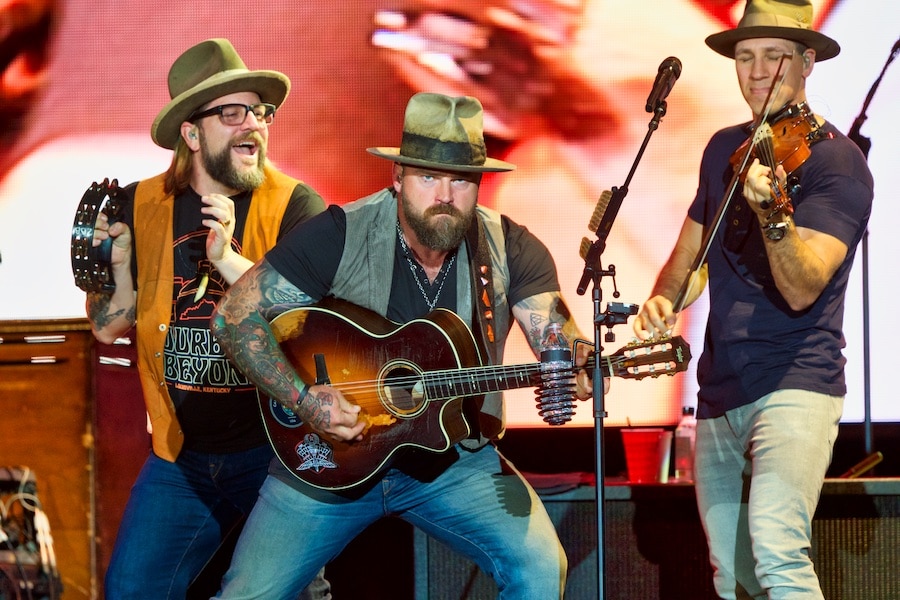
What sets Louisville’s Bourbon and Beyond festival apart from other destination fests throughout the country is its unique inclusion of food and spirits in addition to great music.
“It’s not unlike our festivals that we do on occasion where we infuse food and wine. A good music festival needs good food, good beverage and good bands. And this one has a lot of that,” said Zac Brown Band multi-instrumentalist John Driskell Hopkins prior to the group’s festival closing, Sunday night co-headlining set alongside ZZ Top. “The thing that’s amazing about this is that all of these bourbon companies are coming together to support their art and their family histories in lots of ways.”
Innovation is crucial in the spirits industry. Thinking outside the box and years ahead creates new flavor profiles and pushes something like bourbon forward.
Similarly, working with new producers and exploring different sounds has helped the Zac Brown Band evolve on its latest album The Owl.
Brown worked with a diverse roster on the new record, which includes collaborations with electronic dance music star Skrillex, pop leaning producers and writers like Ryan Tedder and Max Martin and one of America’s greatest songwriters in Brandi Carlile.
We spoke backstage at Bourbon and Beyond with multi-instrumentalists John Driskell Hopkins and Clay Cook and bassist Matt Mangano about using the technology that’s available today to craft great songs and a songwriting process that pushes the envelope on the sixth Zac Brown Band studio album The Owl.
A lightly edited transcript of that conversation follows below.
I want to start with a real basic question: how important is it to you to have your music judged as just that — music. Not as a country song or a rock collaboration or anything else but as music that’s not pigeonholed?
Cook: That’s who we are as a band and we have been for a long time. We’ve not been specifically one genre. The way we look at it is this: there’s good music and there’s bad music. Those are the two genres that we like to classify music as. And we’re purveyors of good music, I believe. And if that ends up being a bluegrass tune or a heavy rock song or a Sinatra style ballad, that’s who we are as a band. So when we make a record like this, or Jekyll + Hyde and to some extent even Uncaged, which is eight years ago now, we’ve always been flirting with different genres. Especially in our live show too.
“Finish What we Started” features Brandi Carlile. When we think of great American songwriters, she’s obviously near the top of that list. How did that collaboration come about? Did you work together in the studio on that song or were the parts recorded separately?
Mangano: She came in and it was the day after the CMT Awards. The day after we won group video of the year, where Zac gave a big impassioned speech. Brandi and her team, I think they were really happy to hear what he had to say. And so the next day she was in the studio. He had asked her to be a part of the record earlier on and I think that kind of sealed the deal for her.
It was a perfect spot. The first notes out of her mouth were incredible. As they kept working on the song, as she kept singing it, she sort of learned it more and there was more depth each time she sang it. What ended up being on the record is really just the best of what she did.
Cook: Brandi has been on our periphery since her first record. Just more and more talks — see her at awards shows and high five. We’re all kind of buddies with her and her band. We were surprised that it took this long for us all to find a spot for it to happen.
Has the gradual industry shift away from the album toward great singles kind of actually helped you in a way to put together a collection of songs like The Owl where you try different things?
Hopkins: Yeah. In the way that this album kind of came together, Zac had done a lot of this work with other artists and producers that we didn’t get a chance to meet or see until later. So, he’s brought to us these new ideas that we’re able to put our stamp on. And that is a very individual process. While the album is cohesive as we have finished it, in the beginning it was one single after another. And so you have to approach it completely differently than we would if we were all in a room together.
And some of the tunes, like “OMW,” we got more excited about the guitar riff than anything else. The band’s all high fiving about Jimmy De Martini playing electric guitar — and he’s the fiddle player. So we get excited about different moments. “OMW” is not a real lyric heavy tune, which is normally our bag. But it was really exciting for us to be part of a different bag. Which is kind of the way we’ve always been in the way that we create music.
Mangano: I should say too that I’m guilty of reading reviews. I’m guilty of going online and reading the comment sections and all of the social media. And that’s fine. I get it – people get to let it out there. And that’s cool. Some of the things I’ve read though are that people sort of have been accusing us of not playing our instruments on the songs – that it’s all being programmed. I just want to speak to that. Because John brought up “OMW…”
Hopkins: Oh yeah. Matt’s playing the keyboard bass on it…
Mangano: Zac brought a track that Skrillex had built, which was awesome on its own. They brought it to us and we all literally sat down in the studio and all played along on it. There’s real drums on there. I’m playing synth bass with my left hand. Clay is playing electric guitar. Jimmy, our fiddle player, is playing electric guitar on that song. What you hear on that record is us as a band.
When I think of great pop music, historically throughout the years, you had these amazing musicians working on those songs. You had The Wrecking Crew or The Funk Brothers, and those types of musicians, playing instruments on pop songs. Maybe in the pop world today we’ve gotten away from that idea a bit, but does your new album throw back to that in a way?
Mangano: There’s real instruments and we’re not afraid to use the technology that’s available to us right now. I think if you look, historically, at music in general, the people who were sort of paving the way were using the technology that was of the time and new. Stevie Wonder. Every time he put out a record, you’d hear these new sounds that you’d never heard before because he was using synthesizers that hadn’t been used on records. He was creating his own sounds. So I feel like we’re sort of trying to do that work.
Cook: The producers that we were working with, traditionally, could go and make all the music and just have a vocalist sing on top. I think they knew what they were getting with us, realizing that we do all play our instruments. We are a live band. And I think they welcomed the chance to collaborate with a band that could just go and make some music tracks along with what they’d done.
People see names like Max Martin or Skrillex and they develop an expectation before they even hear the song. You guys strike me, especially on Jekyll + Hyde and on The Owl, as artists who want to try something different and take risks. How important is it this far along to try new things, challenge yourselves as artists and push the music forward in the process?
Hopkins: I don’t feel like we could ever put ourselves in the same category with bands like Stevie Wonder or The Beatles or U2 who took these massive departures from their original sounds and became iconic musicians. I don’t ever want to be the one to try and say that we are like that or that we’re that good. But you’re never going to get to that level if you don’t try new things. If you just pigeonhole yourself in one little spot all the time, you’re going to be really good at that one little spot…
Cook: And continue to make the same record…
Hopkins: The same record over and over. Every single record that we have, I’ve got my favorites and I’ve got ones that aren’t my favorites. You’re gonna have that all the time when you’re trying to push the envelope.
So if we ever expect to try to be as good as our favorite bands, we have to push the envelope.