Your cart is currently empty!



Vandana Explores Perils of Desire Through Faustian Impulses and a Night-Blooming Flower on “This Hunt”
Often called the “Queen of the Night,” the night-blooming cereus flower unfurls for one night only. The white cactus blossoms at sunset and wilts and dies by dawn. Its fleeting life cycle drew the Brooklyn, New York-based artist into its controlled space, in awe of its ability to bloom in its own time, and roused her new single, “This Hunt.”
“Its refusal to bloom on anyone’s timeline but its own mirrored a lot of what I was questioning,” says Vandana. “We live in a culture that worships speed, control, and constant bloom, but nature doesn’t work that way, and neither do we. Hunger is everywhere in these songs—for love, for meaning, for power, for transcendence—and so is the cost of feeding it.”
A prelude to her upcoming album, “This Hunt,” is not part of its storyline but delivers a critical message around reconnecting with our natural pace and the detriments of hunting for excess.
“If ‘This Hunt’ names the appetite, the album steps into freefall and asks what happens when we stop pretending pleasure is safe or terror is separate from it,” she says. “For me, it’s been a lesson in learning to make honey out of acid, not by denying the burn, but by staying present long enough to let the contradiction transform you.”
Intoxicating by thick throbs, “This Hunt” was about “building tension and refusing early resolution,” she says, much like the blossoming of the cereus. “It’s where waiting is inseparable from the devastating bloom,” adds Vandana, who captured the hynoptic pulses using a drone on a Moog Sub 37 synthesizer, treating it, she says, “like a nervous system rather than a backdrop, letting overtones, instability, and micro-shifts do some emotional work.”
Videos by American Songwriter
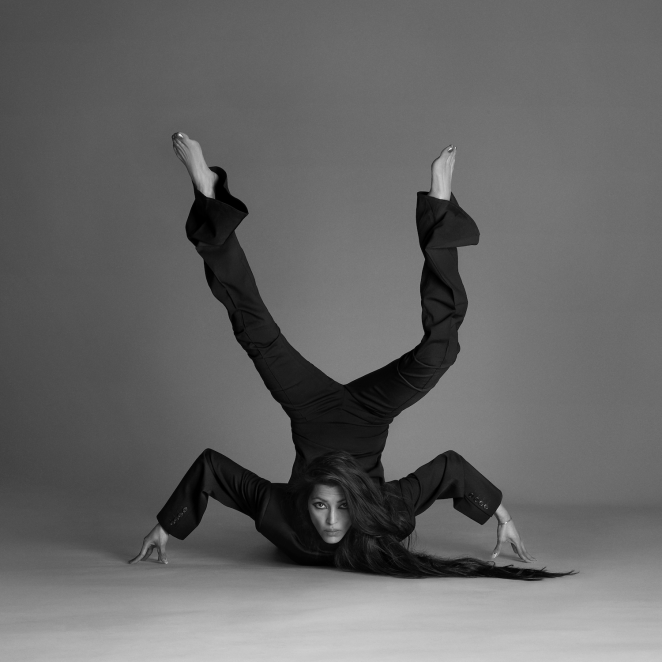
She continues, “From there, I wanted to introduce rhythm as resistance, pushing against the ceremonial stillness until it felt physical. I’m interested in the moment when sound stops obeying its own logic and begins to pull you somewhere unfamiliar. The song lives in that collision point: beauty and brutality, sanctuary and machinery sharing the same symbiotic space.”
Apart from the single, the album is more “sonically and metaphorically vast and unstable by design,” says Vandana. “Sound is porous,” she says. “Faith exists without answers. Love wounds even as it heals. Nature appears as a liquid mirror: tidal, predatory, luminous, awe-inspiring.”
Faith exists without answers. Love wounds even as it heals. Nature appears as a liquid mirror: tidal, predatory, luminous, awe-inspiring.
Vandana
The music video for “This Hunt,” crafted by Carlito Dalceggio, is another spatial entity, delivering trance-like movements of imagery and the lyrics, the cruelty of the hunt and the Faustian notion of sacrificing the spiritual being for power or material gain—This cruel hunt / You never ask for it / This ego′s creation … This insatiable hunt / You can never have enough of it It bends you backwards.
“Carlito’s imagery is entirely his own wild universe,” says Vandana. “His symbols, his creatures, his lines, they come from some electric, ancient place he channels better than anyone. The way those visuals breathe together in the video, the cuts and the unfolding of that fever-dream ritual, that part was me. I took his hallucinatory world and carved the shape of the piece from it.”
Once edited with Dalceggio’s imagery, Vandana says she worked in the rhythm and intention, allowing their “worlds crash into each other until the piece felt hypnotic, feral, and true to the pulse of the song.”
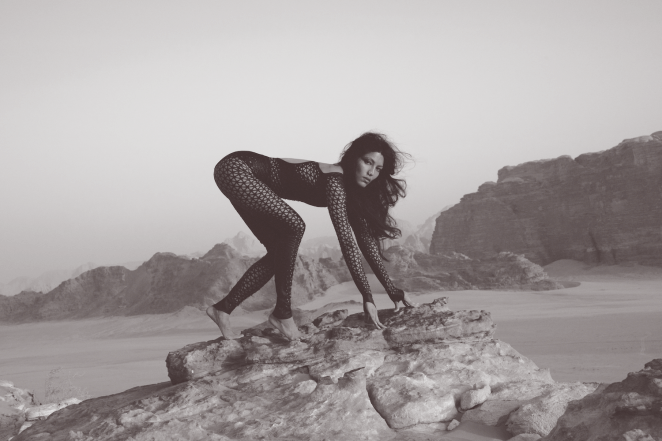
Besides “This Hunt,” Vandana’s newer songs are stories that return to the body “as the site of truth,” she shares. “Even when the language reaches for the cosmic or the symbolic, it always comes back to sensation—warmth dissolving cold hearts, bodies cushioning falls, teeth sinking into ice, weeds growing where nothing should.”
And there’s no settled or recurring theme on the new album. “It comes through living, through friction,” Vandana says, “through staying present when things get uncomfortable. Love isn’t redemptive in a tidy way. Faith doesn’t depend on certainty.”
And she didn’t write these songs to resolve something; it was more about better understanding herself. “I wrote them to stay connected to myself, to explore some deeper mystery of life,” she says. “I realize that’s the point: to remain present inside complexity instead of anesthetizing it.”
In a different space from her 2013 debut Anti Venus, which she called an experiment in “pure curiosity,” her forthcoming album, featuring a collection of contributors—Tal Wilkenfeld (Herbie Hancock, Mick Jagger), Marius de Vries (Björk, PJ Harvey), Cian Riordan (Sleater-Kinney), and Joey Waronker (Atoms for Peace)—is braided into newer revelations.
“Over time, I haven’t lost that experimental instinct, but life fills it with consequence,” says Vandana. “Experience has sharpened the questions I’m asking. Songwriting and lyrics sit at the center now because they’re where memory lives. I’m not experimenting for the sake of novelty, I’m listening more closely to what insists on being revealed, and I’m willing to go out of my depth for it.
The work still comes from the same place, but it carries more history. I’ve lived more, and I’m willing to reckon with it, without editing out the bruises.”
Photo: Elisabet Davidsdottir
Leave a Reply
Only members can comment. Become a member. Already a member? Log in.