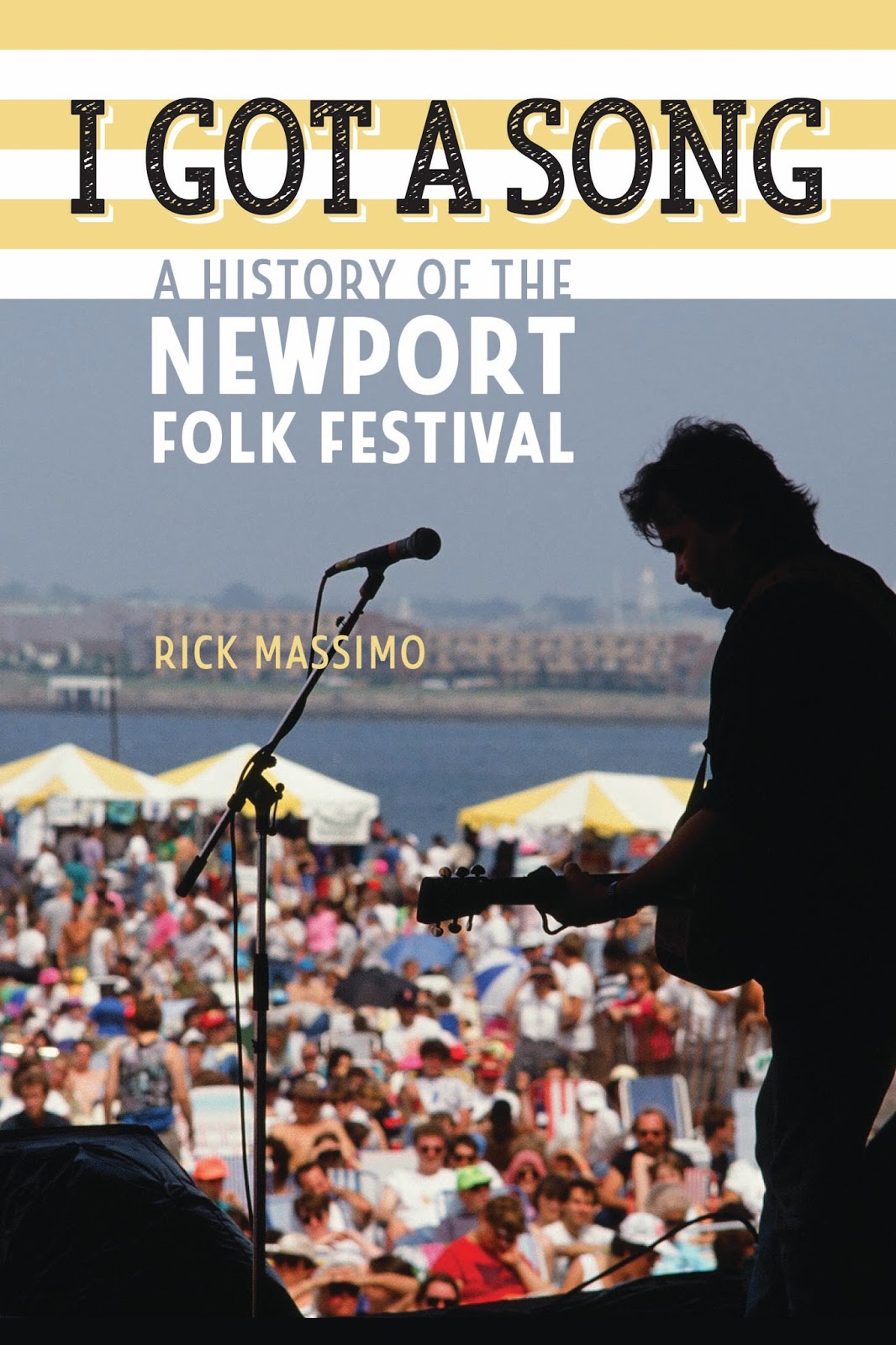
On June 6, Wesleyan University Press will publish I Got A Song: A History of The Newport Folk Festival, by Rick Massimo. Eight years in the making, the first-ever book exclusively devoted to the history of the Newport Folk Festival, I Got a Song documents the trajectory of an American musical cornerstone over its 58 years.
The 2015 Newport Folk Festival concluded with a parade of performers from the weekend, plus several guest stars, celebrating the 50th anniversary of Bob Dylan’s electric performance — those 15 minutes which had so riled observers, ruined Newport in some ways and continued the process of revolutionizing popular music. Performers shuttled on and off stage, paying tribute to songs that ranged through much of what’s considered Dylan’s glory days. The duo of Gillian Welch and David Rawlings essentially anchored the acoustic performances, with beautiful takes on “Mr. Tambourine Man,” “It’s All Over Now, Baby Blue” and more with help from Willie Watson and others; Dawes provided the backing for the electric material, with special appearances including Blake Mills, Deer Tick and most powerfully Robyn Hitchcock, who managed, in the middle of a slam-bang celebration, to make the marathon “Visions of Johanna” mesmerizing.
All the while, many in the crowd of 10,000 were waiting impatiently.
Before the ’65 Revisited tribute began, fans buzzed, as they had for much of the day, with speculation that Dylan himself would be part of the tribute. Other names were bandied about – Bono, Paul McCartney – and their tour schedules scrutinized for clues as to whether they’d be nearby and free to drop in. But many fans wouldn’t give up the dream of Dylan returning to celebrate past glory – never mind that precious few things seemed farther out of character for him, or that the organizers had tweeted, “We can not say this any other way. BOB DYLAN IS NOT PLAYING #NFF15 #DontLookBack.” Jay Sweet says that after a pro forma contact with (and refusal from) Dylan’s management, he had no intention of celebrating the 50th anniversary of Dylan’s feat – “this festival moves forward” – but that he relented after a long-enough succession of artists asked him how the festival would mark the occasion, delegating the job to Welch, Rawlings, Goldsmith and a few other artists. Still, as the show began, one fan even received a text from a friend claiming that he’d seen Dylan, along with Al Kooper, a member of the band that fateful night in 1965, backstage.
The most-anticipated moment of the 2015 finale came when Dawes took the stage to begin the electric segment of the tribute: Here, many in the audience thought, was when the man himself, or someone similarly huge, would appear.
Those fans might have been disappointed when Dawes frontman Taylor Goldsmith essentially took on the electric-Dylan role, with guest verses on various songs outsourced to Hozier, Deer Tick’s McCauley and Ian O’Neil and others. Goldsmith played “Maggie’s Farm” on the same guitar Dylan had played on that night in 1965 – a guitar that had only been rediscovered and authenticated a couple of years before, had been sold for nearly a million dollars to the owner of the Indianapolis Colts football team. (Legend has it that Dylan, who never had much regard for one guitar over another, had absent-mindedly left it on a plane and never bothered to reclaim it.) Meanwhile, Kooper was in fact in the house, returning to the organ for his signature part on “Like a Rolling Stone,” and the day wrapped up with an all-hands-on-deck sing-along on “Rainy Day Women #12 and 35,” with The Preservation Hall Jazz Band providing the indispensible horn-section wheezes.
“This guitar that I’m holding has been on this stage before,” Goldsmith said before “Maggie’s Farm.” Strictly speaking, of course, that wasn’t true. It wasn’t the first time an artist has erroneously thought that he or she is standing on the very stage at which Dylan went electric, slouching under a stone arch that Mississippi John Hurt passed under or eating at a picnic table that once groaned under the weight of Muddy Waters.
But by “this stage,” Goldsmith likely meant the Newport stage, and from his point of view, he was right. At that point, 55 years from its beginning, the Newport Folk Festival had not only contributed to the history of folk music, rock music and other musics, but made a history, an ethos and a tradition of its own.
Who decides when a tradition is being upheld? Who decides when a tradition is being betrayed? Opinions can coalesce, but there’s never one answer. George Wein still wields authority, but he gave up the day-to-day work of the Newport Folk Festival long ago. Pete Seeger was the touchstone, the North Star of the movement, but he’s gone. Bob Dylan never wanted the job. Jay Sweet is the latest in the line of succession. Johnette Rodriguez and Bob Weiser have been attached to the festival longer than Sweet. Where does this credential lie?
A study of the Newport Folk Festival, and the evolution of folk music inside it, reveals that the tradition lies in the tension — the uncertainty. A musical form, or a musical institution, is not a tradition until it’s carried on by someone other than the originator; it’s also likely not a tradition until someone argues that it’s being betrayed. If either the form or the institution have any value, both of these developments will inevitably happen.
And that tension, that uncertainty, that creation of new tradition, happens at least as much in the audience as it does on stage. Dar Williams, during her Newport performance in 1994, claimed that the defining factor of folk music was “an audience that listens.” The audience provides context and meaning as well as the performers – “We Shall Overcome,” as we’ve seen, wasn’t an anthem when Guy Carawan did it at Newport in 1960; it was an anthem when a cast of stars performed it in 1963, during a summer of protest and violence. And while observers can, and do, look at the current incarnation of the Newport Folk Festival and pronounce various versions of John S. Patterson’s assessment of The Kingston Trio (“not a record of traditions, but what a mass audience wishes to accept as traditions”), that attitude can presume an objectivity that doesn’t really exist.
Robert Cantwell wrote that “Like other noble ideas, the idea of the folk must be an invention, a substance sublimated by an aspiration … The performance of a folk song is as much a representation as the pastoral painting or the proletarian novel … claiming and attributing but never confirming.”
“Maggie’s Farm,” as John Cohen pointed out years ago, derived from the chestnut “Penny’s Farm.” At Newport in 1965, though, it wasn’t a folk song – it was a blast of jet exhaust, a thumb in the eye to what had gone before. But when Dawes, with the help of Welch and Rawlings, played it at Newport, in honor of the man who brought it there, with the guitar he’d played it on, they revived a well-known and well-loved song and imbued it with a resonance that rewarded anyone in the audience with a knowledge of what had come before.
Together, they made it a folk song.