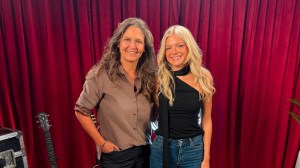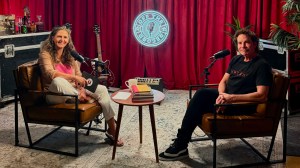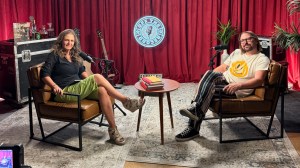
Linda Perry is baring it all. Following the release of her documentary film and its companion album, the rocker appeared on American Songwriter’s Off the Record podcast and told editor-in-chief Lisa Konicki how it all came to be.
Directed by Don Hardy, Linda Perry: Let It Die Here premiered at Tribeca Festival in 2024. Two years later, the film was released wide and on Hulu, and Perry put out a companion album of the same name.
Videos by American Songwriter
“It wasn’t intentional. It wasn’t a plan to do that,” she said of the film. “I guess one of the things that is extremely important to me as a creative is that you have to be honest. I don’t know how to be any other way. I’ve been lied to so much in my life… I just grew up going, ‘I need truth in my life. I need honesty.’ And if anything I’ve learned, that I’m going to give that, because I wanted it, I needed it so desperately as a kid.”
While the candid nature of the project wasn’t unnatural for Perry, “having a camera there catching it all” was.
“All of us, we all have a breakdown about something; we all have a moment of weakness. We all have a bad thought, and we all start disintegrating, just melting away our emotions,” she said. “But we don’t put it on camera, and you don’t put it on Hulu, and you don’t show it to all these people.”
Perry did show it, though. In fact, there’s one scene in the film where she has “a major breakdown.” Despite the rawness of that moment, when Perry saw the first cut of the film, that wasn’t the scene that she wanted to remove.
“Probably three weeks later, I go and see it with my best friend and that scene comes on. And I was, literally, like, ‘Oh my God.’ I was in shock,” Perry said. “… The film is over. I went up to him. There were too many people talking about how great I was. And I said, ‘Please just get rid of those people. Keep Christina [Aguilera], Dolly [Parton], and Brandi [Carlile]. That’s all we need. And Aubin [Crowell]. Get rid of everybody. I don’t need people glorifying me. You didn’t make that film. There’s no point trying to go there now.’”
Linda Perry on Her Musical Process
In the film, viewers get to see Perry working on music, a process during which she’s always hard on herself.
“I’m like, ‘This is not good enough, or blah, blah, blah.’ And then I lose total emotion, because I can’t connect to myself,” she said. “And so, that’s where the movie started.”
Eventually, the film’s companion album came to be, something that Perry said “never would have happened” without the documentary.
“I could see my damage,” she explained. “… I’m watching this documentary and I’m thinking, ‘This girl… I want to hug her. And I want to slap her around a few times too. Like, wake her up.’”
After her mother’s death, Perry decided to put a jam session together and invite Hardy to film it. When Hardy inquired as to the scope of the session for filming purposes, Perry confessed that she had booked a five-piece band, six strings, and two background singers to participate.
“He was all, ‘Is it normal to have strings and background singers in a jam session?’” Perry recalled. “I just got so frustrated with him. I’m like, ‘No, Don. It’s not, but that’s what they’re telling me.’ And he’s all, ‘Who’s they?’ And I’m like, ‘The voices in my f**king head, that haunt me and torture me. That’s what they’re telling me… That’s what they are telling me to do, and that’s what I’m doing.’”
When Hardy asked if, perhaps, Perry had a song she planned to work on, she realized that she did.
“He’s like, ‘OK. Please don’t get upset when I ask you this, but do you have a song?’ And I was like, ‘No. I don’t have a song. That’s not jamming. Jamming is no song.’ He’s like, ‘I understand, but you also just said that it’s not normal to have strings at a jam session.’ The poor guy is just trying to understand how many cameras he should have,” she said. “And I said, ‘And I think I have a song.’ I could see relief from him. He’s like, ‘Great.’”
Perry set about writing the lyrics, and the song came to be within four hours.
“I automatically have this whole arrangement in my head. I could hear it clearly… I’m writing things down, but I’m just on the fly,” Perry said. “And I have to say, that is one of the most powerful and one of the most beautiful things I’ve ever experienced as a creator.”
Linda Perry Discusses Her New Album
That song was “What Lives With You,” a track about Perry’s complicated relationship with her late mother, who had been abusive.
“Once I understood that song I knew I was not going to come from anger. I was surprised by that song, because I was angry… I love her, but I was angry,” she said. “But that song just was so… beautiful.”
Perry further explored those emotions on “Let It Die Here,” where she wrote about her mother being a trickster and a con.
“The songs just started to come,” she recalled. “So, I had ‘What Lies With You.’ Then I had ‘Let It Die Here.’ And I thought it was comical. It’s like, ‘Here’s this cynical description of my mother, and here’s this beautiful release.’”
From there, Perry decided to fill in the blanks. She started with “Balboa Park,” which looks back on “the only time I remember as my happiest moment.”
The songs “just started showing up” for Perry, who wrote, engineered, and produced the album by herself.
“Recording of the album became very difficult, because I had to keep going from producer, engineer to artist to make sure I was getting the right sounds and the performance,” she said. “I got through it. I was so proud of myself, because it was a lot, because I have everything and the kitchen sink in that frigging record.”