
Sometimes you just have to say what a thing is. Facts don’t carry emotions, they just are the way the are. And while most nursery rhymes are known for adding a perspective, or bent, to an idea, some just state the way things are, plainly.
Or do they? Let’s take, for example, the nursery rhyme, “Little Tommy Tucker.” In one sense, looking at the work, it can seem like the lines are just pointing out who Tommy was and what his situation was. But maybe it is also a warning? Or quick and easy way to infiltrate the minds of young listeners.
Videos by American Songwriter
[RELATED: Behind the Hard Working Nursery Rhyme “One, Two, Buckle My Shoe”]
It can be hard to say. But to decipher the work’s meaning, let’s dive in here below.
Who Was Tommy?
In just a few lines, the nursery rhyme explains who Tommy was, what he did and what his circumstances included. Let’s review the most commonly known version of the rhyme, which was first cited in Tommy Thumb’s Pretty Song Book in 1744 (and later in a longer version in Mother Goose’s Melody in 1765):
Little Tommy Tucker
Sings for his supper.
What shall we give him?
White bread and butter.
How shall he cut it
Without a knife?
How will he be married
Without a wife?
Tommy is a singer. But while he may be very talented, he doesn’t exactly have the strongest business sense. He’s not someone who has extra money for meals. Instead, he’s living song-to-mouth.
So, he sings. And for his efforts, he gets a simple bit of bread and butter. But to underscore that Tommy is not wealthy, the lines wonder aloud how he will cut the bread without a knife. Then those same lines make a big leap. If he’s eating, with whom is he doing it? Well, not with a wife. He doesn’t even seem to have any prospects.
Yes, in four quick couplets, we learn seemingly the entirety of Tommy’s life. And it’s not looking great.
Is This A Warning?
Scientists will tell you that a human being’s worst fear is being alone. In many ways, it’s most animals fear, too. We would rather go without food or water than be excommunicated from the pack.
So, to end this rhyme with the note that Tommy has no wife (and no real prospects) and that he is alone seems to be a big caution. In one sense, it means don’t live hand to mouth or paycheck to paycheck. In another, perhaps, it is saying that the life of a singer is hard and perhaps not worth pursuing.
Or perhaps it’s worth looking at another way. Maybe Tommy would be destitute without his singing ability. Maybe he doesn’t want company, maybe he’s the only company he needs, except when he needs to leave home, sing and get a meal?
Final Thoughts
In the end, this nursery rhyme poses a question: how do you want to live? Do you want to live singing for your supper? Do you want to be a nobleman? Do you want to be a pauper?
And if you are more destitute, it says, remember: there is always creativity to help you. He finds community with his song… and maybe, for Tommy, that is just the first step. Maybe love comes next, after music?
Photo by Hulton Archive/Getty Images
More Features
-
Photo by Doug Griffin/Toronto Star via Getty Images -
American singer, songwriter and musician Tom Petty (1950-2017) attends a press conference for his debut solo album 'Full Moon Fever', 1989. (Photo by Vinnie Zuffante/Getty Images) -

(Original Caption) A singer called Joni. Joni Mitchell, Canadian singer-songwriter, United Kingdom, 1968. The guitar-pickin' gal is Joni Mitchell, a long blonde haired Canadian folk singer. Pictured last night outside the Revolution club, Joni is here (until 1st October) for radio, television and concert appearances. Apart from concert appearances, 25 year old Joni will be heard on "Top Gear" on Radio One and "The Monday Show" on BBC 1. (Photo by © Hulton-Deutsch Collection/CORBIS/Corbis via Getty Images) -
English rock band the Beatles arrive at London Airport from the USA, with their manager Brian Epstein (1934 – 1967, in coach doorway), 2nd September 1965. From left to right, John Lennon (1940 – 1980), George Harrison (1943 – 2001), Paul McCartney and Ringo Starr. (Photo by George Stroud/Express/Hulton Archive/Getty Images) -
Musician Willie Nelson attends 24th Annual Academy of Country Music Awards on April 10, 1989 at Disney Studios in Burbank, California. (Photo by Ron Galella, Ltd./Ron Galella Collection via Getty Images) -
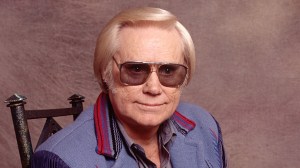
George Jones, who released several country songs about whiskey -
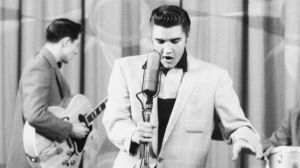
Elvis Presley and Scotty Moore (left) performing on The Milton Berle Show at NBC's Hollywood studio, Los Angeles, California, 5th June 1956. Presley performed 'I Want You, I Need You, I Love You' and 'Hound Dog'. Press reaction to his performance was largely negative with his gyrating movements during 'Hound Dog' proving particularly controversial. (Photo by Bettmann Archive/Getty Images) -

BERKELEY, CA – SEPTEMBER 1977: Linda Ronstadt performs at the Greek Theater on September 17, 1977 in Berkeley, California. (Photo by Ed Perlstein/Redferns/Getty Images)