Your cart is currently empty!



Lane Moore Makes “Happy Music for Sad People” on First Release With Band It Was Romance in 10 Years, ‘Final Girl’
As the last “sister” standing, Olivia Hussey survived death as Jess Bradford in Bob Clarks’ 1974 sorority massacre, Black Christmas. Jamie Lee Curtis’ Laurie Strode was the embodiment of a “final girl” in horror films, surviving a run of eight Halloween movies from the original in 1978 through her last showdown with Michael Myers in 2022, while Sydney Prescott (Never Campbell) lasted through five films in the Scream franchise.
What these Slasher flick survivors have in common was perseverance, and it partially inspired a song and the title track of Lane Moore’s second release with her band It Was Romance, Final Girl.
“I’ve always related to final girls in horror movies because they just keep surviving, and they just keep fighting and they don’t give up, and they don’t die,” Moore tells American Songwriter. “Sometimes, if you’ve been through a lot in your life, it can really feel like that. I was feeling like, ‘Now I have to survive this. Now, I have to deal with this thing that didn’t work out. Now, I have to process this or go to therapy for this.’ Now, like ‘”
Produced by Moore and Bryan Russell (Paul Simon, Coldplay), the four-track EP is a continuation of what the comedian, author, and actress (Girls, Search Party) started with It Was Romance in 2015 and their eponymous debut. Along with guitarist Lisa Bianco, bassist Ryan Ross, and drummer Angel Lozada, Moore reflects on past disappointments and severances and finding the strength to “keep fighting” just like the final girls on screen.
Before its more anthemic title track, Final Girl presses on hardships through an aperture of lighter, dancier pop, opening on “Playing Records,” a song that came together swiftly for Moore. “That was one of those that just came out like ‘Alright, this is happening now,’” recalls Moore. “And I remember it being such a magical night and having that come out and thinking, Whoa, something really magical just happened here.”
Threaded by loneliness and disconnection, loss, and perseverance, and making “happy songs for sad people,” according to Moore, a synthier “TBA” drives home the message of becoming one’s own best friend when there’s no one else around and a phrase she’s grown to loathe—If you need anything, call me.
Videos by American Songwriter
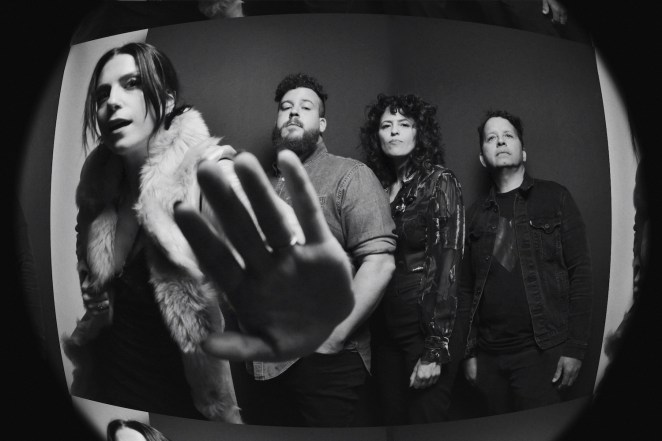
With Russell on board as co-producer, Final Girl was also an about-face in a sense for Moore, who produced, mixed, and mastered the band’s first album, It Was Romance. “I’ve always had that DIY mentality, but I didn’t know the music industry standpoint, what I should be doing,” says Moore. “I had no idea. I was like, ‘Well, I’m gonna make something that I think sounds amazing and put it out there as best I can.’ And even though I didn’t know how to do it ‘correctly’ in terms of releasing an album, it still got placements on TV shows and movies and big press coverage.”
Working alongside Russell gave Moore the space to focus more on the sound and lyrics she wanted. Since childhood, Moore remembers obsessively listening to music, analyzing songwriting and key changes, and trying to hit every note, vocally, of the artists she listened to. Armed with her keyboard, she learned at an early age that she could play along by ear to songs she heard on the radio.
By 10, Moore says she started writing “silly songs,” mostly R&B and soul with funny lyrics, and later gravitated toward music that was more of a “full-body experience.”
“I was always producing music in my bedroom, but it was so hard sometimes to get it to sound the way that it did in my head, even if I loved the lyrics,” she says. “To get that particular sound that just cuts through you and you just feel it everywhere in your body, that’s always been the music that I love. You don’t just hear it; you full-body experience it, and that’s so important to me as a songwriter.”
Always absorbed by different textures and sounds, it wasn’t always easy for Moore to convey the sounds she wanted, and she remembers one kid in school once telling her “that doesn’t count because you don’t know what you’re playing” when she said she could play songs by ear. “It always breaks my heart to think about that,” says Moore, who also didn’t have anyone to champion her talents at the time and encourage her to keep going. “Playing by ear is a skill, and to have somebody tell me it didn’t matter … that was a big turning point where I started to write my own stuff.”
Later, when Moore moved to New York City and started playing with other musicians, she started learning multiple instruments to avoid struggling to translate what she wanted to hear.

“My frustration with not being able to convey my ideas in the room led me to start writing songs on my own,” she says. “Instead of waiting for strangers to understand what I was trying to get across, I needed to find my own footing and find my own voice, on my own, And then it became something where I was writing every day. Even when I felt like nobody in my circle seemed to understand me, I could go home and write a song, and that song would reflect it to me in a way that felt like solace.”
The slower running “Ending Up With Me” closes the album and spells out the confidence Moore found over time as a musician and songwriter. “That is something that I’m very proud of,” shares Moore. “I fought hard for that confidence in my songwriting, and maybe it counts even more when you’re able to believe in something against the odds. It becomes a strength in and of itself.”
“Ending Up With Me” breaks down the frustration and the fear of getting hurt, again, trusting others and letting them in. “It’s exploring how frustrating it is when it’s somebody you’re trying to get close to,” says Moore, ” and the feeling that everybody but you is doing great. Everybody but you has it all figured out and doesn’t struggle with anything. Why do we tell ourselves that everybody’s doing better than us—everybody has the cheat codes, and we didn’t get them? That’s [the song] me trying to stop the train of thinking like that.”
For Moore, who hosts the I Thought It Was Just Me podcast and released her second book, You Will Find Your People: How to Make Meaningful Friendships as an Adult, in 2023, Final Girl translates something more personal, an essay of songs developed by living and learning more over these past years.
“So much of songwriting, for me, is how I process life,” says Moore. “That’s how it’s always been since I was a child, writing songs, and that’s always how it’s been for me now: ‘How can I write a song that feels the way I feel right now? I don’t have another song to listen to that feels the way I feel right now, so what if I write it?’”
She adds, “Then, in a perfect world, it becomes a song that somebody else listens to when they feel the same. And that’s magic. That’s the dream.”
Photos by Shervin Lainez

Leave a Reply
Only members can comment. Become a member. Already a member? Log in.