Your cart is currently empty!



On This Day in 1967, The Beatles Recorded the Most Chaotic ‘Sgt. Pepper’s’ Moment, Complete With Gorilla Paws, Fake Nipples, and Plenty of Champagne
Oh, to be a fly on the wall in EMI Studios on February 10, 1967. If not for the superb vantage point, for the elbow room—it was a crowded affair in the recording room that day, with The Beatles, their star-studded group of pals, studio engineers, George Martin, and 41 professional symphonic musicians all in attendance. Everyone was there to put in some serious work, but one wouldn’t know it by looking at them. February 10 marked the fourth recording session for “A Day In The Life”, the expansive, controversial, and multi-faceted closing track to Sgt. Pepper’s Lonely Hearts Club Band. Members of the Royal Philharmonic and London Symphony Orchestras were there to record the cacophony that separates John Lennon’s somber first verses (“I read the news today, oh boy…”) with Paul McCartney’s bouncy interlude (“Woke up, jumped out of bed, ran a comb across my head.”)
Videos by American Songwriter
The musical task at hand was a challenging one. Most conservatory musicians prefer structure, and The Beatles were after the opposite. But with the help of George Martin’s arranging skills and a vast assortment of gag accessories like clown noises, clip-on nipples, and gorilla paws, everyone at EMI came together to make it happen.
It Wasn’t Just a Recording Session, It Was an Affair
Perhaps the most notable part of the “A Day In The Life” recording sessions is what everyone was wearing. Once The Beatles knew they would be employing a 40+ orchestra, they decided to turn the recording session into an event. In Here, There, and Everywhere: My Life Recording the Music of The Beatles, studio engineer Geoff Emerick recalled Paul McCartney having the initial idea. John Lennon fleshed it out further, saying, “We’ll invite all our friends, and everyone will have to come in fancy dress costume.” When George Martin mentioned that asking the orchestra to dress up might increase their hourly cost, Lennon said, “Sod the cost. We’re making enough bloody money for EMI that they can spring for it…and for the party favors, too.”
Lennon then asked roadie Mal Evans to go to a novelty store and purchase goofy paper glasses, clown noses, wigs, baldcaps, gorilla paws, and, in Emerick’s words, “Lots of clip-on nipples.” When the orchestra arrived at EMI on February 10, 1967, they were wearing their traditional tuxedo stage attire, which they then accessorized with props. Some wore bright red clown noses. One violinist held his instrument with his left hand like normal, but held his bow in a large, fake gorilla paw.
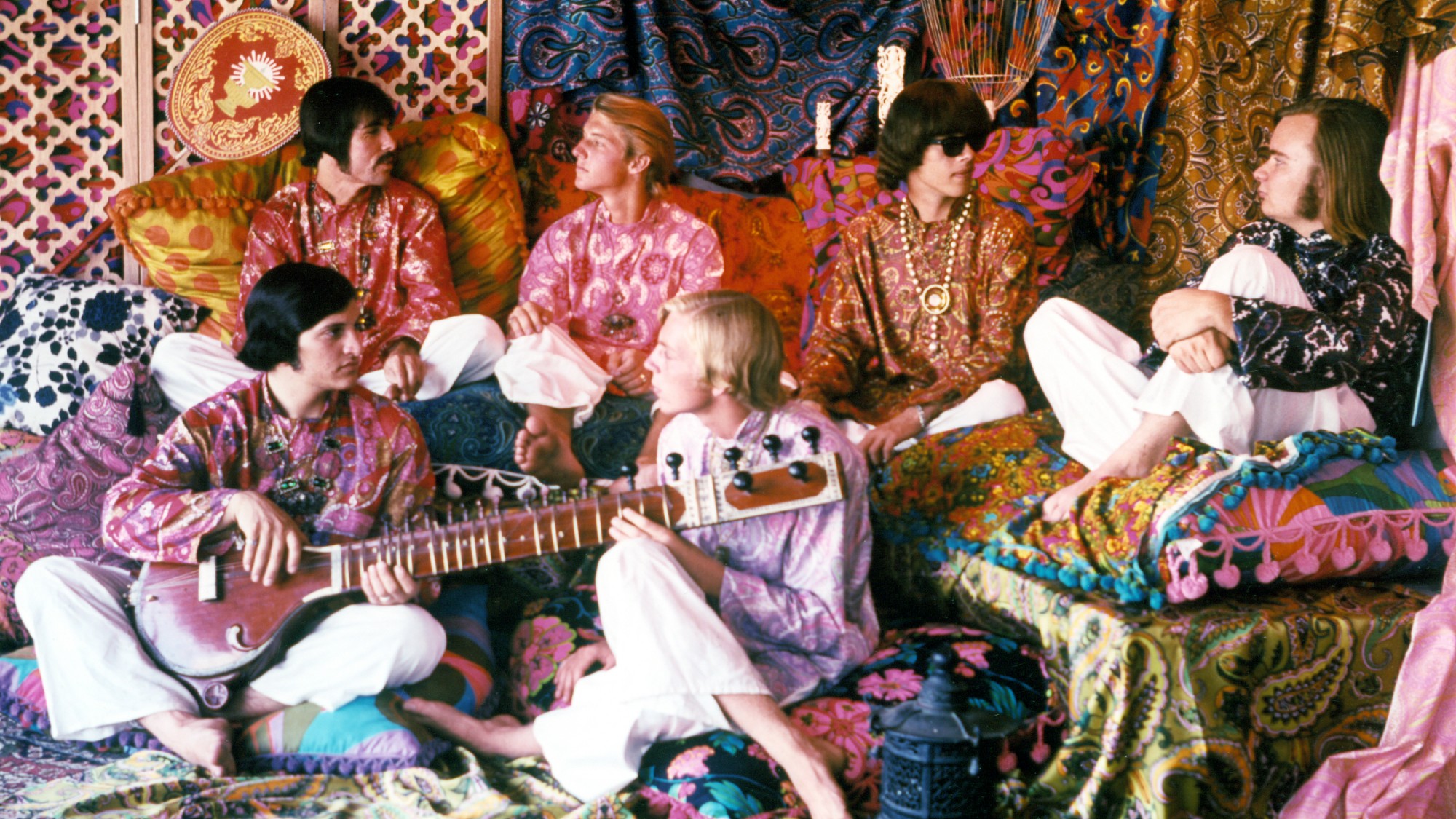
The Beatles’ friends, which included The Rolling Stones’ Mick Jagger and Keith Richards, Marianne Faithfull, Donovan, and The Monkees’ Michael Nesmith, also dressed up in full hippie regalia. In a laughably ironic turn of events, The Beatles were the only ones who didn’t follow through with their own idea.
How the Orchestral Section in “A Day In The Life” Came To Be
The ridiculous accessories and copious amounts of champagne helped loosen up what might have otherwise been an uptight ensemble. With the exception of the jazz-trained musicians, most instrumentalists in this setting prefer structure and clarity as to what they’ll be playing. But the entire point of their feature in “A Day In The Life” is to be a swirling, hypnotic, borderless wall of sound.
George Martin implemented his arranging skills, providing the musicians with a baseline note and notating the measure markers where they should arrive at a new note. In between, Martin told them, “You’ve got to make your own way up there, as slidey as possible, so that the clarinets slurp, trombones gliss, violins slide without fingering any notes. And whatever you do, don’t listen to the fellow next to you because I don’t want you to be doing the same thing. They all looked at me as though I was mad,” per Mark Lewisohn’s The Complete Beatles Recording Sessions.
Paul McCartney, meanwhile, was observing the orchestra working as though it was a theatrical—or maybe pastoral—production. “The strings were like sheep,” he recalled to Lewisohn. “They all looked at each other: ‘Are you going up? I am!’ And they’d all go up together. The leader would take them all up. The trumpeters were much wilder. The jazz guys, they liked the brief. The musicians with the more conventional instruments would behave more conventionally.”
Photo by Keystone/Getty Images

Leave a Reply
Only members can comment. Become a member. Already a member? Log in.