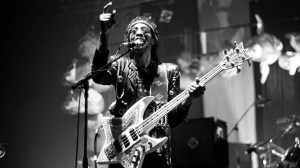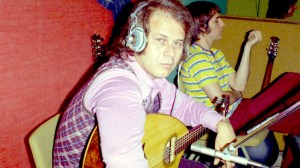
When an artist gets in sync with a producer, the results can be magic. But even when the two entities aren’t on the page, the friction can occasionally lead to something special.
Eagles came to the end of their tether with their original producer while making their third album. But one of the songs the producer oversaw before he got the axe turned out to be one of the most crucial successes of the band’s career.
Videos by American Songwriter
Eagles Change Flight Patterns
Glyn Johns made his mark as an engineer for some of the biggest acts of the 60s. At the turn of the decade, he began to segue into more production work. His efforts on standout albums by The Who and Faces in 1971 put him at the forefront among in-demand producers.
In that same monumental musical year of 1971, Eagles, a promising four-piece band from California, formed. And they were naturally thrilled to have Johns in the fold as producer for the recording of their self-titled debut album the following year.
Johns knew his hard rock. But when he heard Eagles vocal and instrumental blend, he felt that their strengths lay in their ability to combine country textures with a singer-songwriter sensibility. That debut album was a hit, but the follow-up Desperado, also helmed by Johns, didn’t do as well. When Eagles decamped to England for the making of their third album with Johns, problems arose.
‘Border’ War
Eagles wanted to make a conscious effort on their third album, to be titled On The Border upon its release in 1974, to rock harder. But Johns didn’t feel they were at their best in that mode. He kept pushing them in more of a countryish direction.
Fed up after months of work on the album that produced very little usable music, Eagles made the decision to fire Johns. They returned to Los Angeles, where they started working with new producer Bill Szymczyk. Szymczyk didn’t try to influence their creative decisions. He simply did whatever he could to meet their desires in terms of their sound.
Without a doubt, On The Border delivered a slicker, more urban sound from the band. Songs like the title track and “James Dean” were more aggressive musically than anything they’d released to that point. Late in the stages of making the album, guitarist Don Felder joined Eagles as well, adding heft and crunch to songs “Good Day In Hell” and “Already Gone”.
Producer Knows “Best”
Eagles did all this in part because they felt that country rock was fading out of style. They sensed their long-term mainstream success was predicated on an edgier sound. But first single “Already Gone” barely cracked the Top 40. And follow-up “James Dean” didn’t come anywhere near it.
That’s when Eagles turned to one of the few songs left over from the Glyn Johns sessions. Don Henley and Glenn Frey of the band wrote “Best Of My Love” with longtime collaborator JD Souther. It resembled the music of their first two albums far more than it did the surrounding songs on On The Border.
Lo and behold, “Best Of My Love” caught fire on pop radio and gave the band their first-ever No. 1 single. From that point, Eagles always made sure to dip back into the sound that got them started, the sound that Glyn Johns helped them formulate, in between the heavier stuff that they seemed to prefer.
Photo by Gems/Redferns
More Features
-
Photo by Michael Ochs Archives/Getty Images -
American country music singer Earl Thomas Conley (1941 – 2019) performs at the Poplar Creek Music Theater in Hoffman Estates, Illinois, May 26, 1985 in Hoffman Estates, Illinois (Photo by Paul Natkin/Getty Images) -
American funk band Cameo (American singer Charlie Singleton, American singer and musician Larry Blackmon, and American singer and musician Tomi Jenkins) in the press room of the 1987 Soul Train Music Awards, held at the Santa Monica Civic Auditorium in Santa Monica, California, 23rd March 1987. Cameo won the awards for 'Album of the Year (Group, Duo, or Band)' for 'Word Up!' and 'Best Single (Group, Duo, or Band)' for 'Word Up'. (Photo by Vinnie Zuffante/Getty Images) -
UNITED KINGDOM – JANUARY 01: Photo of Pete SEEGER; Pete Seeger performing on stage at a Paul Robeson benefit concert (Photo by Brian Shuel/Redferns) -
UNSPECIFIED – CIRCA 1970: Photo of Diana Ross Photo by Michael Ochs Archives/Getty Images -
The British singer Kate Bush poses for a photo shoot. Great Britain, 1980 (Photo by Angelo DeligioMondadori via Getty Images)