
Stevie Wonder simply owned the pop charts for about three decades or so. Few artists consistently courted the mainstream for such a long period of time as Wonder managed to do. That he did it while also delivering musically groundbreaking and lyrically substantial material only makes it that much more of an achievement.
But that chart dominance all began with a fluke of sorts. It happened when a 12-year-old Wonder called an audible during a live performance and gave everyone a heaping helping of his capacious talent.
Videos by American Songwriter
Little Stevie’s Early Efforts
Motown signed Steveland Judkins at the age of 11 in 1961, dubbing him Little Stevie Wonder as his professional moniker. By that time, Wonder was already accomplished on multiple instruments and had started to dabble in songwriting. You could understand Berry Gordy’s excitement at signing such a prodigy.
But Gordy and others at the label struggled to find the right way to display his talents. His first album at the label tried to find a middle ground between jazz and R&B. The follow-up featured Wonder trying his luck with Ray Charles cover songs. Neither LP did much in the sales department.
He didn’t fare any better in the singles department, as three songs arrived in 1962 that failed to reach the Top 100. Everything changed, however, when Wonder started playing live shows with other Motown acts. At one of those shows, Wonder made a bold, unexpected move that ended up bringing his talents to the mainstream.
A Live Adlib
In March 1963, Wonder was playing in Chicago at a Motown revue with many other acts from the label. At that time, Motown was already starting to exert its dominance in the pop music world as well. Since Wonder hadn’t scored any hit singles yet, he was given his allotted time in the middle of the show and then expected to cede the stage to more established acts.
For the closing performance of his time on stage, he chose the song “Fingertips”. Taken from his first solo album, the song was a jazzy instrumental written by Clarence Paul and Henry Cosby. On the LP, Wonder only played the bongos. Flutes dominate the proceedings.
On stage, however, Wonder added his harmonica to replace the flutes. The song progressed in instrumental fashion for a while before Wonder started adding some ad-libbed call-and-response vocals. He played a cheeky little bit of “Mary Had A Little Lamb” on his harmonica before the band seemingly closed out the performance. The MC came on to announce him off the stage. But Stevie had other plans.
The Crown Reacts
As some of Wonder’s band members moved off the stage to be replaced by the backing group for The Marvelettes, Stevie started playing the harmonica once again. On the recording, you can hear the bassist who had just come on stage, asking what key he should be playing. Wonder’s surprising decision sent the crowd in attendance into a frenzy.
So how come the version that hit the top of the charts in 1963 is called “Fingertips – Part 2”? Because Wonder’s performance was so long, it had to be split into two sides of a single. “Part 2”, which was relegated to the B-side, began with the section when Wonder calls out to the crowd.
But DJs gravitated to that part, false ending and all. That’s how “Fingertips – Part 2” not only became Stevie Wonder’s first US Top 40 hit, but also his first No. 1 as well.
(Photo by David Redfern/Redferns/Getty Images)
More Behind The Song
-
UNITED STATES – MAY 09: Photo of Bob DYLAN; performing live onstage at the benefit for ousted Chileans: Felt Forum, New York (Photo by Steve Morley/Redferns) -

NEW YORK: Janis Ian performs live on stage in New York in 1975 (Photo by Richard E. Aaron/Redferns) -
Musician Bob Seger performs at the Poplar Creek Music Theater, Hoffman Estates, Illinois, August 13, 1986. (Photo by Paul Natkin/Getty Images) -

American vocalist, musician, songwriter, producer, actress and narrator Rickie Lee Jones performing live, circa 1979. (Photo by Gus Stewart/Getty Images) -
UNSPECIFIED – JANUARY 01: Photo of Huey LEWIS & The News; (Photo by David Redfern/Redferns) -
Photo by Fireshot/Universal Images Group via Getty Images -
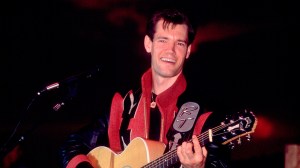
American Country musician Randy Travis plays guitar as he performs onstage at the Wisconsin State Fair, Milwaukee, Wisconsin, July 15, 1988. (Photo by Paul Natkin/Getty Images) -
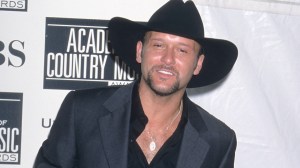
UNIVERSAL CITY, CA – MAY 3: Singer Tim McGrawl attends the 35th Annual Academy of Country Music Awards on May 3, 2000 at the Universal Amphitheatre in Universal City, California. (Photo by Ron Galella, Ltd./Ron Galella Collection via Getty Images)