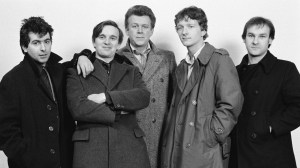
More than most bands of their era, The Who focused on making album-length statements. Pete Townshend, who wrote the band’s songs, tried to make thematically coherent LPs rather than just throwing together a collection of songs.
If he’d been that stringent about unity in 1975, however, we would have missed out on “Blue, Red And Grey”. An island of happiness amidst a sea of gloom on the album featuring it, the little ditty Townshend wanted to shelve became a beloved Who track.
Videos by American Songwriter
Concepts and Colors
The Who By Numbers came after the massive troika of Tommy, Who’s Next, and Quadrophenia in The Who’s catalog. Strict concepts and storylines governed the first and third of those records. And Who’s Next featured songs that Pete Townshend had written for another conceptual project that the group eventually abandoned.
By contrast, The Who By Numbers deviates from all that in that there isn’t technically a unifying concept or story Townshend had in mind while writing the songs. But his state of mind at the time unified most of the record. Townshend’s deep depression at the time and his ambivalence toward his art colored many of the songs.
So how did “Blue, Red And Grey”, with its sprightly melody and unswerving optimism, push through all that? If Townshend had his way, it wouldn’t have. But producer Glyn Johns, upon hearing Townshend’s demo of the song, insisted that it belonged on the album.
The Who kept the song nearly as minimal as it was on the demo. Aside from Townshend’s vocals and ukulele, the only sounds you hear are John Entwistle’s subtle but moving brass flourishes. Somehow, in the midst of all the downcast songs on the album, “Blue, Red And Grey” doesn’t break the spell. Instead, it acts as a kind of brief beam of sunshine parting the clouds before receding.
Exploring the Lyrics of “Blue, Red And Grey”
The narrator of “Blue, Red And Grey” suggests that the rest of the world around him needs to compartmentalize their pleasure into certain hours. As opposed to his own outlook, which he repeats again and again through the song: “But I like every minute of the day.”
In the first verse, he talks about the early risers, those who “Get up early just to watch the sun rise.” He also mentions those whose finest moments come in the afternoon. “Some people like it when there’s fire in the sky/Worship the sun when it’s high.” And some prefer the “sultry evenings/Sipping cocktails in the blue, red and grey.”
Note that the descriptions of all these different times of day are positive, with the song title itself lovingly evoking the glorious colors of the night sky. He’s not denying these people their pleasures. Instead, he wonders why he can’t extend them throughout the entirety of the 24-hour period.
He later explains that someone special in his life helps him cultivate this attitude. “I like every second,” he says. “So long as you are on my mind/Every moment has its special charm.” Maybe Townshend was trying to wish this into existence, as a bit of darkness creeps into his description of the weather: “The pleasure seems to balance out the pain.”
Maybe Townshend was right in that “Blue, Red And Grey” doesn’t quite fit with the rest of The Who By Numbers. But he thankfully relented and allowed this jolt of magnificent happiness into the world.
(Photo by Gijsbert Hanekroot/Redferns)
More Behind The Lyrics
-

Elvis Costello Top of the Pops London 1982 -

IN CONCERT – Airdate: March 1, 1974. (Photo by ABC Photo Archives/Disney General Entertainment Content via Getty Images) LINDA RONSTADT -

0000120354-PC-Vue22A-Korody 001 -
UNITED KINGDOM – JANUARY 01: HAMMERSMITH ODEON Photo of Bill WITHERS, 231-233 (Photo by Fin Costello/Redferns) -

(EXCLUSIVE, Premium Rates Apply) BOSTON – NOVEMBER 19: Bruce Springsteen and Organ/Accordian player Danny Federici perform with The E Street Band during their "Magic" tour on November 19, 2007 in Boston. **Exclusive** (Photo by Kevin Mazur/WireImage) -
Paul Simon 1965 in London..© Chris Walter.. -
UNITED STATES – MAY 09: Photo of Bob DYLAN; performing live onstage at the benefit for ousted Chileans: Felt Forum, New York (Photo by Steve Morley/Redferns)