Your cart is currently empty!



The Song Midge Ure “Co-Wrote” for Thin Lizzy During His Brief Stint with the Band and His 1980 Solo Hit for Phil Lynott
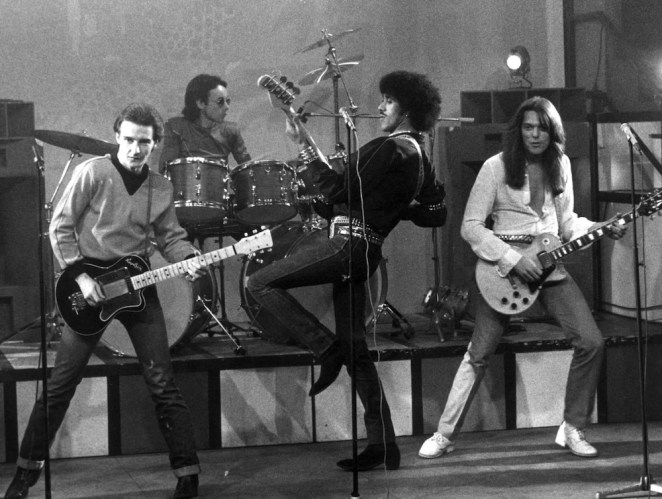
In July of 1979, Midge Ure was drafted as a guitarist in Thin Lizzy to replace Gary Moore, who abruptly left the band during their U.S. tour. Within 24 hours of saying “Yes,” Ure was on a Concorde headed to America to play his first show with the band. At the time, Ure had just joined Ultravox but agreed to help Thin Lizzy temporarily.
“Midge listened to ‘Live And Dangerous’ all the way over on the plane,” recalled Thin Lizzy guitarist Scott Gorham in Mark Putterford’s 2002 book Philip Lynott: The Rocker. Ure was flying to New Orleans to play with the band, who had a show at the Fox Theatre that evening. “As soon as he got to New Orleans, he went straight to his hotel room, and he and I sat down and worked out who was going to play which parts.”
Gorham continued, “An hour later, we were at the soundcheck, ironing out a few of the more tricky parts, and 45 minutes later were on stage doing it for real. Midge was great, he didn’t drop a note.”
Months into Ure’s brief stint with the band, Dave Flett briefly took over on guitar, and Ure switched to playing keyboards during Thin Lizzy’s tour in Japan.
“I was never a keyboard player by any stretch of the imagination,” said Ure, who added that he was kept on to add another dimension to the band.
“Both Phil and I agreed that with bands like the Rich Kids, Midge was a latter-day Steve Marriott,” said Thin Lizzy’s longtime manager Chris O’Donnell. “He was a great guitar player, even though he never got any credit for it, and he had a great rock’n’roll voice. He was certainly better than the bands he’d been involved with before. He was just a stop-gap in Lizzy, but we did see tremendous potential in him.”
Videos by American Songwriter
“Get Out of Here”
As a member of Thin Lizzy, Ure helped contribute to “Get Out of Here” with Lynott for the band’s 1979 album Black Rose. Though Ure says he was barely a co-writer on the track.
“It was one of those oddities,” Ure told Song Facts in 2015. “I was hanging out with Phil in London, and he started working on this song, and I kind of strung along with him. I didn’t really add an awful lot to it—he was very generous. At the end of the afternoon, when he was knocking this song together, in which I was very much a passive participant, he said, “We’ve written a song together.” I said, “Have we? Really? Are you sure?”
At the time, Ure was struggling, so getting the songwriter credit on the song helped him financially. “To get me a percentage of the song was just phenomenal, bearing in mind I didn’t have two cents in my pocket to rub together,” said Ure. “He [Lynott] looked after me like a big brother.”
Their lyrics were a swift sayonara to a lover.
I used to be a dreamer
But I realize that it’s not my style at all
In fact it becomes clearer that a dreamer doesn’t stand a chance at all
Get out of here (Get out of here)
Get out of here (Get out of here)
Get out
Do I make myself clear
No way, I must go, can’t stay, must run
No chance, I can’t give a second chance
No hope, there’s no hope for you now
No romance, no more romance
Kraftwerk and Magazine
Though Ure had a successful run with Thin Lizzy, he was never a contender to join the band full-time. “The moments that we’d sit in a limousine and we’d all take turns playing cassettes on the car system, every time it came to my turn, you could see Scott Gorham and Brian Downey just looking distraught while I’d put on Kraftwerk or Magazine or whatever I was listening to at the time,” recalled Ure. “So I don’t think there was any chance whatsoever I was going to end up joining the band. My interest lay with technology.”
Lynott was still interested in the more synth direction Ure was heading with Ultravox, and later connected with him when he started working on his solo debut, Solo in Soho.
“He wanted to incorporate some of the stuff I had been playing him in the car,” said Ure. “I think he would have quite liked me to be a part of it, but I was never a whiz-kid guitar player. I was never the fast, flash, twiddly-diddly guy.”
“Yellow Pearl”
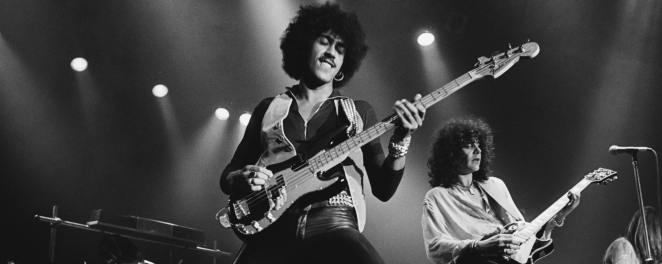
Ure continued working with Thin Lizzy well into 1980 and also co-wrote “Yellow Pearl” with Lynott for Solo in Soho. Unlike “Get Out of Here,” Ure was much more involved in the writing of the “Yellow Pearl.” A remixed version of the song later became the theme song to the British music show Top of the Pops from 1981 through 1986 and went to No. 14 in the UK.
“Just as Steve Jones and Paul Cook had been Phil’s link with punk, so I became his connection to the po-faced electronic scene that was blossoming,” said Ure. “Phil had the only seven-track studio in the history of the world at the bottom of his garden.” The studio was an eight-track one, but Lynott couldn’t get one of the tracks to work. Ure added, “So when I had my 24-track studio built at home, I used to invite him over to have a dabble. He loved it because I had an engineer working in there, so he didn’t have to worry too much about working the new technology; he could just mess around with a few ideas.”
“Yellow Pearl” originated while Ure was on tour with Thin Lizzy in Japan in 1979, but its meaning was an elusive one. “I actually have no idea what the song is really about, except perhaps that, as a thin outline,” said Ure of the song. “It’s a comment on the thought of Japanese technology taking over, a twist on the Yellow Peril idea.”
We all must beware of the yellow pearl
The Yellow Pearl control, attack, attack, attack, attack
Yellow Pearl
It is foolish to venture into strange, enchanted places
If they aren’t the places you want to be
Attack, attack, attack, attack, attack, attack, attack
Is what we lack
We will arise
We will control
We will command
We will patrol
It is foolish under the guise of love and liberty
That we should capitalize and rob and fell
The poor for the socialistic tree
We will arise
We will control
Ure and Lynott continued to collaborate. In the midst of Ultravox’s height—and between the band’s 1981 album Rage in Eden and Quartet a year later—Ure also produced “Together” on Lynott’s second and final album before he died in 1986, The Philip Lynott Album.
In a 2024 interview with American Songwriter, Ure called songwriting a “wound-inflicting process” and likened it to baking. “It does take a long time to get something you’re satisfied with,” said Ure. “Not that your standards are ridiculously high, but what you’re competing with is stuff that you’ve written before, and you don’t want to do something substandard. You’re trying to find a more interesting way of saying things each time you write something new, and that becomes more and more difficult the longer you’ve been doing it, so it just takes its own time.
I liken it to baking a cake. You put it in the oven for the right amount of time, and when it’s done, it’s done. When it’s ready, it’s ready.”
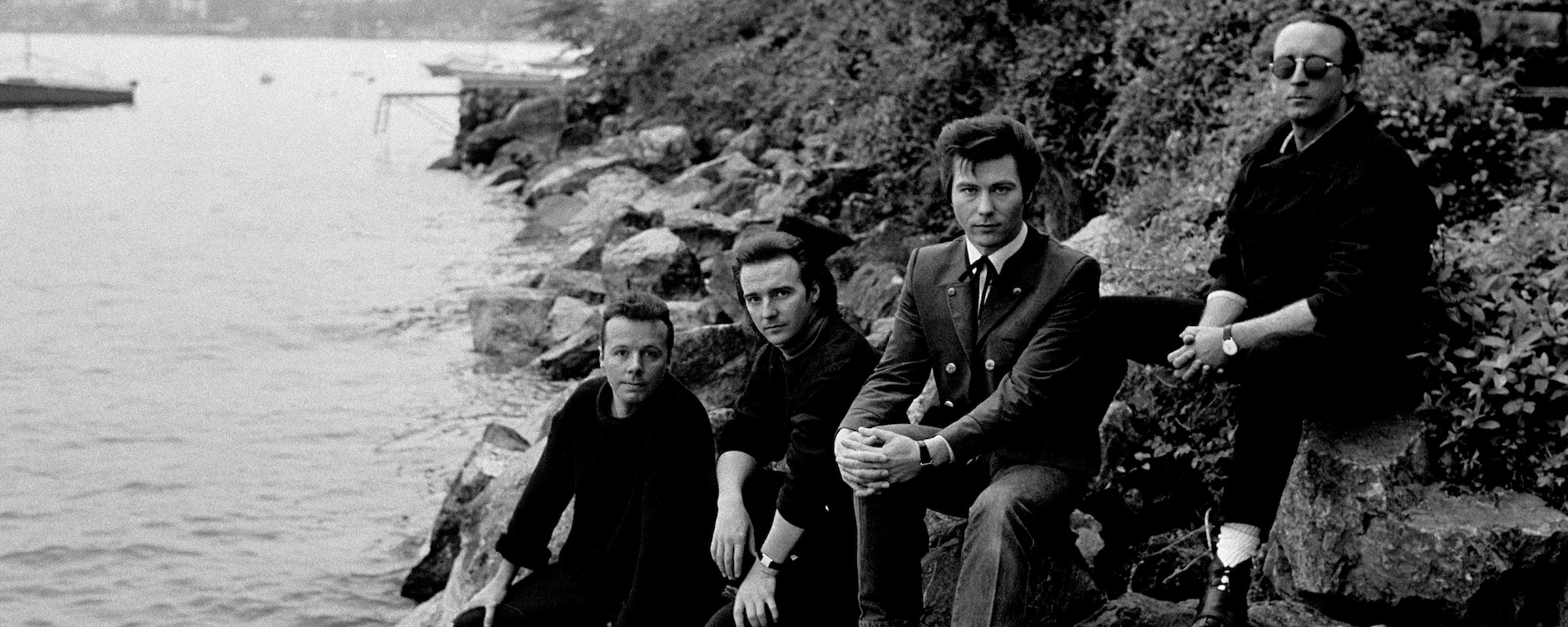
Photo: Jürgen & Thomas/ullstein bild via Getty Images





Leave a Reply
Only members can comment. Become a member. Already a member? Log in.