Your cart is currently empty!



“It’s like something that should be the soundtrack to a ’70s cop show,” said Lettuce keyboardist Nigel Hall of the band’s latest release, Cook. Regardless of whether it may have been well-suited for an episode of Kojak or Starsky & Hutch, Cook is an apt title for the band that has prided itself as much for its love of food as for the music all six band members have made together in nearly 35 years.
A collection of movable vignettes, Cook goes further than Lettuce has gone before, mixing more of the band’s ingredients, blending soul, funk, jazz, hip-hop, and dipping into more across 16 tracks, from the opening “Grewt Up” to a cover of Keni Burke’s 1982 R&B hit “Risin’ to the Top” with Hall on vocals, and four interludes, “Shessins,” running 40 seconds or less.
To accompany the new album, band members Eric “Benny” Bloom and Ryan “Zoid” Zoidis recently partnered with Aquila Cellars in the North Fork Valley of Colorado to blend the band’s own Lettuce Crush wines. The wines include a Red Crush and Orange Crush, along with a recipe book of pairings, featured in the digital and vinyl release of Cook.
“Lettuce has always stood for well-made things in their purest form,” said the band in a previous statement. “Well-made records, well-made instruments, well-made food—and now, well-made wine. We don’t need filler, additives, or any gobbledygook. So, we decided to make a wine that is just that, nothing added or taken away, just as Mother Earth intended it.”
Earlier in 2025, the band also released the live album and concert film Lettuce with the Colorado Symphony and later partnered with the nonprofit Music is a Language to launch a new scholarship in their name to help fund tuition for students attending Berklee College of Music, where Lettuce got its start during the summer of 1992.
Saxophonist Ryan Zoidis and bassist Erick “Maverick” Coomes reflected on the band’s nearly 35-year journey, the meaning behind Cook, keeping their music ‘organic,” and blending their first Lettuce wines.
Videos by American Songwriter
After releasing Unify in 2022, when did you start pulling together the songs for Cook?
Ryan Zoidis: For this record, we were a little bit more prepared. We wrote a few things off the road, and by the time we got into the studio, we had a better idea of what we wanted to record.
Erick Coomes: A lot of times, we play the album before it comes out, because we’re on the road so much, but this time, we saved it, and we haven’t played all these songs a million times live, yet.
Most of what Lettuce does is so improvisational. How do songs often transform live?
RZ: We improvise a lot. We’re always trying to play things a little differently night to night. If we’ve been playing a song for a while, we try to put a different spin on it, depending on the mood. Sometimes the songs will develop on the road, and then we’ll record them.
Was there a song that kicked things off for Cook?
EC: “Grewt Up,” we wrote it and played it a few times, and liked the energy of it. Then it ended up being the first song on the record. I was writing at my house on bass, and I was trying to come up with an old school bass line, something like James Jamerson. I played a little guitar that sounded like Curtis Mayfield, and some bass that sounded like James, and sent that to Adam Deitch, our drummer, who put drums on it and helped flesh it out a bit. There are a lot of beautiful songs on the record.
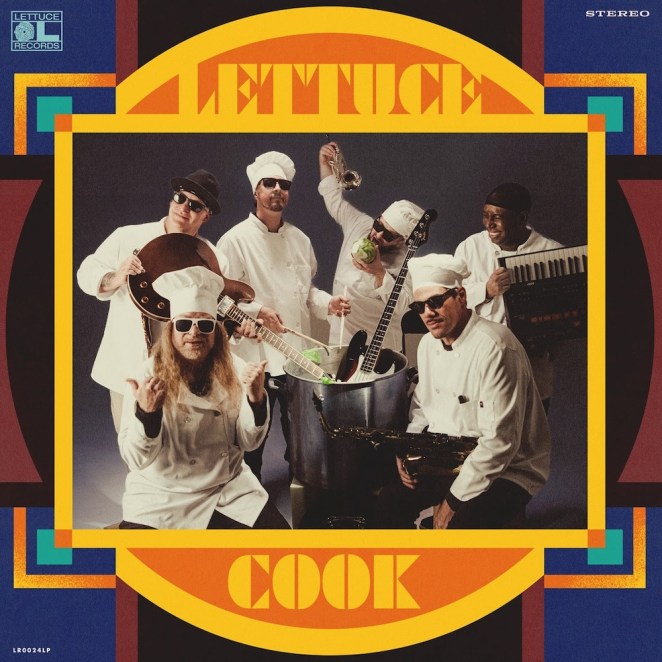
Considering how immersed you are in food, Cook is the perfect title for this Lettuce album.
EC: It’s a cool slang people are saying these days about when you’re doing your craft really well. People say, “Let him cook.” We’ve been hearing that a lot, and our drummer really liked that phrase, which is just starting to go out of style right now. I think it’s cool because of the double entendre, and we all love food so much, and getting to travel to Europe and around the world and experience different cultures, cuisine, and people at the top of their craft.
In Japan, I went to see this guy who creates beautiful soba. I realized that this guy is at his shop every day. He probably wakes up and gets there at five in the morning every day, hand-cutting soba and milling the buckwheat flour. This dude has dedicated his entire life to being the best at this thing, and he doesn’t care who sees it or doesn’t see it.
I think we feel a really strong connection to people like that, who just serve their food every day for people who understand it and have a palate for it.
Why did you call the album “three-dimensional”?
RZ: It’s just another thing that represents the band as much as we can, and captures it in the studio, which has always been a challenge for us to really capture what we do live in the studio. We’re all so comfortable in the studio that it ends up being something that isn’t ever close to capturing us live.
The wines are a great complement to the music and bring attention to a lesser-known wine region in the U.S.: Colorado.
RZ: Along with trumpet player, Benny [Eric “Benny” Bloom], we started Benny & Zoid Selections, a distribution company in Colorado, six years ago. Distribution is a one-third tier of the alcohol system that is hard to explain to people, so everyone thinks we have our own wine, and they’ve been asking about our own wine for the last six years, but there’s a lot of behind-the-scenes work that happens just distributing wine in Colorado.
We hooked up with Aquila Wines and brainstormed putting out a Lettuce wine, and they had a bunch of wine in barrels that we could blend and come up with something. So we did, and now we have two Lettuce wines.
Along with the Barbera blend and the orange wine, would you make a bigger red at some point?
RZ: This came together really quickly, and we were limited to what he had in the barrel, but next time we want to spend more time and think about what grapes we want and really customize it. This was cool because we got to actually come up with different blends, and it made us want to do more. The Lettuce Crush Orange wine is fun in the summertime and spring. It’s not too acidic, like a lot of orange wines can be. It’s a little tannic too, so it can hold up to different foods.
It’s been more than 30 years since the band formed and more than two decades since your debut, Outta Here (2002). How has the songwriting process within the band evolved throughout the decades?
EC: We like to say 10 years. (Laughs) We have multiple processes. We all have a voice recorder on our phones, and stop to record. Then we get together, listen back to those, and work on some of those ideas. We write together a lot during sound checks. We’ll just come up with a little groove on bass or guitar or drums, and then the sax and horns, and the trumpet will put their melody on top of it. We’ve always written together and separately, and I don’t think that’s changed over the years.

I definitely have melodies that I’ve heard for years that keep coming back to me. And those are ones I know are really good, because I can’t shake them.
RZ: We’re writing together more now, because on the road we have sound checks that are substantial enough to actually create something. When we’re on a bus tour, and we have all our own gear, we have plenty of time every day because we’re headlining every night and not worrying about support. So we get the stage to ourselves all day and can tighten things up and prepare ourselves so the studio is more productive.
Lettuce has been going strong since 1992. What’s next for the band?
RZ: I actually like that we’re up against AI now, yeah, because we’re such an organic band. What we do is going to hopefully become more special than it has been over the years. The fact that we can just create music every day together is going to be a good thing for AI to study. You know,
EC: And Lettuce can make music without instruments. We can just start singing and hitting the walls. It’s always organic, and the further things get towards AI, I think people will want to see what else is going on.
Photo: Jay Sansone





Leave a Reply
Only members can comment. Become a member. Already a member? Log in.