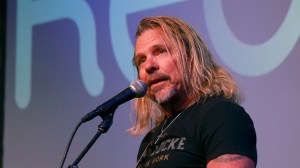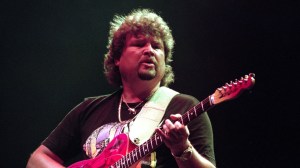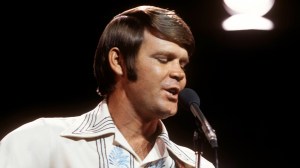
Bob Dylan, Bruce Springsteen, John Mellencamp, Jerry Garcia, Bob Weir—the list of folk and rock legends influenced by Woody Guthrie is long. Nearly six decades after the folk pioneer’s death at age 55, Guthrie’s legacy still looms large. With songs like “This Land Is Your Land” and “Tear the Fascists Down”, he dared to directly challenge power and impart his ideas of anti-fascism and anti-racism. Today we’re raising a glass to Woodrow Wilson “Woody” Guthrie, born in Okemah, Oklahoma, on this day (July 14) in 1912.
Woody Guthrie’s Life Was Marred By Early Tragedy
The son of a once-powerful businessman and local politician, Woody Guthrie’s early life was forged in flames—literally.
Videos by American Songwriter
Three years before his birth, his family lost their newly-completed home to a fire. When Guthrie was seven, his sister Clara died after setting fire to her clothes during an argument with their mother. And in 1927, his father sustained severe burns in a fire at home.
Unbeknownst to her family, Nora Guthrie also suffered from Huntington’s disease. The resulting dementia and muscle degeneration prompted her commitment to a mental hospital when her son was 14.
Her husband, Charles Guthrie, had relocated to Pampa, Texas, where he worked to repay debts from unsuccessful real estate deals. This left Woody and his siblings on their own, and the 14-year-old worked odd jobs around town, frequently begging for meals and sleeping on friends’ couches.
Music remained a constant for the young Guthrie throughout the trials and tribulations of early life. He learned traditional English and Scottish folk songs from his parents. And after befriending a Black shoeshine boy named George who played blues on his harmonica, Guthrie bought his own instrument and began playing alongside him.
Hitting the Road and Finding the Music
As the ’20s faded into the ’30s, Okemah’s thriving oil economy went bust. Then 18, Woody Guthrie headed to join his father in Texas, foregoing a high school education for days spent busking on the streets or reading in the town library.
In Pampa, he met his first wife, Mary Jennings, the younger sister of his musician friend, Matt Jennings. The couple had three children together.
About that time, the Dust Bowl arrived right on the heels of the Great Depression. Unable to provide for his family, Guthrie hit Route 66 in search of work. He hitchhiked and hopped freight trains, often playing guitar and singing in exchange for room and board.
Finally arriving in California in 1937, Guthrie landed a singing gig on a Los Angeles radio station. Singing commercial hillbilly and traditional folk music with partner Maxine “Lefty Lou” Crissman, he gained a following among the thousands of relocated Okies surviving in makeshift migrant camps.
Embracing his role as a voice for the downtrodden, Guthrie also used his platform to speak out on social issues he cared about. He channeled that passion and advocacy into songs like I Ain’t Got No Home”, “Goin’ Down the Road Feelin’ Bad”, “Talking Dust Bowl Blues”, “Tom Joad” and “Hard Travelin’”.
New York Bound
In 1940, the “Oklahoma cowboy” left California for the other coast, settling in New York City’s Greenwich Village.
That same year, Woody Guthrie wrote his most famous song, “This Land Is Your Land”, as a kind of allergic reaction to Irving Berlin’s patriotic anthem “Gold Bless America”. He also released Dust Bowl Ballads, the only non-compilation album of his musical career.
Along with fellow musical outsiders like Lead Belly, Burl Ives, Seeger, and more, Guthrie formed the Almanac singers. Establishing folk as a viable musical genre, they also advocated tirelessly for social causes, such as union organizing, anti-fascism, and anti-war efforts.
Stricken with the same illness that befell his mother—Huntington’s disease—Woody Guthrie died in New York City at age 55 on October 3, 1967. However, his legacy endures.
[RELATED: Woody Guthrie Initially Wrote This 1945 Song as a Parody of a Popular Patriotic Tune]
“When it comes to the genre of singer-songwriters, all roads lead to Woody Guthrie,” Billy Bragg said.
Featured image by Michael Ochs Archives/Getty Images
-
New Orleans, LA – 1978: (L-R) Daryl Dragon, Toni Tennille, the Captain and Tennille performing on the ABC tv special 'The Captain and Tennille in New Orleans'. (Photo by Neal Preston / Mirage /Disney General Entertainment Content via Getty Images) -
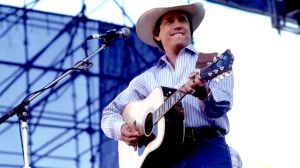
George Strait (Photo by Paul Natkin/WireImage) -
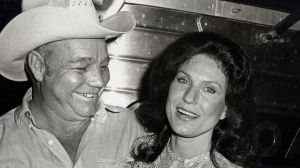
NEW YORK, NEW YORK – Oliver Mooney and Loretta Lynn during Party In Honor of President Jimmy Carter – August 14, 1980 at Xenon in New York City, New York, United States. (Photo by Ron Galella/Ron Galella Collection via Getty Images) -

NASHVILLE, TN – Reba McEntire performs ontstage at The 43rd Annual CMA Awards at the Sommet Center on November 11, 2009 in Nashville, Tennessee. (Photo by Frank Micelotta/Getty Images) -

NASHVILLE, TN – Musician Kenny Malone performs during Listen To The Band: The Nashville Cats In Concert With Special Guests For "Dylan, Cash, And The Nashville Cats" Exhibition Opening Weekend at the Country Music Hall of Fame and Museum on March 28, 2015 in Nashville, Tennessee. (Photo by Rick Diamond/Getty Images for Country Music Hall Of Fame And Museum)