Of the thousands of stage entrances the Rolling Stones have made over their decades-long career, perhaps the most memorable was when the band was bailed out of jail by the mayor of Boston in what was supposed to be a sold-out Stones concert at Boston Garden on July 18, 1972.
The band arrived at the arena five and a half hours late and with a few new charges under their belt, including assault and obstruction of a police officer. Luckily, Mayor Kevin White was there to save the night.
Videos by American Songwriter
The Airport Incident That Led To The Stones’ Arrest
On the night of their capacity Boston Garden show, the Rolling Stones had to make an emergency landing at Theodore F. Green State Airport in nearby Warwick, Rhode Island, due to heavy fog. While the band waited for a bus to take them the rest of the way to Boston, Providence Journal-Bulletin photographer Andrew Dickerman began taking photos of the British rockers, much to their chagrin.
Apparently testing their already thin patience, Dickerman alleged that members of the Stones’ crew tried to assault him for taking photos. The airport called the police and former Warwick Police Sgt. Frank Ricci responded. Once Ricci arrived on the scene, the band’s security guard reluctantly permitted Dickerman to resume taking photos. Keith Richards, however, was not ready to acquiesce. “As soon as he [starts to take photos], some long-haired guy got up, whipped his belt off, and went after Dickerman,” Ricci recalled to South Coast Today.
“I said, ‘OK, that’s it. I don’t care who you say you are. You’re under arrest,’” Ricci continued. The officer said Mick Jagger jumped on his back, yelling, “If you take him, you’re taking me, too.” Ricci replied, “OK, we can take you, too.” The brouhaha ended with Ricci arresting Richards, Jagger, head of Rolling Stones Records Marshall Chess, security guard Stanley Moore, and filmmaker Robert Frank, who was making a documentary of the band at the time.
How The Boston Mayor Ended Up Bailing The Stones Out Of Jail
By the time the Warwick police took the Rolling Stones musicians and crew to jail, the concert at Boston Garden had already started. Opener Stevie Wonder had taken the stage while the musicians and their crew sat in a Rhode Island jail cell. As soon as news of the rockers’ incarceration got out, phone calls began flooding into the jail from concert organizers and Stones fans alike. (The latter included Ricci’s children, who unsuccessfully begged their dad for a chance to meet the imprisoned rockstars.)
The most pressing of these phone calls, however, was from then-Mayor Kevin White. White frantically called the jail to say that Wonder had finished his set, and the 15,000 fans waiting in the arena were growing restless. Fearing a riot, White insisted the court arraign the band and crew immediately. And because being an international rockstar affords certain civil liberties, the court obliged. All five men pleaded not guilty to their charges, and White sent a limousine with a state police escort to fetch them from Rhode Island. “I called, and I got them out,” White told the anxious crowd. “They’re on their way” (via Rolling Stones Data).
The Stones took the stage at 12:45 am, opening with “Brown Sugar,” a controversial track they’ve since removed from their live performances. Fans waited a whopping five and a half hours to see the freshly released jailbirds and the Stones delivered, performing until 2 am. “This place is better than Warwick,” frontman Jagger told the Boston Garden audience.
Photo by Graham Wiltshire/Shutterstock
More Did You Know
-
Willie Mae “Big Mama” Thornton performing, Photo by GBH Archives/YouTube -
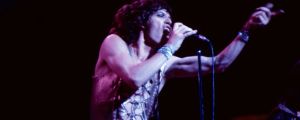
Rock band: The Rolling Stones: – Mick Jagger, Keith Richards (Photo by Roger Bamber/Shutterstock) -
Singer and songwriterJohn Lennon (1940 – 1980) with his wife Yoko Ono, signing copies of her conceptual art book 'Grapefruit' at Selfridges, London, 15th July 1971. (Photo by Jack Kay/Daily Express/Getty Images) -
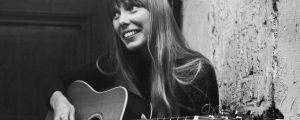
Despite its fantastical origin story of surviving a shrapnel attack in the Vietnamese jungle, the D-28 met its demise on a flight to Hawaii. Not only did the turbulent flight damage the instrument in storage; someone later stole the guitar from the luggage carousel. Mitchell was never able to find her long-lost instrument, something she’s lamented for years. Aside from the sentimental connection guitarists typically have to their first ax, Mitchell was particularly fond of her Martin for functional reasons. After a bout of childhood polio affected Mitchell’s ability to form chord shapes in standard tuning, the singer-songwriter had to adapt with eccentric tunings that allowed her to create rich harmonic structure with limited mobility. Whether open, an octave below, or otherwise, Mitchell’s unique tunings placed stress on the guitar neck that it wasn’t originally made to endure. Moreover, to ensure the dissonance within her tunings was purposeful and not merely off-pitch, Mitchell needed a guitar with pristine intonation—something she frequently lauded the D-28 for having. “I need really good intonation,” she explained to Acoustic Guitar. “One of the signs of really good intonation is how flashy the harmonics are with a light touch. You should be able to get them to bloom like jewels.” While Mitchell has found other guitars that come close in that department, as she put it in her 1996 magazine interview, “I’ve never found an acoustic that could compare with it.” Photo by Central Press/Hulton Archive/Getty Images -

Drummer Ringo Starr of English rock band the Beatles during a reception at the London home of the group's manager Brian Epstein, 20th May 1967. The Beatles' song 'A Day In The Life' had recently been banned by the BBC for its references to drug-taking. (Photo by John Pratt/Keystone/Hulton Archive/Getty Images) -
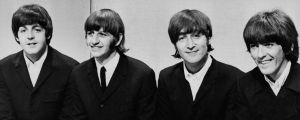
English rock band the Beatles at the BBC television studios in London before leaving for a concert tour of Germany, and afterwards Japan, 16th June 1966. From left to right, they are Paul McCartney, Ringo Starr, John Lennon and George Harrison. (Photo by Central Press/Hulton Archive/Getty Images) -
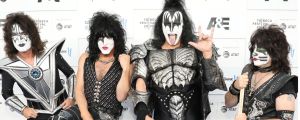
NEW YORK, NEW YORK – JUNE 11: (L-R) Tommy Thayer, Paul Stanley, Gene Simmons, and Eric Singer of KISS attend the 2021 Tribeca Festival screening of "Biography: KISStory" at The Battery on June 11, 2021 in New York City. (Photo by Monica Schipper/Getty Images)