
Some people would do anything to achieve fame and success, whether that means lying, cheating, stealing, or, in the case of blues legend Robert Johnson, selling his soul to the devil. Johnson was a pioneer of the Delta blues movement in the early 1930s, performing on the streets of southern towns of Mississippi and Arkansas. Johnson followed in the footsteps of other notable blues figures of the day, like Son House, but struggled to keep up musically.
Johnson’s playing was something of a scene-wide joke until he mysteriously vanished for over a year. When he returned, something was noticeably different about the tall, soft-spoken guitar player.
Videos by American Songwriter
An Irksome Newbie To The Delta Blues Scene
Robert Johnson’s origins are as opaque as the otherworldly legend that colored the final years of his life. Historians estimate the future blues icon was born in the spring of 1911 in Hazlehurst, Mississippi. Johnson picked up harmonica as a young child, inspired by other notable musicians of the time, like Son House, who eventually moved to the same city as Johnson. Son House came to know the Johnson family, and his early memories of the family’s son on guitar were less than admirable.
“I think it was in Robinsonville I met him,” Son House later recalled, per TeachRock. “I got friendly with his mother and father, and he was blowing [jaw harp]. Why, then, he could blow the pants off just about anyone, but he wanted to play guitar. When he grabbed guitar, the people asked why don’t he stop. He was driving ‘em all crazy with his noise.”
“Then he slipped off to Arkansas somewhere, but sure enough he came back, and he found [Willie Brown and me]. We was asking if he remembered what we’d showed him. But then he showed us something, and we didn’t believe what we saw. I said to ol’ Bill, ‘That boy’s good.’”
Indeed, something had changed when Johnson returned from what would be an 18-month hiatus from the Delta blues scene. Suddenly, he could pluck out entire band arrangements with just a six-string guitar. He could punctuate a bass line while he plucked a melody on the high strings, all while maintaining a percussive rhythm. The change was so dramatic that people started to speculate the only explanations they deemed plausible: Johnson must have made a deal with the devil.
The Myth of Robert Johnson, Blues Legend
A male Black musician cutting their teeth in the 1930s deep South was liable to take any boosts to his career that he could find, and Robert Johnson was certainly no different. Rumors began swirling in the musical community that Johnson must have sold his soul to the devil to become so masterful at his instrument in just over a year. It was a wild story but not a particularly uncommon one. Other blues musicians of the time used similar stories to add allure and intrigue to their musical talents. Johnson willingly joined their ranks.
The legend of Johnson selling his soul to the devil in exchange for mastery of Delta blues guitar was made all the more eerie after his tragically premature death at 27 years old. The vacuum left by his short life and the few details historians have of it naturally fanned the flames of these otherworldly claims. However, Johnson’s family suggested a far less divine explanation. During Johnson’s 18-month absence, he returned to his hometown in Mississippi and began studying with Ike Zimmerman, another notable guitarist in the area. After over a year of dedicated practice, Johnson was able to hone his skills enough to inspire devilish fear in those who heard him.
Perhaps the embarrassment of Son House describing his guitar playing as mind-numbing “noise” was enough motivation for Johnson to practice his instrument more diligently for a year straight. Or, maybe he really did sell his soul to the devil in exchange for his instrumental abilities. Whatever deal Johnson made with himself or otherwise, the results helped shape blues music forever and inspired countless musicians of all genres, including Eric Clapton and Canadian singer-songwriter Colter Wall.
Photo by Robert Knight Archive/Redferns
More Did You Know
-
The Rolling Stones in concert, Tour of Europe '76, Earls Court Arena – Mick Jagger and Keith Richards (Photo by Graham Wiltshire/Shutterstock) -
Rock band: The Rolling Stones: – Mick Jagger, Keith Richards (Photo by Roger Bamber/Shutterstock) -
Singer and songwriterJohn Lennon (1940 – 1980) with his wife Yoko Ono, signing copies of her conceptual art book 'Grapefruit' at Selfridges, London, 15th July 1971. (Photo by Jack Kay/Daily Express/Getty Images) -
Despite its fantastical origin story of surviving a shrapnel attack in the Vietnamese jungle, the D-28 met its demise on a flight to Hawaii. Not only did the turbulent flight damage the instrument in storage; someone later stole the guitar from the luggage carousel. Mitchell was never able to find her long-lost instrument, something she’s lamented for years. Aside from the sentimental connection guitarists typically have to their first ax, Mitchell was particularly fond of her Martin for functional reasons. After a bout of childhood polio affected Mitchell’s ability to form chord shapes in standard tuning, the singer-songwriter had to adapt with eccentric tunings that allowed her to create rich harmonic structure with limited mobility. Whether open, an octave below, or otherwise, Mitchell’s unique tunings placed stress on the guitar neck that it wasn’t originally made to endure. Moreover, to ensure the dissonance within her tunings was purposeful and not merely off-pitch, Mitchell needed a guitar with pristine intonation—something she frequently lauded the D-28 for having. “I need really good intonation,” she explained to Acoustic Guitar. “One of the signs of really good intonation is how flashy the harmonics are with a light touch. You should be able to get them to bloom like jewels.” While Mitchell has found other guitars that come close in that department, as she put it in her 1996 magazine interview, “I’ve never found an acoustic that could compare with it.” Photo by Central Press/Hulton Archive/Getty Images -

Drummer Ringo Starr of English rock band the Beatles during a reception at the London home of the group's manager Brian Epstein, 20th May 1967. The Beatles' song 'A Day In The Life' had recently been banned by the BBC for its references to drug-taking. (Photo by John Pratt/Keystone/Hulton Archive/Getty Images) -
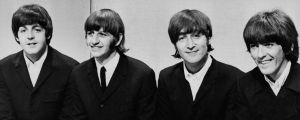
English rock band the Beatles at the BBC television studios in London before leaving for a concert tour of Germany, and afterwards Japan, 16th June 1966. From left to right, they are Paul McCartney, Ringo Starr, John Lennon and George Harrison. (Photo by Central Press/Hulton Archive/Getty Images) -

NEW YORK, NEW YORK – JUNE 11: (L-R) Tommy Thayer, Paul Stanley, Gene Simmons, and Eric Singer of KISS attend the 2021 Tribeca Festival screening of "Biography: KISStory" at The Battery on June 11, 2021 in New York City. (Photo by Monica Schipper/Getty Images)