
The Beatles might’ve been superstars, but offstage, they were average (and gross) human beings like anyone else—an unavoidable, all-natural quality exemplified in stomach-twisting detail by their disgusting honorary Beatles member, whom they nicknamed “The Thing.” The fifth Beatle gave all new meaning to rock and rollers trashing a hotel room.
The legend of “The Thing” dates back to the earliest years of the Beatles. Pre-Ringo Starr, the quartet was still using their original drummer, Pete Best. Pre-Beatlesmania, the band was performing in rather racy venues across Europe while they worked toward their first big break.
Videos by American Songwriter
George Harrison Introduced “The Thing” To The Beatles
When the Beatles weren’t playing hours-long sets at the Star-Club in Hamburg, Germany, they were crashing in a modest hostel that the club’s owner, Manfred Weissleder, provided for them. One night, George Harrison vomited in a corner of their hostel after a particularly long drinking session. As the story goes, neither Harrison nor the woman hired to clean the hostel was willing to clean up the mess.
Weissleder tried to get Harrison to tend to the puke pile on several occasions, and each time, he refused—perhaps a revealing glimpse into his future celebrity status or maybe a protest against the band’s less-than-ideal living situation. In any case, Pete Best wrote in his memoir that the vomit corner became a running joke amongst the group.
Eventually, cigarette butts and food scraps made their way into the unsightly corner, creating an even bigger stench and eyesore than the first one Harrison created. The band lovingly (or disgustingly?) dubbed the mess in the corner “The Thing” and called it an honorary Beatle.
The Band’s Hilarious Reaction To Their Fifth Member’s End
After two weeks of living next to a pile of puke and trash, the hostel owner finally cleaned up the mess. The Beatles reportedly protested when the time came to say goodbye to The Thing and even held a mock funeral for their “honorary bandmate.” Best later said of the biohazard, “Now you could probably flog it for thousands on eBay” (via ANI).
As stomach-turning as the thought might be, Best is probably right about that. The Fab Four’s Hamburg years are a superfan goldmine, offering an intimate, warts-and-all glimpse into the quartet’s earliest stages. The Beatles’ time playing as a house band in Europe was a formative experience professionally, musically, and personally. As John Lennon would later say in Anthology, “I grew up in Hamburg, not Liverpool.”
George Harrison offered similar sentiments in Anthology, describing Hamburg as “brilliant” and the Reeperbahn and Gross Freiheit, two of the main entertainment districts where they played, as “the best thing we’d ever seen, clubs and neon lights everywhere and lots of restaurants and entertainment. It looked really good. There were seedy things about it, obviously, including some of the conditions we had to live in when we first got there.” Gross conditions indeed—thanks in no small part to Harrison and the band’s honorary fifth member, “The Thing.”
Photo by Central Press/Hulton Archive/Getty Images
More Did You Know
-
Willie Mae “Big Mama” Thornton performing, Photo by GBH Archives/YouTube -
The Rolling Stones in concert, Tour of Europe '76, Earls Court Arena – Mick Jagger and Keith Richards (Photo by Graham Wiltshire/Shutterstock) -
Rock band: The Rolling Stones: – Mick Jagger, Keith Richards (Photo by Roger Bamber/Shutterstock) -
Singer and songwriterJohn Lennon (1940 – 1980) with his wife Yoko Ono, signing copies of her conceptual art book 'Grapefruit' at Selfridges, London, 15th July 1971. (Photo by Jack Kay/Daily Express/Getty Images) -
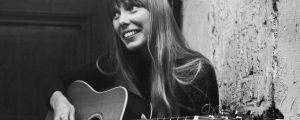
Despite its fantastical origin story of surviving a shrapnel attack in the Vietnamese jungle, the D-28 met its demise on a flight to Hawaii. Not only did the turbulent flight damage the instrument in storage; someone later stole the guitar from the luggage carousel. Mitchell was never able to find her long-lost instrument, something she’s lamented for years. Aside from the sentimental connection guitarists typically have to their first ax, Mitchell was particularly fond of her Martin for functional reasons. After a bout of childhood polio affected Mitchell’s ability to form chord shapes in standard tuning, the singer-songwriter had to adapt with eccentric tunings that allowed her to create rich harmonic structure with limited mobility. Whether open, an octave below, or otherwise, Mitchell’s unique tunings placed stress on the guitar neck that it wasn’t originally made to endure. Moreover, to ensure the dissonance within her tunings was purposeful and not merely off-pitch, Mitchell needed a guitar with pristine intonation—something she frequently lauded the D-28 for having. “I need really good intonation,” she explained to Acoustic Guitar. “One of the signs of really good intonation is how flashy the harmonics are with a light touch. You should be able to get them to bloom like jewels.” While Mitchell has found other guitars that come close in that department, as she put it in her 1996 magazine interview, “I’ve never found an acoustic that could compare with it.” Photo by Central Press/Hulton Archive/Getty Images -

Drummer Ringo Starr of English rock band the Beatles during a reception at the London home of the group's manager Brian Epstein, 20th May 1967. The Beatles' song 'A Day In The Life' had recently been banned by the BBC for its references to drug-taking. (Photo by John Pratt/Keystone/Hulton Archive/Getty Images) -

NEW YORK, NEW YORK – JUNE 11: (L-R) Tommy Thayer, Paul Stanley, Gene Simmons, and Eric Singer of KISS attend the 2021 Tribeca Festival screening of "Biography: KISStory" at The Battery on June 11, 2021 in New York City. (Photo by Monica Schipper/Getty Images)