
The country music world was robbed of one of its most singular voices on March 5, 1963, when Patsy Cline died in a plane crash near Camden, Tennessee. Just 30 years old, Cline made her recording debut in 1955. Within the span of several years, she became one of the first country artists to also find success on the pop charts thanks to hits like “Walkin’ After Midnight” and “Crazy”. As brief as her time in the spotlight was, it was almost even shorter. On this day (June 14) in 1961, the singer nearly lost her life in a brutal car accident in Nashville.
Beating the Odds
In June 1961, Patsy Cline’s mother, sister, and brother arrived in Nashville to see her new home. On June 14, she and her brother, Sam Hensley Jr., were shopping for material that their mother could use to make clothing.
Videos by American Songwriter
On their way home, another vehicle struck theirs head on, hurling Cline into the car windshield. She sustained a broken wrist, dislocated hip, and a large cut across her forehead that barely missed her eyes.
Later, Cline’s friend, country singer Dottie West—who rushed to the scene after hearing about the accident on the radio—recalled picking glass from her hair.
When first responders arrived, Cline insisted they treat the other driver first. Tragically, two of the three passengers riding in the car that struck hers died after arriving at the hospital.
Unfortunately, things were touch-and-go for Cline as well, and doctors initially didn’t expect her to survive. However, she made it through surgery.
Upon waking up, she reportedly told her husband, Charlie Dick, “Jesus was here, Charlie… He took my hand and told me, ‘No, not now. I have other things for you to do.’”
Patsy Cline Didn’t Stay Away From the Stage for Long
Five months before the near-fatal accident, Patsy Cline released the song “I Fall to Pieces” as a single in January 1961. The song reached number one on the Hot Country Songs chart during her month-long recovery in the hospital.
Due to the circumstances, Cline couldn’t perform the song live for several months. However, she was determined that the accident wouldn’t derail her career.
Six weeks after the fact, Cline returned to the Grand Ole Opry stage, still on crutches.
“You’re wonderful,” she told the audience. “I’ll tell you one thing: the greatest gift, I think, that you folks coulda given me was the encouragement that you gave me. Right at the very time I needed you the most, you came through with the flying-est colors. And I just want to say you’ll just never know how happy you made this ol’ country gal.”
Featured image by Michael Ochs Archives/Getty Images
More Did You Know
-

The Rolling Stones in concert, Tour of Europe '76, Earls Court Arena – Mick Jagger and Keith Richards (Photo by Graham Wiltshire/Shutterstock) -

Rock band: The Rolling Stones: – Mick Jagger, Keith Richards (Photo by Roger Bamber/Shutterstock) -

Singer and songwriterJohn Lennon (1940 – 1980) with his wife Yoko Ono, signing copies of her conceptual art book 'Grapefruit' at Selfridges, London, 15th July 1971. (Photo by Jack Kay/Daily Express/Getty Images) -

Despite its fantastical origin story of surviving a shrapnel attack in the Vietnamese jungle, the D-28 met its demise on a flight to Hawaii. Not only did the turbulent flight damage the instrument in storage; someone later stole the guitar from the luggage carousel. Mitchell was never able to find her long-lost instrument, something she’s lamented for years. Aside from the sentimental connection guitarists typically have to their first ax, Mitchell was particularly fond of her Martin for functional reasons. After a bout of childhood polio affected Mitchell’s ability to form chord shapes in standard tuning, the singer-songwriter had to adapt with eccentric tunings that allowed her to create rich harmonic structure with limited mobility. Whether open, an octave below, or otherwise, Mitchell’s unique tunings placed stress on the guitar neck that it wasn’t originally made to endure. Moreover, to ensure the dissonance within her tunings was purposeful and not merely off-pitch, Mitchell needed a guitar with pristine intonation—something she frequently lauded the D-28 for having. “I need really good intonation,” she explained to Acoustic Guitar. “One of the signs of really good intonation is how flashy the harmonics are with a light touch. You should be able to get them to bloom like jewels.” While Mitchell has found other guitars that come close in that department, as she put it in her 1996 magazine interview, “I’ve never found an acoustic that could compare with it.” Photo by Central Press/Hulton Archive/Getty Images -

Drummer Ringo Starr of English rock band the Beatles during a reception at the London home of the group's manager Brian Epstein, 20th May 1967. The Beatles' song 'A Day In The Life' had recently been banned by the BBC for its references to drug-taking. (Photo by John Pratt/Keystone/Hulton Archive/Getty Images) -
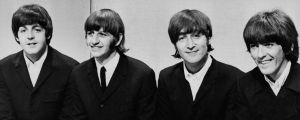
English rock band the Beatles at the BBC television studios in London before leaving for a concert tour of Germany, and afterwards Japan, 16th June 1966. From left to right, they are Paul McCartney, Ringo Starr, John Lennon and George Harrison. (Photo by Central Press/Hulton Archive/Getty Images) -

NEW YORK, NEW YORK – JUNE 11: (L-R) Tommy Thayer, Paul Stanley, Gene Simmons, and Eric Singer of KISS attend the 2021 Tribeca Festival screening of "Biography: KISStory" at The Battery on June 11, 2021 in New York City. (Photo by Monica Schipper/Getty Images)