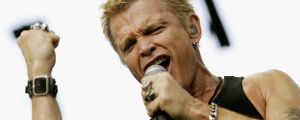
Some parts of United States history sound more like a fever dream Simpsons episode than real life, including the time rock music lovers called into a radio station to help create a “sound torture” playlist during the 1989 U.S. invasion of Panama. Sound torture typically involves playing music or noise uncomfortably loud for extended amounts of time. The U.S. government has implemented this practice since the mid-20th century.
In 1989, the U.S. military radio for Central America, the Southern Command Network, made the government’s sound torture tactics a group project as military personnel began phoning in the radio station with their song requests. And as the target of this sound torture would come to find out over the course of several days, the soldiers’ musical tastes were ear-splittingly effective.
Videos by American Songwriter
Building a Sound Torture Playlist During U.S. Invasion of Panama
In late 1989, the United States invaded Panama under President George H.W. Bush. American troops were to depose Panama’s de facto ruler, General Manuel Noriega, who was wanted by the U.S. authorities for several criminal charges, including racketeering and drug trafficking. Upon the troops’ arrival to the Central American country, Noriega fled to the Vatican’s embassy in Panama City. Due to the embassy’s sacrosanct status, U.S. troops could not legally enter the premises after the then-papal nuncio Monsignor Sebastiano Laboa agreed to provide Noriega asylum.
So, the U.S. military adapted. Soldiers might not have been allowed on the premises, but there were no international laws pertaining to soundwaves. Troops surrounded the embassy with speakers, dialed them into the Southern Command Network’s radio feed, and began blasting the property with rock music around the clock. As more soldiers got word of this sound torture technique, they started calling into the Central America radio station with specific requests for Noriega. Popular requests included AC/DC’s “You Shook Me All Night Long” and Rick Astley’s “Never Gonna Give You Up.”
The tongue-in-cheek nature of the troops’ task was not lost on the soldiers. Many specifically requested songs that coyly fit within the context of the invasion. The Clash’s “I Fought the Law” was a top choice, as was Bruce Cockburn’s “If I Had a Rocket Launcher.” Perhaps most appropriately, the Southern Command Network frequently played Van Halen’s “Panama” because when in Rome, right?
A Notably Divisive Technique Proved To Be Effective
Once word of the crowdsourced sound torture playlist made its way back to the States, President George H.W. Bush’s administration ordered the troops to press pause. Bush’s national security adviser, Brent Scowcroft, called the tactic “undignified,” per NPR. The president described the tactic as “politically embarrassing” and “irritating and petty,” per a report by the Office of the Chairman of the Joint Chiefs of Staffs, Ronald H. Cole. This same report argued that the military initially used loud rock music as a way to mask potential eavesdropping on sensitive conversations.
Once they discovered the music could potentially agitate General Manuel Noriega to the point of surrender, they kept the loudspeakers on, and radio requests began pouring in. Whether undignified, unintentional, or petty, the tactic worked well enough to push Noriega to his 1990 surrender. Considering how some U.S. officials have described it in the past, it’s not surprising that it worked.
“If you play [loud rock music] for 24 hours, your brain and body functions start to slide,” Sergeant Mark Hadsell told Newsweek. “Your train of thought slows down, and your will is broken. That’s when we come in and talk to them.”
Photo by Fin Costello/Redferns
More Did You Know
-
The Rolling Stones in concert, Tour of Europe '76, Earls Court Arena – Mick Jagger and Keith Richards (Photo by Graham Wiltshire/Shutterstock) -
Rock band: The Rolling Stones: – Mick Jagger, Keith Richards (Photo by Roger Bamber/Shutterstock) -
Singer and songwriterJohn Lennon (1940 – 1980) with his wife Yoko Ono, signing copies of her conceptual art book 'Grapefruit' at Selfridges, London, 15th July 1971. (Photo by Jack Kay/Daily Express/Getty Images) -
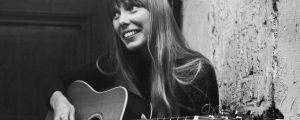
Despite its fantastical origin story of surviving a shrapnel attack in the Vietnamese jungle, the D-28 met its demise on a flight to Hawaii. Not only did the turbulent flight damage the instrument in storage; someone later stole the guitar from the luggage carousel. Mitchell was never able to find her long-lost instrument, something she’s lamented for years. Aside from the sentimental connection guitarists typically have to their first ax, Mitchell was particularly fond of her Martin for functional reasons. After a bout of childhood polio affected Mitchell’s ability to form chord shapes in standard tuning, the singer-songwriter had to adapt with eccentric tunings that allowed her to create rich harmonic structure with limited mobility. Whether open, an octave below, or otherwise, Mitchell’s unique tunings placed stress on the guitar neck that it wasn’t originally made to endure. Moreover, to ensure the dissonance within her tunings was purposeful and not merely off-pitch, Mitchell needed a guitar with pristine intonation—something she frequently lauded the D-28 for having. “I need really good intonation,” she explained to Acoustic Guitar. “One of the signs of really good intonation is how flashy the harmonics are with a light touch. You should be able to get them to bloom like jewels.” While Mitchell has found other guitars that come close in that department, as she put it in her 1996 magazine interview, “I’ve never found an acoustic that could compare with it.” Photo by Central Press/Hulton Archive/Getty Images -

Drummer Ringo Starr of English rock band the Beatles during a reception at the London home of the group's manager Brian Epstein, 20th May 1967. The Beatles' song 'A Day In The Life' had recently been banned by the BBC for its references to drug-taking. (Photo by John Pratt/Keystone/Hulton Archive/Getty Images) -
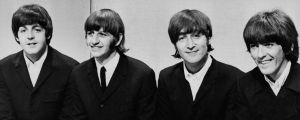
English rock band the Beatles at the BBC television studios in London before leaving for a concert tour of Germany, and afterwards Japan, 16th June 1966. From left to right, they are Paul McCartney, Ringo Starr, John Lennon and George Harrison. (Photo by Central Press/Hulton Archive/Getty Images) -
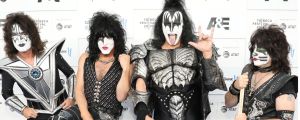
NEW YORK, NEW YORK – JUNE 11: (L-R) Tommy Thayer, Paul Stanley, Gene Simmons, and Eric Singer of KISS attend the 2021 Tribeca Festival screening of "Biography: KISStory" at The Battery on June 11, 2021 in New York City. (Photo by Monica Schipper/Getty Images)