
Founding an enduring rock outfit is a finicky endeavor. You need just the right recipe or things will quickly begin to falter—great songs, great musicians, and a great band name. Typically, the first two are cultivated first. You actually need to be able to play together before you can dub yourself a band. But, eventually, every fledgling rock group has to face the age-old question— “yeah, but what are we gonna be called?”
REO Speedwagon is a name that is deeply unique. Even if you don’t know their music, however unlikely, that name has flittered around in pop culture for long enough that you’re aware of its stature. But, how did they land on such a name? We’re going through the origins of REO Speedwagon and walking through their legacy, below. Let’s dive in.
Videos by American Songwriter
Behind the Band Name
In the mid-’60s, Neal Doughty and Alan Gratzer lived in the same dormitory at the University of Illinois. Gratzer had been lending a hand behind the drums in a couple of local bands when one of them caught Doughty’s eyes. He began following them and even jumped in to play keyboards a time or two. Noticing a kindred spirit in one another, they decided to trek out on their own, playing covers of The Kinks and Hendrix. Clearly, what resulted was something special.
As the story goes, Doughty is credited with coming up with the group’s moniker. While taking a class in college on “The History of Transportation,” he saw the term “R.E.O. Speedwagon” written on the blackboard. The R.E.O Speedwagon was a vehicle popular in 1915 from the Oldsmobile automotive company. Ostensibly, it was an ancestor of the pick-up truck today. It seems that sometimes the best band names come from the most unlikely of sources.
Regardless of the origins, the name is now synonymous with arena rock and few people are hit with images of Henry Ford-era machinery when they hear it.
Legacy
After shuffling through a number of line-ups, the group landed on Doughty, Gratzer, guitarist Gary Richrath, bassist Gregg Philbin, and vocalist Terry Luttrell. The outfit released its debut LP in 1971 to middling success. The album featured 8 original songs all credited to the band as a unit. Despite the slow start, the self-titled album features some of the band’s signature songs like “157 Riverside Avenue.”
The album did well enough to warrant a second effort, but soon the group began to fracture. Luttrell became unhappy, eventually began to check out, and was replaced by Kevin Cronin, who created a fake referral agency in which he was the only client.
The group jumped into their second album with a clearer headspace. Though the album, again, didn’t make huge waves in the music industry, it solidified what we’ve come to know from the group as their signature sound.
Across their career, REO Speedwagon has gifted the world several iconic tracks, notably “Can’t Fight This Feeling Anymore” and “Take It On the Run.” Cronin’s unique vocals are an emblem of the ’80s. Their songs evoke a certain sense of nostalgia and charm that has kept their appeal alive for generations.
Photo: Randee St. Nicholas / Live Nation Release
More Features
-

NEW YORK – SEPTEMBER 1958: Pianist Bob Gaudio, drummer Tom Austin, tenor sax Larry Qualiano, singer Dianne Costello and guitarist Billy Dalton of the rock and roll band "The Royal Teens" pose for a portrait in September or October of 1958 at the Brooklyn Paramount in New York, New York. (Photo by PoPsie Randolph/Michael Ochs Archives/Getty Images) -
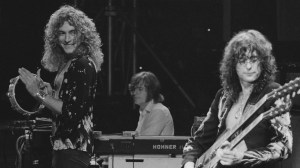
Left to right: Robert Plant, John Paul Jones and Jimmy Page, of British heavy rock group Led Zeppelin, performing at Earl's Court, London, May 1975. The band were initially booked to play three nights at the venue, from 23rd to 25th May, but due to public demand, two more concerts were later added, for 17th and 18th May. Total ticket sales were 85,000. (Photo by Michael Putland/Getty Images) -
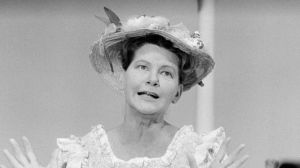
American country comedienne Minnie Pearl (1912 – 1996) performing, circa 1970. (Photo by Silver Screen Collection/Getty Images) -
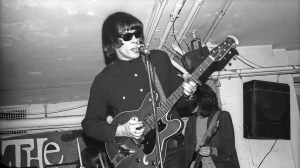
NEW YORK – JUNE 11: Rock and roll band Steppenwolf (L-R Jerry Edmonton, John Kay and Michael Monarch) perform at Steve Paul's The Scene nightclub on June 11, 1968 in New York, New York. (Photo by Don Paulsen/Michael Ochs Archives/Getty Images) -
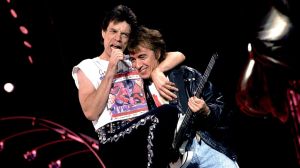
British musicians Mick Jagger (left) and Bill Wyman of the Rolling Stones performs on stage during the band's 'Steel Wheels' tour, late 1989. (Photo by Paul Natkin/Getty Images) -
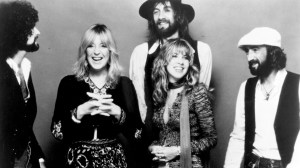
CIRCA 1977: (L-R) Lindsey Buckingham, Christine McVie, Mick Fleetwood, Stevie Nicks and John McVie of the rock group 'Fleetwood Mac' pose for a portrait in circa 1977. (Photo by Michael Ochs Archives/Getty Images) -
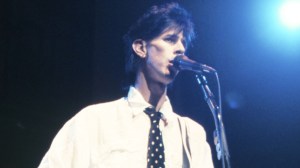
ATURDAY NIGHT LIVE — Episode 19 — Pictured: Singer Ric Ocasek of musical guest The Cars performs on May 12, 1984 — Photo by: NBC/NBCU Photo Bank -
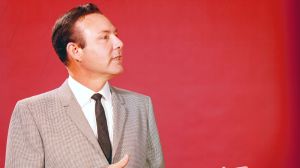
UNSPECIFIED – CIRCA 1970: Photo of Jim Reeves Photo by Michael Ochs Archives/Getty Images