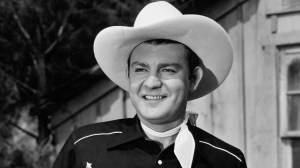
On this day (August 12) in 1929, Buck Owens was born Alvis Owens Jr. in Sherman, Texas. He and his band, the Buckaroos, rose to prominence in the 1960s. During the decade, they launched a long string of singles to the top of the country chart. Owens was instrumental in developing and popularizing the Bakersfield Sound. As a result, he influenced many future country artists, including Merle Haggard, Brad Paisley, and Dwight Yoakam.
Owens’ parents were sharecroppers who lived in a house with dirt floors in Sherman. The family owned a donkey named Buck, which is where the future country legend took his nickname when he was very young. In 1937, the Owens family was one of countless families who headed west during the Dust Bowl. However, they didn’t make it to California. When their trailer hitch broke in Arizona, they settled in Mesa.
Videos by American Songwriter
According to Salon, Owens dropped out of school at 13 to work in the fields. It was during these long days of hard work that he began to dream of a life of comfort away from manual labor under the desert sun. That Christmas, he received a mandolin, which he taught himself to play. This was the first step in achieving his dream.
Over the next few years, Owens taught himself to play several instruments. This allowed him to sit in with multiple local bands. This allowed him to hone his skills not just as a musician but also as a performer.
Buck Owens Heads to Bakersfield
In 1945, when Buck Owens was 16 years old, he started playing pedal steel for Mac’s Skillet Lickers. He soon fell in love with and married their singer, Bonnie Campbell. This was around the same time that he started driving a produce truck to California. During his trips, he discovered Bakersfield, a town full of oil workers who populated the bars and created a thriving music scene. In 1950, Owens, his wife, and their kids moved to California.
Owens landed a gig as the guitarist for the house band at the Corral. Then, he started playing at the Blackboard, the dance hall that became the epicenter of the Bakersfield Sound in the years to come.
To supplement his income, Owens began making the drive to Hollywood, where he played sessions for Capitol Records. There, he played for Tennessee Ernie Ford, Wanda Jackson, Tommy Duncan, and many others.
Owens met Don Rich, his right-hand man, in 1958. They played together at venues in the Tacoma, Washington, area until Owens’ recording career took off in 1959. That year, “Second Fiddle” reached No. 24 on the country chart. He followed that with “Under Your Spell Again,” which peaked at No. 4. Then, Owens left Washington and returned to Bakersfield.
Rich was reluctant to follow Owens south. However, in late 1960, he finally relocated to Bakersfield, cementing one of the most legendary duos in country music history. Three years later, “Act Naturally,” with Rich on lead guitar, became Owens’ first No. 1 hit. It was the start of a monumental string of 14 chart-topping singles.
Smash Hits, TV Shows, and a Painful Loss
Buck Owens’ second No. 1 single, “Love’s Gonna Live Here,” spent 16 weeks at No. 1. It was the only song to spend more than 10 weeks at the top of the country chart for the next 49 years.
In the late 1960s, Owens appeared on several high-profile TV shows, including The Ed Sullivan Show, the Jimmy Dean Show, and The Jackie Gleason Show. In 1969, he joined Roy Clark as the co-host of Hee Haw. The variety show put Owens, Clark, and some of the biggest country stars of the era on millions of television sets every weekend.
By the early 1970s, Owens’ singles weren’t climbing the charts like they once did. Then, in 1974, Don Rich died in a motorcycle accident. Reflecting on the loss in the late 1990s, Owens said, “I think my music life ended when he died. Oh yeah, I carried on, and I existed, but the real joy and love, the real lightning and thunder is gone forever.”
Buck Owens died in March 2006. By that time, his music had influenced multiple generations of artists and touched countless fans. The country music world wouldn’t be the same without his contributions.
Featured Image by David Redfern/Redferns
-
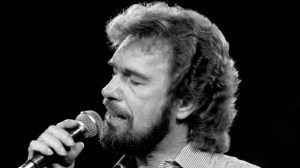
Gene Watson, who had several hits with Dallas Harms songs -
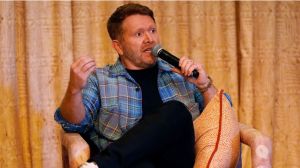
NASHVILLE, TENNESSEE – Shane McAnally speaks onstage during GLAAD's Pride & Progress Event at Soho House Nashville on June 05, 2026 in Nashville, Tennessee. (Photo by Erika Goldring/Getty Images for GLAAD) -
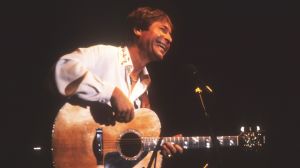
MINNEAPOLIS, MN – John Denver performs at the Northrup Auditorium in Minneapolis, Minnesota on October 5, 1991. (Photo by Jim Steinfeldt/Michael Ochs Archives/Getty Images) -
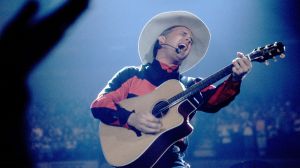
American country musician Garth Brooks performs onstage, Chicago, Illinois, October 1, 1993. (Photo by Paul Natkin/Getty Images) -
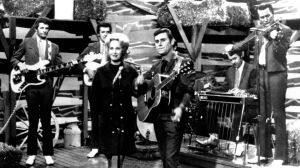
Tammy Wynette and George Jones Perform on stage with the Jones Boys in circa 1972. (Photo by Michael Ochs Archives/Getty Images) -
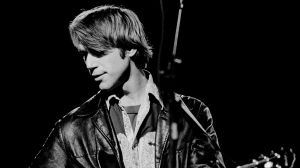
American Folk musician Todd Snider plays guitar as he performs onstage at Medinah Temple, Chicago, Illinois, November 27, 1997. (Photo by Paul Natkin/Getty Images)