
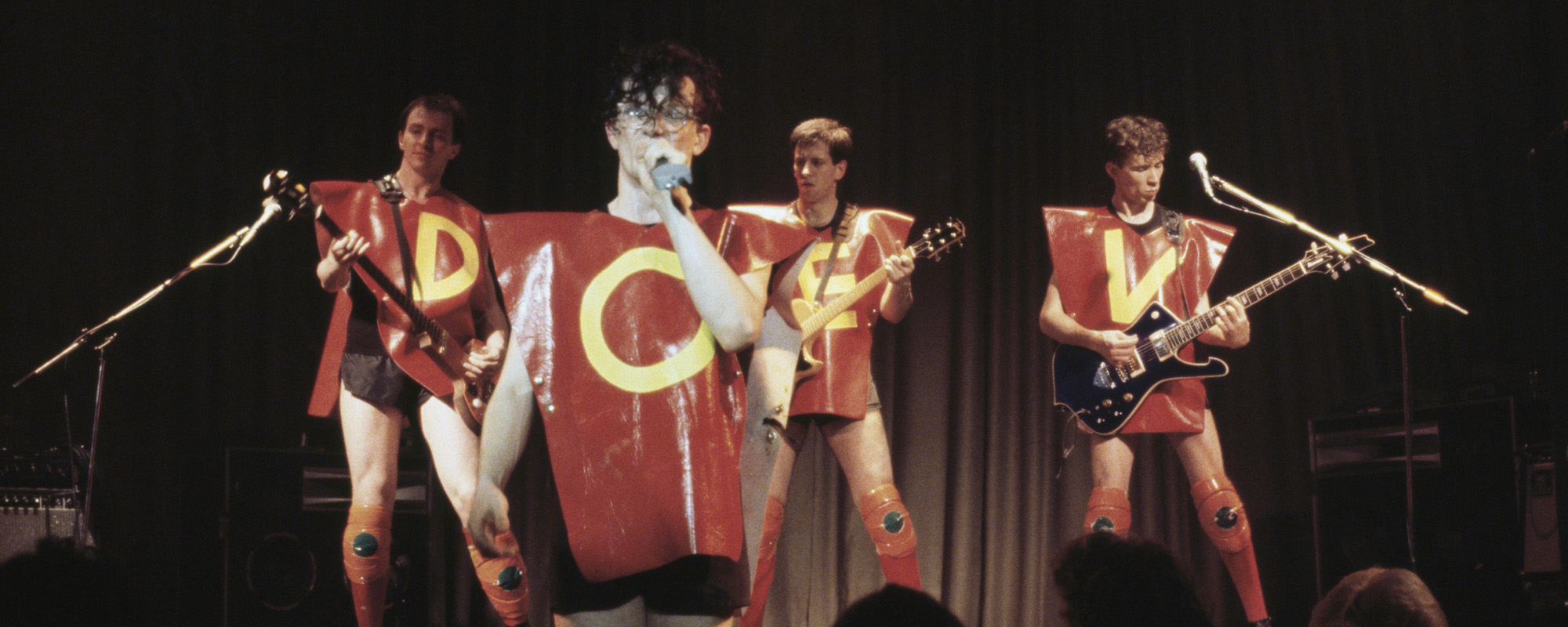
Everything was art. And they were cloaked in music as confrontational satire. Functioning more like a multimedia art project than a band, there was nothing normal about Devo. Their pastiche was a mix of Ziggurat-shaped energy domes inspired by the Bauhaus movement and slick JFK-coif molded wigs, coupled with experiments in video, blending elements of Dadaism and the absurdity of Marcel Duchamp, German Expressionism, the abstract work of Robert Rauschenberg, and Andy Warhol‘s pop art, along with the sci-fi films Inherit the Wind and Island of Lost Souls.
“We paid attention to people like Andy Warhol and Rauschenberg and a lot of other people who were conceptualists,” Devo’s Mark Mothersbaugh tells American Songwriter. “We felt like we were conceptualists, too.”
Devo gravitated to Warhol, in particular, since he penetrated multiple media. He was a painter, a photographer, worked in printmaking, and even co-produced The Velvet Underground and Nico’s 1967 debut. “We liked that the idea could come first,” says Mothersbaugh, “and then the technology would follow.”
Coming out of the rubber capital of the world—Akron, Ohio—there was nothing artsy about the band’s upbringing that would suggest their future socio-political métier, yet they crafted a united avant-garde front illustrating the reasons why they came together in the first place. The band wasn’t a band at first. Devo started as a “literary and art movement,” said Gerald Casale, in the band’s 2025 Netflix documentary, Devo.
“There were all these great art movements back then,” says Mothersbaugh. “There was Bauhaus and Dada and futurists and the Russian suprematists. They were the most Devo of all of them, because they made fun of how humans believed they were the center of the universe and deserved to destroy the planet.”
Growing up in the middle of the Vietnam War and later witnessing friends and classmates killed during the Kent State Shootings helped light another fire under the band, which started as a sextet in 1973, and eventually landed on the classic lineup of dual brothers Bob and Mark Mothersbaugh, Bob and Gerald Casale, and drummer Alan Myers.
Videos by American Songwriter
Prompted by a strange 1924 anti-evolutionary pamphlet, written by preacher Betrand Henry Shadduck, Jocko Homo Heavenbound, which looked at Charles Darwin’s research and any theories of evolution as folly. The band was also prompted by the degeneration, or “de-evolution,” they witnessed during the ’50s through 1960s, something that helped later formulate their “De-Evolutionary Oath,” the satirical idea that humans came from mutant, brain-eating apes, and are regressing, not progressing.
It was a similar notion they picked up on in the 1932 film Island of Lost Souls, where Charles Laughton plays Dr. Moreau, a scientist on a remote island experimenting on animals and attempting to evolve them into human-like forms, including one of his “beast folk,” Sayer of the Law, played by Bela Lugosi, who says in the film, “Not men. Not beasts…Things.”
Another line in the film, “Are we not men?” made its way onto the band’s 1978 debut, Q. Are We Not Men? A: We Are Devo! They also landed on the band name from the 1960 courtroom drama Inherit the Wind, starring Spencer Tracy and Gene Kelly, centered around the 1925 Scopes Monkey Trial, and a Tennessee teacher who is arrested for teaching Darwin’s theory of evolution.
In the film, a carnival barker mocks the trial with a sideshow courtroom, exclaiming, “Devolution is not a theory, but a proven fact. My friends, man did not evolve from the ape, but the ape devolved from man,” alongside a cigarette-smoking dressed chimpanzee with the words “Devolution Man” behind him, with only the words “Devo” and “Man” visible. Devo stuck.
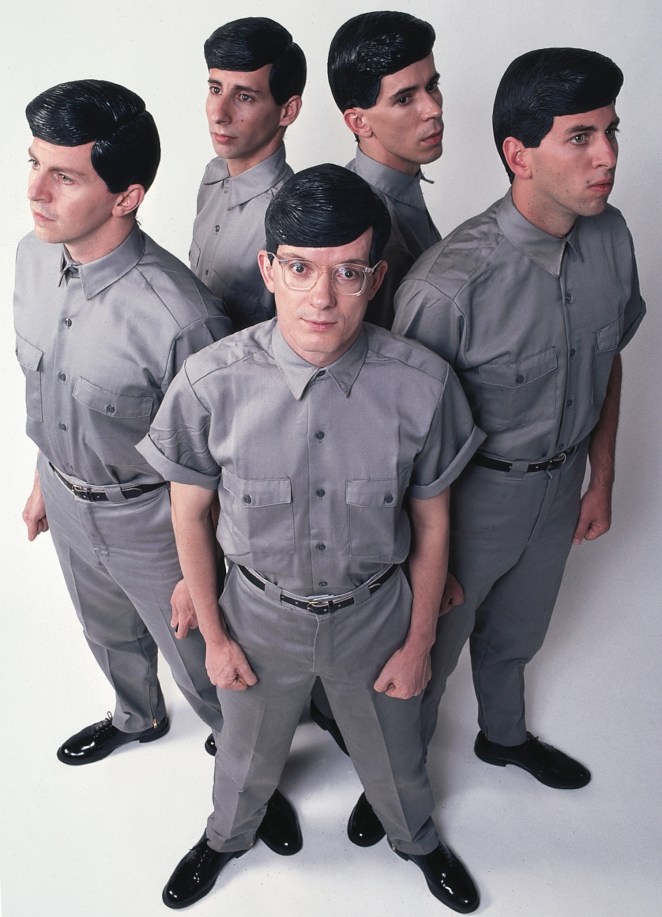
“It seems like every 50 years, greed and capitalism and stupidity all coalesce,” says Mothersbaugh. “Fifty years ago, it was ‘Let’s stop communism in Vietnam, because we want to take over and make those people dig for oil for free for us, and 50 years before that, it was fascists in Europe. And it’s when these times happen that artists get really inspired, and they make art that talks about that.”
God made man, but he used the monkey to do it, sings Mark Mothersbaugh on “Jocko Homo,” which was released as a B-side in 1977 to the band’s debut single “Mongoloid. Humans as apes or something less evolved would stick as a recurring theme throughout Devo’s music on “Go Monkey Go,” “Gates of Steel,” and more. Even Devo’s early mascot, Booji (or “Boogie”) Boy, first introduced in the 1976 Chuck Statler-directed nine-minute short film, In the Beginning Was the End: The Truth About De-Evolution, had the appearance of a more infantile, malformed human.
Led by the devolution of the masses, Devo’s sound was fitted around a brutalism and the mechanical nature of humans. “We’re not cynical, we just watch the news” became a band catchphrase.
The Grammy-nominated documentary, directed by Chris Smith, who Mothersbaugh previously worked with on Tiger King, followed the band’s earliest days of experimentation to stepping up their musical production with Brian Eno, who produced their 1978 debut, Q. Are We Not Men? A: We Are Devo! after David Bowie, who called Devo “the band of the future,” couldn’t commit.
“Chris [Smith] was smart enough to keep us all at arm’s length, because everybody had a very strong opinion of what Devo was and where we came from,” shares Mothersbaugh of the documentary. “He did a really good job of interviewing people and keeping Jerry out of the editing bay, and keeping me away from bringing in more stuff that he didn’t need. At the end of the day, it’s a pretty informative, pretty even-handed documentary that even the most cynical of band members like.”
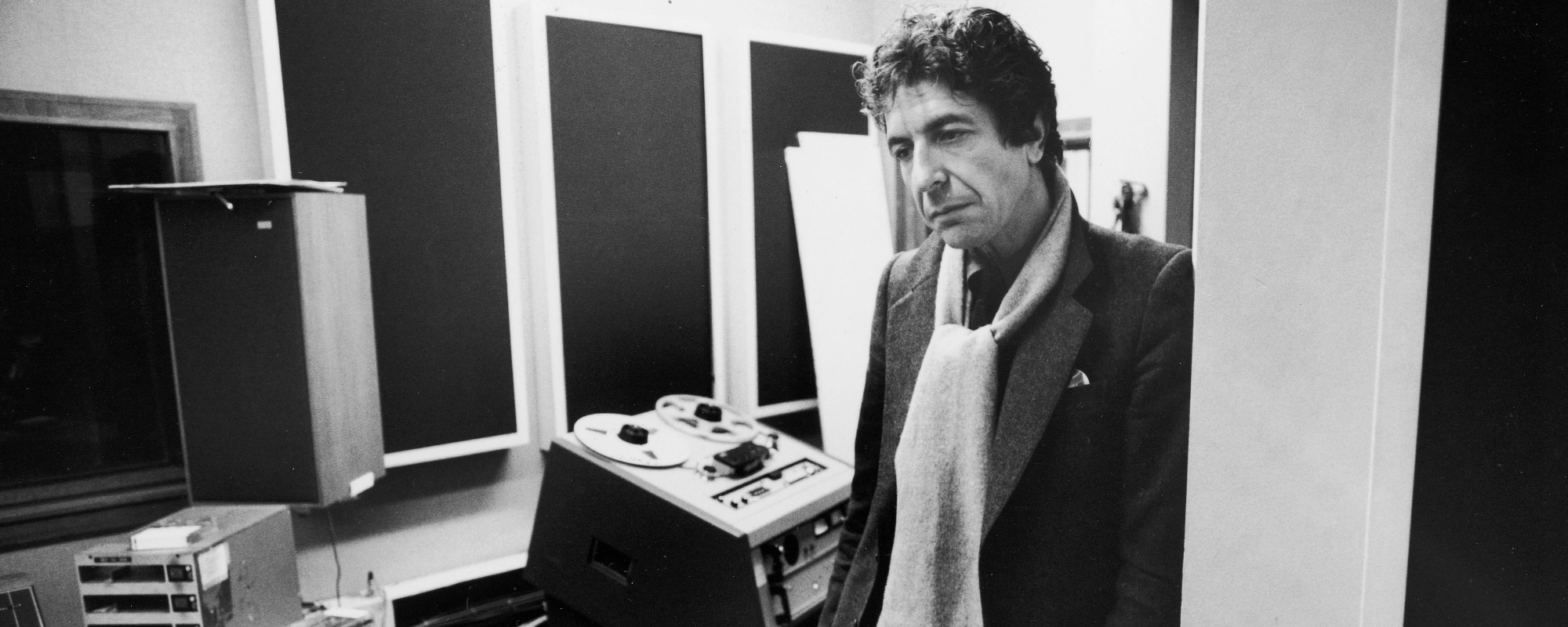
Early on, some famous new fans, including Leonard Cohen, Debbie Harry, and Jack Nicholson, were seen at Devo shows to find out what the spectacle was all about. Neil Young even took a liking to the band and wrote them into his 1982 nuclear holocaust comedy, Human Highway. With Iggy Pop along as another fan, Devo even fell into the ’70s punk genre, playing with the Dead Boys, the Ramones, Suicide, the Cramps, and more during a period when they felt more critical of the then-newish genre than a part of it. Casale once referred to the Devo as “punk scientists,” and, in the documentary, Mothersbaugh joked, “We’re the fluid in the punk enema bag.”
The band also considered themselves “musical reporters,” navigating subjects most bands would never touch, including religion, including the raging evangelists around Ohio, and later on, through the band’s 1980 hit “Whip It,” with its presumed sado-masochistic connotations in the iconic music video, directed by Gerald Casale. Influenced by the misogynist magazine, Tab, which showed a cowboy whipping off his wife’s clothes, the song was also a critique of consumerism and the incessant messaging pushed on Americans.
“We’re a musical laxative for a constipated society”—another relevant one-liner by Mothersbaugh in the film.
[RELATED: 3 Songs Devo’s Mark Mothersbaugh Wrote for Other Artists]
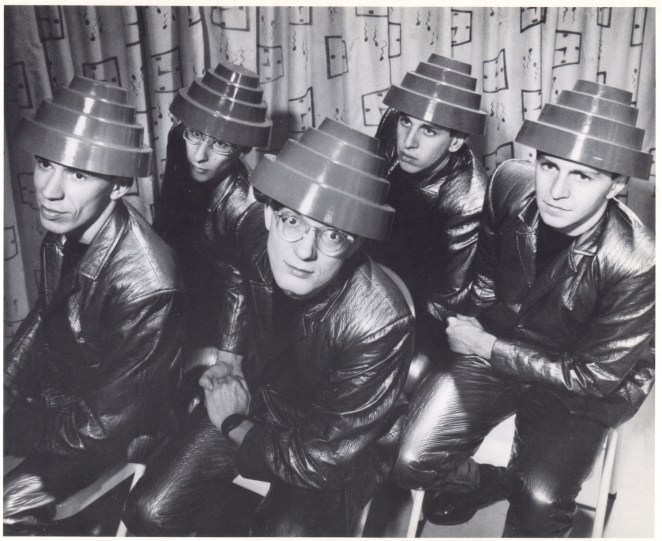
Misunderstood, Devo released eight albums through 1990 with Smooth Noodle Maps. By this point, Casale had already started directing commercials and music videos for bands like Rush, and later for Foo Fighters and Soundgarden during the ’90s, while Mothersbaugh was scoring for television, including the children’s TV series Pee-Wee’s Playhouse and the Rugrats, and later for film and video games.
After a lengthy hiatus, Devo reunited for their ninth album, Something for Everybody, in 2010, which also marked the final release with Bob Mothersbaugh, who died in 2014; Myers also passed away a year earlier.
All along, Devo’s art followed the concept of devolution, which is still prevalent today. “It came from people 50 years earlier, the same people, now that are calling immigrants rapists, terrorists, and they’re eating the dogs, and are eating the cats,” says Mothersbaugh. “Years before that, there were right-wing Christians who were afraid of science. To me, science and religion are both important, and they each have functions in the human mechanism.”
When talking about humans devolving, Mothersbaugh says they were talking more about humans becoming less natural. “We’re the species that is insane and out of touch with nature, so that’s what we talked about for the first 50 years,” he says. “Now is a time to really accept that. We’re not going back to living in caves. There’s no reason to do that, and I don’t think I could do that. I would miss my Nespresso coffee machine.”
He continues, “We have to respect how important nature is. I think Elon Musk is heading in the wrong direction when he says we’re all going to get in a spaceship and go to Mars. I don’t want to live on Mars. Have you taken a look at what Mars looks like? To destroy planet Earth just so you could live on Mars is senseless.”
Now, the band’s 2026 Mutate Don’t Stagnate Tour continues with the band’s next 50-year adage that addresses the “unnatural” state of humanity and finds a more positive outlook.
“Mutate, don’t stagnate means we are what we are,” says Mothersbaugh. “We’re an odd species, but we’re smart enough to recognize how important the planet is and realize that we don’t really want to melt it down and kill everything and turn it into Mars. What we want to do is take care of it.”
Mothersbaugh reflects on the message behind Hoppers, the recent animated Pixar sci-fi comedy he worked on about a young girl who becomes an activist and tries to protect the wildlife and glades where she grew up by transforming herself into a robotic beaver to better communicate with animals and save their habitat from human destruction.
Since the film is for kids, it’s not as heavy-handed in its messaging, but Mothersbaugh says kids are “smarter” now than when he was a kid and will get the underlying message.

“In the story, young kids will walk out and go, ‘Humans are the ones that aren’t paying attention to what’s going on with the other animals on our planet, and we’re the species that’s out of touch with nature,’” says Mothersbaugh, who was also surprised when Devo were a guest opener for My Chemical Romance and saw high school-aged kids singing along to their songs. “That’s the kind of thing I think of with ‘Mutate, don’t stagnate.’”
Advancements in technology, including AI, are also part of the human equation now, but it’s something Mothersbaugh says he doesn’t have an aversion to and has tried to embrace, particularly with music. “What started 50 years ago was a precursor to what we have now, which is like paradise,” he says. “You don’t have to buy a bass or drums and learn how to play them. You can just pick an instrument on your phone, and it doesn’t cost anything. And you don’t have to go, ‘Well, how do I find a record company to press a record and put it out?’ That’s irrelevant.”
When Devo formed in 1973, Mothersbaugh, now 75, said technology was benign compared to now, and “humans could use it one way or the other,” he says. “It’s the same thing now that we have more powerful technology,” Mothersbaugh adds. “I think AI is going to do amazing things for health, for instance. Maybe I could someday get my eyesight fixed.”
During the pandemic, Mothersbaugh was accidentally punched in his right eye while in the hospital and lost nearly half of his eyesight. “At least, it happened when I was 69,” he jokes. “If it had happened when I was 20, that would have sucked. My optical nerve is still working, but my eyeball has been destroyed, so maybe they can make me a better-than-human eyeball.”
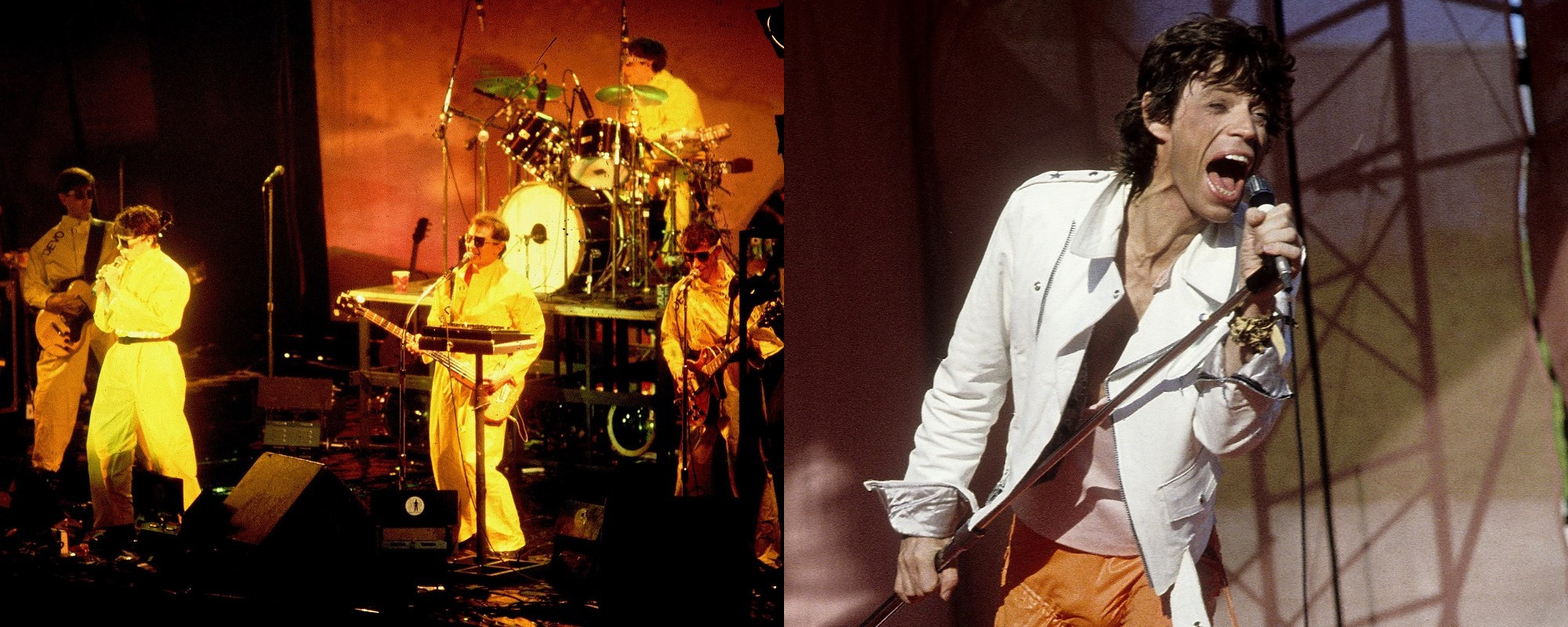
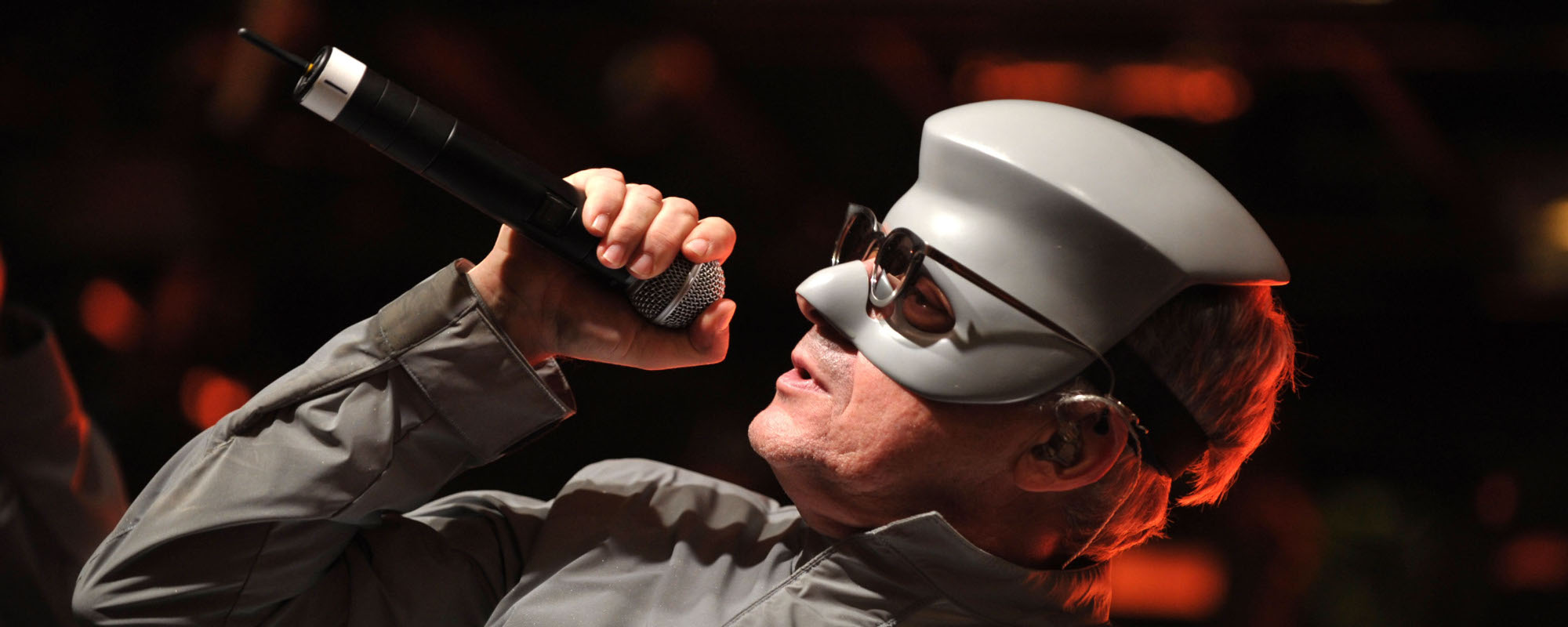
Photo: Mark Mothersbaugh of Devo performs at Shoreline Amphitheatre on October 16, 2025, in Mountain View, California. (Steve Jennings/Getty Images)



Leave a Reply
Only members can comment. Become a member. Already a member? Log in.