
People began calling for September 25 to officially be named Dolly Parton day after the icon’s passing. It’s a clever reference to “9 to 5,” one of her biggest hits. However, many don’t realize that the date also marks the anniversary of her debut on The Porter Wagoner Show.
Wagoner’s was one of the most popular and longest-running country music variety show. It premiered in September 1961. When his “girl singer,” Norma Jean, left the show in 1967, he offered Parton the role. At the time, she was recording for Monument Records and writing songs for Combine Music, where she had already written a top-10 hit for Bill Phillips. She released her debut album, Hello I’m Dolly, on September 18. A week later, Wagoner introduced her to his audience. She performed “Dumb Blonde” and “Something Fishy” during her debut appearance.
Videos by American Songwriter
Note: The clip above shows the date the episode was filmed.
Dolly Parton Finds a New Audience
When she first appeared on The Porter Wagoner Show, Dolly Parton was still relatively unknown. Her biggest hit at the time, “Something Fishy,” had peaked at No. 17 on the country chart on September 5, 1967. So, most of Wagoner’s audience was unfamiliar with her.
Wagoner’s audience, by the way, was huge. At its peak, the program was broadcast in more than 100 markets across the United States. Millions of viewers tuned in every week. As a result, she quickly became a household name. However, many viewers were Norma Jean fans. So, there was some backlash when Wagoner announced the change. Over time, though, his fans became her fans.
Parton didn’t just appear on Wagoner’s TV show. She also joined him on his road show. Additionally, they began recording together. Before they could do that, though, Wagoner had to convince his label, RCA Victor, to sign her. More importantly, he had to convince Fred Foster at Monument to release the up-and-comer from her contract.
The Perfect Day to Celebrate Dolly Parton
No one can say whether or not she would have been as successful without The Porter Wagoner Show. However, there is no denying that she gained nationwide exposure with the role. At the same time, her partnership with Wagoner led to a major-label deal. They also released several hit albums and singles and won multiple ACM and CMA Awards together. Furthermore, Parton wrote “I Will Always Love You” for Wagoner when she finally chose to break away from him and focus solely on her solo career.
So, in short, the anniversary of her debut on The Porter Wagoner Show is the perfect day to celebrate Dolly Parton’s legendary career and shining legacy. Then again, so is every other day.
Featured Image by Michael Ochs Archives/Getty Images
More Did You Know
-
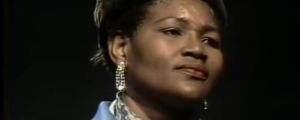
Willie Mae “Big Mama” Thornton performing, Photo by GBH Archives/YouTube -

The Rolling Stones in concert, Tour of Europe '76, Earls Court Arena – Mick Jagger and Keith Richards (Photo by Graham Wiltshire/Shutterstock) -

Rock band: The Rolling Stones: – Mick Jagger, Keith Richards (Photo by Roger Bamber/Shutterstock) -

Singer and songwriterJohn Lennon (1940 – 1980) with his wife Yoko Ono, signing copies of her conceptual art book 'Grapefruit' at Selfridges, London, 15th July 1971. (Photo by Jack Kay/Daily Express/Getty Images) -

Despite its fantastical origin story of surviving a shrapnel attack in the Vietnamese jungle, the D-28 met its demise on a flight to Hawaii. Not only did the turbulent flight damage the instrument in storage; someone later stole the guitar from the luggage carousel. Mitchell was never able to find her long-lost instrument, something she’s lamented for years. Aside from the sentimental connection guitarists typically have to their first ax, Mitchell was particularly fond of her Martin for functional reasons. After a bout of childhood polio affected Mitchell’s ability to form chord shapes in standard tuning, the singer-songwriter had to adapt with eccentric tunings that allowed her to create rich harmonic structure with limited mobility. Whether open, an octave below, or otherwise, Mitchell’s unique tunings placed stress on the guitar neck that it wasn’t originally made to endure. Moreover, to ensure the dissonance within her tunings was purposeful and not merely off-pitch, Mitchell needed a guitar with pristine intonation—something she frequently lauded the D-28 for having. “I need really good intonation,” she explained to Acoustic Guitar. “One of the signs of really good intonation is how flashy the harmonics are with a light touch. You should be able to get them to bloom like jewels.” While Mitchell has found other guitars that come close in that department, as she put it in her 1996 magazine interview, “I’ve never found an acoustic that could compare with it.” Photo by Central Press/Hulton Archive/Getty Images -

Drummer Ringo Starr of English rock band the Beatles during a reception at the London home of the group's manager Brian Epstein, 20th May 1967. The Beatles' song 'A Day In The Life' had recently been banned by the BBC for its references to drug-taking. (Photo by John Pratt/Keystone/Hulton Archive/Getty Images) -
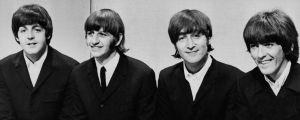
English rock band the Beatles at the BBC television studios in London before leaving for a concert tour of Germany, and afterwards Japan, 16th June 1966. From left to right, they are Paul McCartney, Ringo Starr, John Lennon and George Harrison. (Photo by Central Press/Hulton Archive/Getty Images)