It’s a classic scene we’ve seen played out in Western films for decades: two opposing forces (in this case, the British psychedelic Nirvana and the American grunge Nirvana) facing off with one another, saying something like, “This town ain’t big enough for the two of us.” Cue tumbleweed rolls, squinted eyes, twitching fingers, lawsuit filings, etc.
Except on May 2, 1992, the two bands of the same name decided that there was room for both of them…after a $100,000 payout, that is.
Videos by American Songwriter
Before There Was American Grunge Nirvana, There Was British Psychedelic Nirvana
Nirvana, as in the American rock band, pioneered the burgeoning grunge movement of the Pacific Northwest scene beginning in the late 1980s. They quickly rose to prominence as one of the most famous bands in the world, transcending genres with behemoth hits like “Smells Like Teen Spirit” and “Lithium.” In their short seven years together, the Seattle band became one of the best-selling groups of all time. Their success was so massive and influential that many credit their rise to the fall of hair metal. Despite these impressive accolades, they weren’t the first Nirvana.
That title belongs to Irish musician Patrick Campbell-Lyons and Greek composer Alex Spyropoulos, who formed the psychedelic pop band Nirvana in 1966, beating the West Coast trio by almost two decades—of course, to Nirvana frontman Kurt Cobain’s credit, he wasn’t even born yet. British Nirvana enjoyed modest success in 1968 with their single “Rainbow Chaser,” but the band’s original lineup didn’t last past 1971. However, in 1985, just before the American Nirvana would start to make a name for itself, the British duo reunited for a European tour and the release of a compilation album in 1987, Black Flower.
In 1992, at the peak of American Nirvana’s success, the British band filed a lawsuit for the sole use of the name. “We want our name clean,” Spyropoulos told the Los Angeles Times. “We want to be fair. Nothing against [the other Nirvana]. They’re great. But they’re destroying over 25 years of work we’ve done, and for us, that’s something we can’t take lying down.”
How Much Is A Name Really Worth, Anyway?
Unsurprisingly, the American Nirvana’s lawyers argued against the British Nirvana’s claim of any real damage caused by their Seattle clients. “It’s our position that any rights they had to the name have been long since abandoned,” Nirvana attorney Alan Mintz said, per the Los Angeles Times. “If you look at their history, they had some mild success in the late ‘60s and early ‘70s, and virtually the only records released since then were reissues.” Ultimately, and true to each band’s peaceful name, the two groups were able to reach an agreement that both bands would continue using the name and the American Nirvana would pay the British Nirvana a cool $100,000 (that’s around $228,000 in 2025).
Blending the two bands even further was the British band’s decision to release a tongue-in-cheek album called Nirvana Sings Nirvana in the mid-1990s. However, following the tragic death of Kurt Cobain, the psychedelic group from the U.K. opted to abandon the album. They did release one (American) Nirvana cover, “Lithium.”
Photo by Roger Sargent/Shutterstock
-
CHICAGO, ILLINOIS – American Rock musician David Lee Roth, of the group Van Halen, performs onstage at the Aragon Ballroom, Chicago, Illinois, March 4, 1978. (Photo by Paul Natkin/Getty Images) -
UNSPECIFIED – CIRCA 1970: Photo of Cal Smith Photo by Michael Ochs Archives/Getty Images -
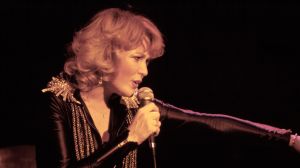
American Country musician Tanya Tucker performs onstage at the Bottom Line, in Greenwich Village, New York, New York, December 13, 1978. (Photo by Gary Gershoff/Getty Images) -
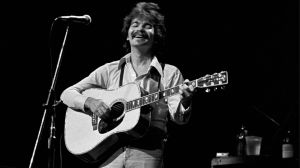
ATLANTA – Singer-songwriter John Prine performs at Atlanta Symphony Halll on April 23, 1975 in Atlanta, Georgia. (Photo by Tom Hill/Getty Images) -
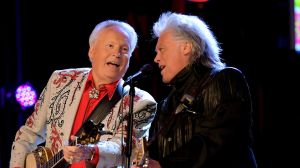
NASHVILLE, TENNESSEE – Buck Trent performs with Marty Stuart and his Fabulous Superlatives at the second of three Marty Stuart Artist-in-Residence Shows at Country Music Hall of Fame and Museum on September 18, 2019 in Nashville, Tennessee. (Photo by Jason Kempin/Getty Images for Country Music Hall of Fame and Museum)