One of the benefits of fame is access to an international platform that allows you to be taken seriously by the general public. One of the downsides of fame is access to an international platform that allows you to be taken seriously by the general public, even when it seems glaringly obvious that you were just kidding. Such was the case for The Beatles, who spent their short tenure as a band debunking a rumor that they started themselves.
Okay, technically, it was John Lennon.
Videos by American Songwriter
John Lennon Came Up With a Fantastical Origin Story
Part of The Beatles’ charm, especially in their early days, was the fact that they were quick to poke fun at themselves before anyone else. They were some of the world’s biggest rockstars of the day. But they would undercut this staggering success with self-deprecating jokes, Monty Python-esque bits about other bandmates, and fantastical stories that avoided pretension by making their origin stories sound more ludicrous than lucky. Take, for example, the story John Lennon came up with to explain why The Beatles called themselves The Beatles in The Mersey Beat.
Recounted in Anthology, the story is as follows: “Once upon a time, there were three little boys called John, George, and Paul, by name christened. They decided to get together because they were the getting-together type. When they were together, they all wondered what for after all, what for? So, all of a sudden, they grew guitars and formed a noise. Funnily enough, no one was interested.”
Lennon continued the story in this same style. He referenced the addition of Stuart Sutcliffe and their transition from acoustic to electric guitars. He then concluded, “Ugh, Beatles, how did the name arrive? So, we will tell you. It came in a vision. A man appeared on a flaming pie and said unto them, ‘From this day on, you are Beatles with an A.’ ‘Thank you, Mister Man,’ they said, thanking him.”
People Took This Beatles Bluff Seriously for Years
Years after The Beatles disbanded, Paul McCartney discussed the “studenty, humorous” paper that his former bandmate, John Lennon, wrote about their band’s origins in their local music magazine. “We always knew it was a joke,” McCartney said. “And that wasn’t the real answer. When we came to do the Anthology, one or two people said, ‘No, no, John had a vision.’ We said, ‘No, no, that was like a joke, you know.’ It became a joke amongst us about the fact that flaming pie could be taken seriously. This man on a flaming pie.”
“We kept trying to explain, ‘No, no. This is British humor. You know, flaming chariot or phoenix, yeah. But pie? No.’ It just became a bit of a joke,” McCartney said with a smile. “But we let it pass in the Anthology, and it was just a bit of fun.”
In reality, The Beatles landed on their name by taking a cue from Buddy Holly’s backing band, The Crickets. “I was looking for a name like The Crickets that meant two things,” John Lennon recalled in Anthology. “I changed the BEA because ‘beetles’ didn’t mean two things on its own. When you said it, people thought of crawly things. When you read it, it was beat music.”
But as is so often the case when it comes to creative interpretation, sometimes the untrue stories that come out of band names, song meanings, and album titles are better than the original. At least, we’d have to assume the man on the flaming pie thinks so.
(Photo by Keystone-France/Gamma-Keystone via Getty Images)
More Features
-
Meat Loaf Backstage at the Manchester Apollo, England 1981 (Sony Music Archive via Getty Images/Terry Lott) -
UNSPECIFIED – JANUARY 01: Photo of Kitty WELLS (Photo by David Redfern/Redferns) -
Boston, MA – August 28: Billy Idol performs live in concert at the Paradise Theater in 1982. The venue is now known as the Paradise Rock Club. (Photo by Jim Wilson/The Boston Globe via Getty Images) -
Tears for Fears – Koninklijk Circus – Brussel – Belgium – 21/04/1985 Roland Orzabal, Curt Smith Photo gie Knaeps -
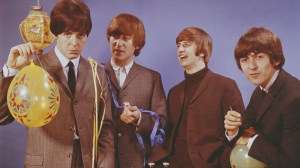
UNITED KINGDOM – 1st OCTOBER: The Beatles posed with bottles of beer and party snacks and balloons in October 1964. Left to right: Paul McCartney, John Lennon (1940-1980), Ringo Starr and George Harrison (1943-2001). The session was taken to promote the BBC World Service. (Photo by Mark Hayward Archive/Redferns) -

Alanis Morissette, Torhout/Werchter Festival, Werchter, Belgium, 7th July 1996. (Photo by Gie Knaeps/Getty Images) -
Photo by Ivan Keeman/Redferns