
“Woke up, got out of bed…”
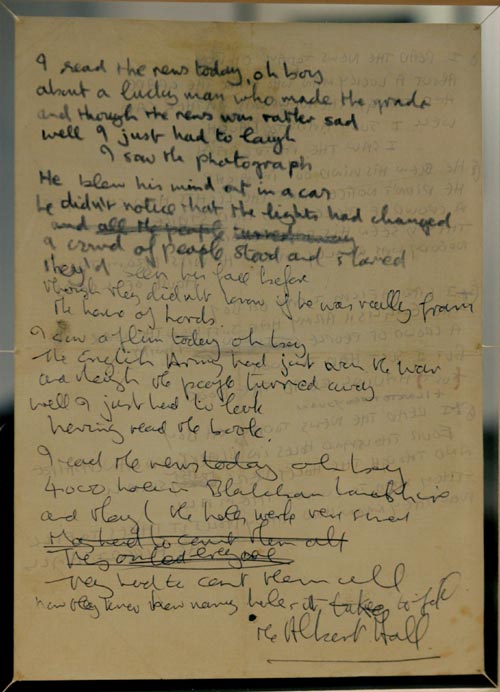
Album: Sgt. Pepper’s Lonely Hearts Club Band (1967)
Composer: Lennon/McCartney
For those of you expecting “The End,” “When I’m Sixty-Four,” “The Long and Winding Road,” or “Why Don’t We Do It In the Road,” we sincerely apologize. “A Day in the Life” closes out our Beatles countdown, and for good reason. In Mikal Gilmore’s “Night Beat: A Shadow History of Rock and Roll,” he calls it “the loveliest-sounding song about alienation that pop had ever yielded.” Indeed, it seems the saddest songs are often the sweetest.
With an arrangement and story that follow the Beatles’ habit of conflating the ups and downs of the everyman with the unique, intimate moments we all meet, “A Day In the Life” simultaneously ties up loose ends and asks unanswered questions. Like any good rock song, it makes us laugh and cry, forget and remember.
The lyrics read variously like the works of an unexcitable journalist, a simple folk singer, and a transcendental philosopher. John explained the inspiration for three of the song’s four verses: “I was writing “A Day in the Life” with the Daily Mail propped in front of me on the piano.” The most notable of his borrowed headlines plays out in the first verse, which references the accidental death of Guinness heir, Tara Browne. While Lennon confirmed using Browne’s wreck as a model, Paul insists that some lines, including “he blew his mind out” and “I’d love to turn you on,” were “purely a drugs reference.”
Meanwhile, Paul had been sitting on a little piano ditty for quite some time and used it to fill in the third verse. His seemingly petty reflection on daily routines contrasts sharply with John’s devastating daily news, but the general melancholic mood pervades the track. Through all its detached nostalgia, “A Day in the Life” seems to echo Thoreau’s maxim, “The mass of men lead lives of quiet desperation.”
Producer George Martin is largely responsible for the dissonant orchestral crescendos that punctuate the verses. In discombobulating listeners, these interludes help separate Paul’s poppy piano piece from Lennon’s more mellow work. Further contributing to this technically simple song’s illusion of disarray are Ringo’s cymbals, which musicologist Alan Pollack says “challenge your sense of meter.” Though some looped chattering lingers at the very end of the track, the song is known to end with an over-amplified piano chord, played in unison by at least three of the Beatles (production assistant Mal Evans may have taken George’s spot).
Gilmore describes the essential conclusion of the song: “As that chord lingered and then faded, it bound up an entire culture in its mysteries, its implications, its sense of power and hope.” A fitting end to Sgt. Pepper, a fitting end to our countdown, and what Gilmore called “the last gesture of genuine unity that we would ever hear from the Beatles,” “A Day in the Life” casually captivates us, perhaps confuses us, but then leaves us with a definitive, if unsettled, bang.
More The List
-
UNITED KINGDOM – JANUARY 01: Photo of Pete SEEGER; Pete Seeger performing on stage at a Paul Robeson benefit concert (Photo by Brian Shuel/Redferns) -
UNSPECIFIED – CIRCA 1970: Photo of Diana Ross Photo by Michael Ochs Archives/Getty Images -
The British singer Kate Bush poses for a photo shoot. Great Britain, 1980 (Photo by Angelo DeligioMondadori via Getty Images) -
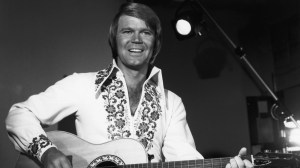
Photo via NBC/Getty Images -
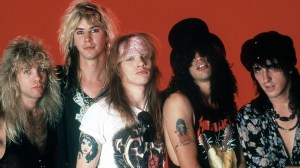
DETROIT, MI – MAY 7: (L-R) Drummer Steven Adler, Duff McKagan, vocals Axl Rose, guitarist Slash and guitarist Izzy Stradlin of the music group Guns N' Roses pose for a portrait on May 7, 1988, at the Detroit State Theater in Detroit, Michigan. (Photo by Ross Marino/Getty Images) -
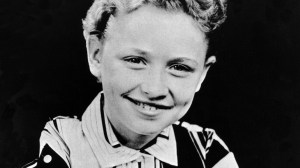
TENNESSEE – CIRCA 1955: Country singer Dolly Parton poses for a portrait in circa 1955 in Tennessee. (Photo by Michael Ochs Archives/Getty Images) -
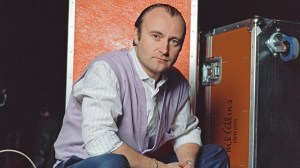
Phil Collins seen here following rehearsals in a London studio for his forthcoming Seriously tour, which begins in Japan. 14th February 1990 (Photo by Steve Woods/Mirrorpix via Getty Images) -
(L-R) Joe Walsh, Timothy B. Schmit, Glenn Frey, Don Henley and Don Felder of the rock band "Eagles" performing onstage in 1980. (Photo by Michael Ochs Archives/Getty Images)