
The first country music hit is often traced to Vernon Dalhart’s “Wreck Of The Old 97” from 1924. The first country music hit by a female artist wouldn’t come about until three decades later, in 1952. And in those thirty-ish years of men dominating the charts with songs about the woes of women, women certainly came up with a lot to say in response. Starting with Kitty Wells, country music began shifting toward a female perspective in the early 1950s to the late 1960s.
Here are some of the best songs to come out of this stylistic shift.
Videos by American Songwriter
“It Wasn’t God Who Made Honky Tonk Angels” by Kitty Wells
Kitty Wells released “It Wasn’t God Who Made Honky Tonk Angels” in June 1952. The song was a direct response to Hank Thompson’s “The Wild Side Of Life”. Thompson’s was one of many country songs lamenting over untrustworthy women. Wells’ retort perked up women’s ears everywhere. Indeed, they were tired of being the scapegoats for all of men’s problems. And this early 1950s country song helped back them up well into the 60s.
“It’s a shame that all the blame is on us women / It’s not true that only you men feel the same / From the start most every heart that’s ever broken / Was because there always was a man to blame.”
“Don’t Come Home A-Drinkin’ (With Lovin’ On Your Mind)” by Loretta Lynn
The conservative Christian values pervasive in 1950s and 60s country music paint heteronormative pictures of domesticity between a man and a woman. In those scenarios, the latter is subservient to the former. But Loretta Lynn’s first No. 1 hit, “Don’t Come Home A-Drinkin’ (With Lovin’ On Your Mind)” challenged this expectation of submission. Why should the husband get to pick and choose when he wants to treat his wife like his wife?
“You never take me anywhere because you’re always gone / Many a-night I’ve laid awake and cried here all alone / Then you come in a kissin’ on me, it happens every time / Don’t come home a-drinkin’ with lovin’ on your mind.”
“Second Fiddle (To An Old Guitar)” by Jean Shepard
Jean Shepard released “Second Fiddle (To An Old Guitar)” in April 1964. Unlike other scorned-woman songs about another woman, this 1960s country tune’s antagonist was an inanimate object. The narrator is tired of the husband spending so much of his time playing guitar, especially since it hasn’t resulted in any of the “money and lots of fun” the narrator was promised when he first bought it.
“You gaze at that guitar on your knee / in a way that you never look at me / This love affair of yours has gone too far / and I’m tired of playin’ second fiddle to an old guitar.”
“Harper Valley P.T.A.” by Jeannie C. Riley
Finally, Jeannie C. Riley’s 1968 one-hit wonder, “Harper Valley P.T.A.”, was unique in that it held no punches, not even for the women. This scathing rebuttal to small-town gossip calls out men and women for their hypocritical behavior. It also denounces people who judge women for the clothes they wear or the people they date.
“Well, there’s Bobby Taylor sittin’ there, and seven times he’s asked me for a date / and Mrs. Taylor sure seems to use a lotta ice whenever he’s away / and Mr. Baker, can you tell us why your secretary had to leave this town? / And shouldn’t Widow Jones be told to keep her window shades all pulled completely down?”
Photo by Michael Ochs Archives/Getty Images
More The List
-
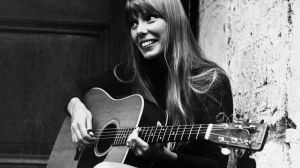
(Original Caption) A singer called Joni. Joni Mitchell, Canadian singer-songwriter, United Kingdom, 1968. The guitar-pickin' gal is Joni Mitchell, a long blonde haired Canadian folk singer. Pictured last night outside the Revolution club, Joni is here (until 1st October) for radio, television and concert appearances. Apart from concert appearances, 25 year old Joni will be heard on "Top Gear" on Radio One and "The Monday Show" on BBC 1. (Photo by © Hulton-Deutsch Collection/CORBIS/Corbis via Getty Images) -
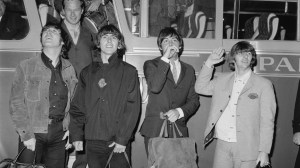
English rock band the Beatles arrive at London Airport from the USA, with their manager Brian Epstein (1934 – 1967, in coach doorway), 2nd September 1965. From left to right, John Lennon (1940 – 1980), George Harrison (1943 – 2001), Paul McCartney and Ringo Starr. (Photo by George Stroud/Express/Hulton Archive/Getty Images) -
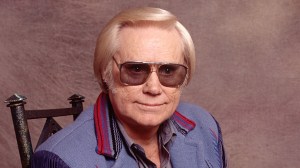
George Jones, who released several country songs about whiskey -
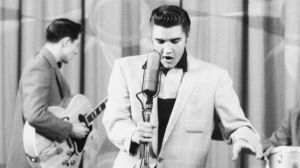
Elvis Presley and Scotty Moore (left) performing on The Milton Berle Show at NBC's Hollywood studio, Los Angeles, California, 5th June 1956. Presley performed 'I Want You, I Need You, I Love You' and 'Hound Dog'. Press reaction to his performance was largely negative with his gyrating movements during 'Hound Dog' proving particularly controversial. (Photo by Bettmann Archive/Getty Images) -
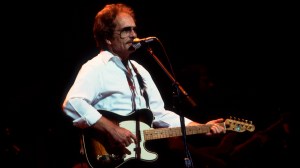
Singer and musician Merle Haggard performs at the Poplar Creek Music Theater, Hoffman Estates, Illinois, August 16, 1983. (Photo by Paul Natkin/Getty Images) -
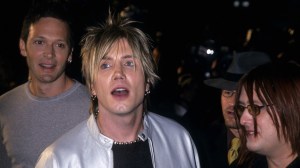
John Rzeznik of Goo Goo Dolls at event, New York, 1990s. (Photo by Steve Eichner/Getty Images) -
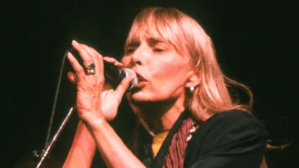
Photo by Michael Putland/Getty Images -
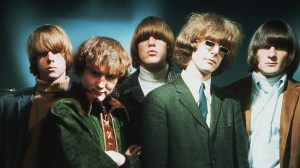
Pop group The Byrds (l to r): Chris Hillman; Dave Crosby; Mike Clark; Jim McGuinn; and Gene Clark. (Photo by © Hulton-Deutsch Collection/CORBIS/Corbis via Getty Images)