
Free from the demands of being The Beatles, the four men who comprised the group took on all sorts of projects following their breakup. That included shepherding the careers of other artists via their Apple Records label.
Although they didn’t deliver hands-on help to many of the bands they had in their employ, they did pay special, if sporadic, attention to Badfinger. In fact, George Harrison sat in the producer’s chair (for a while, anyway) on the group’s best album.
Videos by American Songwriter
A Slow Badfinger Build
When The Beatles signed Badfinger to Apple, they took on a group that held some striking similarities to themselves. Badfinger boasted three talented writer-singers. They also played melodic rock not unlike what the Fab Four favored. Considering some of the members came from Liverpudlian backgrounds, they even sounded like them from a vocal standpoint.
The Beatles didn’t always do right by Badfinger. (You can argue that nobody did that consistently for the star-crossed group.) But when they did offer them some help, the group took advantage. For example, Paul McCartney gift-wrapped “Come And Get It” for them as their first big hit single.
Badfinger’s 1970 album No Dice included the hit “No Matter What”, a song that helped establish their power-popping style. Their next album featured George Harrison as producer. He only took that job, however, as a fallback plan.
George to the Rescue
Geoff Emerick, a longtime Beatles engineer, had co-produced No Dice and was also hired to do the follow-up album. But after the band laid down an album’s worth of material in early 1971, the label rejected it and fired Emerick. That’s when Harrison was called in as a kind of relief pitcher.
Harrison knew the band well, as a couple of members of Badfinger appeared on his solo smash All Things Must Pass. He joined Badfinger in the studio, where they worked on re-recording some of the songs from the earlier sessions while also tackling some new tracks. Among the new songs was one written by Pete Ham called “Day After Day”.
Harrison went beyond his duties as the producer when that song was being recorded, as he added his inimitably weeping slide guitar to the track. “Day After Day” served as an excellent foundation on which to build the record. Unfortunately, Harrison couldn’t stick around to see the entire LP through before he had to tend to another commitment.
Rundgren to the Rescue
Harrison took off from the sessions with Badfinger to organize The Concert for Bangladesh. Enter Todd Rundgren, who stepped in to produce the rest of the album. Among the songs that came from this association was another gem from Ham called “Baby Blue”.
Despite the disjointed process, the album that would be titled Straight Up upon its release in 1971 showed Badfinger at their absolute best. Aside from Ham’s two hits, fellow group members Tom Evans and Joey Molland also rose to the occasion with outstanding numbers. It appeared that the group was about to go on a stellar run.
Unfortunately, Badfinger never recaptured the magic of that record. Tragedy ensued in the coming years with the suicide deaths of both Ham and Evans. But no one can take away the brilliance of Straight Up, the album where a pair of star musicians with production capabilities helped them realize their potential.
(Photo by Michael Putland/Getty Images)
More Features
-
(L-R) Joe Walsh, Timothy B. Schmit, Glenn Frey, Don Henley and Don Felder of the rock band "Eagles" performing onstage in 1980. (Photo by Michael Ochs Archives/Getty Images) -
LOS ANGELES – CIRCA 1974: Singer Patti Labelle performs onstage with her group LaBelle in circa 1974 in Los Angeles, California. Also in the group were former Bluebelles, Sarah Dash and Nona Hendryx. (Photo by Michael Ochs Archives/Getty Images) -
Photo by Rick Diamond/WireImage for BMI Nashville -
IN CONCERT – From London – Shoot Date: June 13, 1974. (Photo by ABC Photo Archives/ABC via Getty Images) BLUE SWEDE -
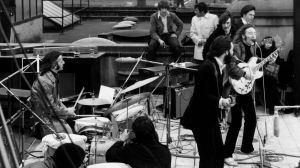
30th January 1969: British rock group the Beatles performing their last live public concert on the rooftop of the Apple Organization building for director Michael Lindsey-Hogg's film documentary, 'Let It Be,' on Savile Row, London, England. Drummer Ringo Starr sits behind his kit. Singer/songwriters Paul McCartney and John Lennon perform at their microphones, and guitarist George Harrison (1943 – 2001) stands behind them. Lennon's wife Yoko Ono sits at right. (Photo by Express/Express/Getty Images) -
MELBOURNE, AUSTRALIA – Keith Urban performs during "The Songs Of John Farnham, The Celebration Concert" at Rod Laver Arena on September 20, 2026 in Melbourne, Australia. (Photo by Graham Denholm/Getty Images) -
3rd September 1968: American psychedelic rock band, The Doors during a press conference at Heathrow Airport, London (left to right); drummer John Densmore, keyboard player Ray Mansarek, vocalist Jim Morrison (1943 – 1971) and guitarist Robby Krieger. (Photo by Central Press/Getty Images) -
Australian-American singer, songwriter, author, actress, and activist Helen Reddy (1941 – 2020), 1975. (Photo by Tony Russell/Redferns)