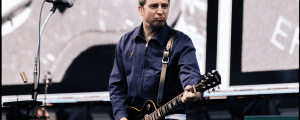
When it comes to rock guitar, Jimmy Page is undoubtedly one of its most influential players. From his time with the Yardbirds to his legendary run with Led Zeppelin, Page created a foundation that many players have built themselves upon. Known for his blistering solos, swinging riffs, and innovative recording methods, Jimmy Page was also a master of tone. Let’s pull out our violin bows, crank up our amps, and lower our guitar straps and see if we can break down his iconic sound.
The Electric Guitars
Throughout his career with Led Zeppelin, Jimmy Page used quite a few Electric guitars. A session guitarist since the early 60s, Page used whatever guitar would serve the song best. Let’s take a look at a few of the iconic instruments he used to shape the sound of Led Zeppelin.
Videos by American Songwriter
Fender Telecaster
Primarily associated with Gibson guitars, Jimmy Page used a Fender Telecaster in the earliest days of Led Zeppelin. A holdover from his time in The Yardbirds, this was the guitar used during their earliest shows and on their debut album, Led Zeppelin. Of all the options on the market, the Vintera III mid-60s Telecaster and Jimmy Page Signature Telecaster are the most obvious winners.
Page’s Telecaster was a 1959 model; it had an ash body and maple neck with a rosewood fingerboard. The Vintera III mid-60s Telecaster delivers both of these key features at a reasonable price point. In addition to these specs, it also features vintage-correct pickups and neck dimensions, giving it an authentic sound and feel.
If you really want to nail it, the Fender Jimmy Page Signature Telecaster will get you the closest. Based on the actual Telecaster he used during this period, this guitar features specially voiced pickups and neck dimensions taken from the exact guitar. In addition, this guitar also bears the same psychedelic appearance he had.
Gibson Les Paul
The guitar Jimmy Page was most associated with; this was his main guitar for most of the band’s discography, starting with Led Zeppelin II. A 1959 model, he purchased his iconic sunburst Les Paul from Joe Walsh in April 1969. Chasing a thicker sound, the change was immediate. This is the guitar featured on iconic songs like “Whole Lotta Love”, “Heartbreaker”, “Black Dog”, “Immigrant Song”, etc. When you imagine Led Zeppelin, this guitar is the sound.
Good options for Les Pauls would be either the Gibson Standard series or the Epiphone Inspired by Gibson Custom. Made in the USA, the Standard series is offered in 50s and 60s variants. The 50s version has Burstbucker 1 & 2 pickups, a large neck profile, and classic tuners. The 60s version features 61 Burstbucker pickups, a slimmer neck, and Grover Rotomatic tuners. You can’t go wrong with either! In my experience, the 60s is better suited for Zeppelin-esque material. The 61 Burstbuckers give it a punchier sound, and the slim neck is better suited for those blistering Page solos.
The Epiphone Inspired by Gibson Custom Shop series is Chinese-made but delivers Custom Shop specs. Featuring both 1959 and 1960 models, the biggest difference between the two is the neck profile and cosmetics. The 1959 neck will be larger, the 1960 will be slim, and they will have slightly different knobs and tuners. Electronically, they are both the same. They feature Gibson Custombucker pickups, Luxe Bumblebee capacitors, and high-quality pots, switches, and jacks. If you’re chasing the tone, these guitars are my personal favorite on the market. They sound like the records; they feel great to play, and they are super affordable for what they are. Take it from me, I own three guitars from this series. They are the real deal.
Danelectro 3021 DC-2 Shorthorn
Used quite a bit by Page; his Danelectro was primarily for songs with alternate tunings. Some of the most iconic performances with this guitar were “White Summer/Black Mountain Side”, “Kashmir”, “When the Levee Breaks”, and “In My Time of Dying”. Still made today, the best option on the market is the Danelectro Stock 59. This instrument is based on the same model he used and features the same pickups, control layout, and look.
Gibson EDS-1275 Double Neck
Is it the most practical guitar to carry around? Absolutely not. However, I’m pretty sure it would be a crime not to mention his iconic double-neck guitar. The EDS-1275 was primarily a live show guitar for Page. Usually featuring multiple overdubbed guitar parts on their recordings, the EDS-1275 allowed him to bring those songs to life on stage by giving him a 6- and 12-string neck to jump between seamlessly. Iconic songs featuring this guitar were “The Song Remains the Same”, “Tangerine”, “The Rain Song”, and, of course, “Stairway to Heaven”.
Options on the market are slim for an EDS-1275. However, if you must have one, the best route is to search for an Epiphone. Unfortunately, at this time, the Epiphone version is discontinued; you’ll have to search the used market. For Gibson, the Custom Shop is your only option and will require a small bank loan.
The Acoustic Guitars
Although he’s primarily known as an electric player, Jimmy Page was also a spectacular acoustic player. A session guitarist for many years, Page’s acoustic playing was dynamic, precise, and the star of many iconic Zeppelin tracks. Let’s pull the plug and see what we need to capture the softer side of Page.
Harmony H1260 Soverign
If you’re going to get one acoustic for the Page sound, this is the one to get. Made in Chicago from 1959 to 1971, the H1260 was Harmony’s flagship acoustic guitar. This guitar was his primary songwriting tool for the first 4 Led Zeppelin albums and found its way onto iconic tracks like “Over The Hills And Far Away”, “Going To California”, and “Stairway To Heaven”.
No longer being made, you will have to buy a genuine vintage model on the used market. Don’t worry, unlike most vintage guitars, these are still very affordable. In fact, I would argue they are the last great deal on the vintage guitar market. They’re American-made, use solid old-growth wood, and are quite common to find. Just make sure you budget for a neck reset; if you find one, it’s going to need it!
Martin D-28
When Jimmy Page wasn’t using the Harmony, he was using a Martin D-28. Featuring a spruce top and rosewood back and sides, the D-28 delivers a rich and clear sound. Because of this, a lot of the songs he recorded with the Harmony were performed live with the D-28. He did use it in the studio sometimes, most famously on “The Rain Song”.
Still being made today, the current production Martin D-28 will do the job.
Gibson SJ-200
Primarily used in the studio, the SJ-200 was another Page favorite. Known for its large, balanced sound, the SJ-200 was used as the main acoustic on the first album. If you’re chasing the sound of songs like “Babe I’m Gonna Leave You”, “Your Times Gonna Come”, or “Black Mountain Side”, this is the acoustic you need.
For an SJ-200, my favorite option is the Epiphone 1957 SJ-200 reissue. Featuring all-solid-wood construction, an onboard LR Baggs pickup, and classic Gibson looks, this one is hard to beat.
Amplifiers
Throughout his career, Jimmy Page used many different kinds of amps. From Fender and VOX with The Yardbirds, to Hiwatt and Orange, he was constantly changing things up. However, when it comes to the Led Zeppelin sound, two reign supreme. Those amps are Marshall and Supro.
Supro 1690T
On the debut album, Jimmy Page used a small Supro combo amp to get his iconic sound. A modified Coronado model, this amp featured a 12-inch speaker and a few alterations to the circuit. These changes and the swapped speaker gave the small amp a big and aggressive sound. This amp is the sound of Led Zeppelin’s first album.
For this, I would recommend the Supro 1696RT Black Magick Reverb combo. Designed to emulate his legendary amplifier, this gives you the sounds and specs without any modifications. Just open the box, plug it in, and rock out!
Marshall Super Lead and Super Bass
The amps primarily associated with Jimmy Page, the Marshall Super Lead and Super Bass delivered the bulk of his iconic sound. Beginning on the second album, Led Zeppelin II, Page’s sunburst Les Paul and those Marshall amps created the core guitar sound for Led Zeppelin. It was punchy, it was loud, and it was loaded with dynamics.
If you want to go all out, you can still buy a handwired 100-watt Super Lead Marshall. However, for practicality, I would go with the Marshall SV20H Studio Vintage Head. The SV20H knocks the power down from 100 watts to a more reasonable 20. It features all of the classic controls of the original; it has the looks, and it has extra features like an FX loop and DI out. The series also has a couple of matching cabinet options as well as a 1×10 combo offering.
The power reduction circuit adds another layer of versatility. This feature allows you to take the wattage down from 20 watts to a very friendly 5 watts. This gives you the ability to turn the amp up and achieve those legendary overdrive tones without the deafening volume.
Effect Pedals
Getting the bulk of his sound from his guitar and amp, Page used effect pedals to further color his sound. From sustaining leads to psychedelic textures, here are some options to tie it all together.
Vox Wah
Since his time in The Yardbirds, Jimmy Page used wah often. Based on photographs, his main wah of choice was the classic VOX. Using it both as a filter for leads and as a texture for rhythm playing, his use of a wah pedal can be found on classics like “Whole Lotta Love”, “No Quarter”, “How Many More Times”, and “Dazed and Confused”.
My recommendation for this effect is the V847-A Classic Reissue wah from VOX. There are many options out there. However, I find the VOX nails that classic 60s and 70s wah sound at a great price.
Tonebender Fuzz
Used primarily on the first two albums, this pedal is great for adding grit and sustain. When combined with a Telecaster or Les Paul, a good Tonebender will help you nail down songs like “Communication Breakdown”, “How Many More Times”, and “You Shook Me”.
For a Tonebender, my favorite one on the market is the Fulltone Soul-Bender. This pedal gives you the sound of an MK III Tonebender, just like Page used, and puts it in a more compact pedal.
Echoplex Tape Echo
From fattening up leads to creating otherworldly soundscapes, the Echoplex was another Page favorite. Jimmy Page loved the way the preamp colored his sound and would leave it on all the time live. When engaging the echo effect, he would use it subtly for solo and rhythm work or to the extreme when improvising on longer songs. This is when the iconic violin bow would come out. Iconic songs that feature this are “Whole Lotta Love”, “Rock And Roll”, “No Quarter”, and “What Is And What Should Never Be”.
For this effect, my favorites on the market are the Dunlop Echoplex Delay and the Catlinbread Belle Epoch. I find both of these effects replicate the iconic sound of these tape echoes without the large footprint, finicky tape, and high cost of the originals.
Closing Thoughts
Always chasing new sounds, Jimmy Page used whatever would fit the song the best. Whether he was using his iconic Les Paul or an affordable Harmony Sovereign, Page’s remarkable playing was the true source of the magic. There may only be one Jimmy Page, but if you follow this guide, I guarantee you will be one step closer to capturing his iconic sounds.
(Photo by Robert Knight Archive/Redferns)
![The Best Acoustic Guitars [2026, All Budgets]](https://americansongwriter.com/wp-content/uploads/sites/7/2024/03/best-acoustic-guitars-2026.png?w=300)