On this day (July 29), Randy Travis released “On the Other Hand” as the lead single from his debut album, Storms of Life. The song missed the top 40 of the Billboard Hot Country Songs chart upon its initial release. Then, a year later, it topped the chart, becoming his first No. 1.
Written by Paul Overstreet and Don Schlitz, “On the Other Hand” was the lead single from Travis’ debut album, Storms of Life. It eventually became his first No. 1 hit and a highlight from the smash hit album. However, much like the artist, the single had to fail before it could rise to the top.
Videos by American Songwriter
Travis released two previous singles under his birth name, Randy Traywick, in 1978. “She’s My Woman” peaked at No. 91, and “I’ll Take Any Willing Woman” failed to chart. Behind the scenes, he was working hard to break into the music industry while holding down regular jobs. He was washing dishes and performing at a nightclub called the Nashville Palace in 1982 when he started to gain traction. Then, in 1985, he inked a deal with Warner Nashville. However, it would be another year before his star began to rise in Nashville.
Randy Travis Finds His First No. 1 with “On the Other Hand
“On the Other Hand” peaked at No. 67 on the Hot Country Songs chart. In December, he followed it with “1982,” which peaked at No. 6 on the chart, giving Travis his first top 10 hit. At the time, the label didn’t believe that the up-and-comer had any material that was suitable for the radio. As a result, they chose to release “On the Other Hand” again.
Warner Nashville released “On the Other Hand” for the second time on April 21, 1986. Then, on July 26, 1986, more than a year after its first release, the song became Travis’ first No. 1. It started a long run of hits that stretched through the 1990s. He released 35 top 40 country hits between 1985 and 1999. Sixteen of those singles went to the top of the chart.
Featured Image by Beth Gwinn/Redferns
-

CIRCA 1972: Country singer Dolly Parton poses for a portrait in circa 1972. (Photo by Michael Ochs Archives/Getty Images) -
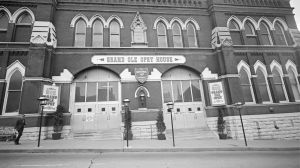
Since 1925, Ryman Auditorium has been the "home" of the Grand Ole Opry and the national headquarters of foot-stomping, tear-jerking country music. By the spring of 1972, the red brick walls and stained glass windows will cease to echo the sounds of western music. At that time, not too far away, will be the new Opry House, surrounded by a series of specialty shops, restaurants, a motel and rides for the kids. -

The Texas Playboys, backup band for the late Bob Wills pose for a Capitol Records publicity still circa 1975. (Photo by Michael Ochs Archives/Getty Images)