In the early 1950s, a new style of music began to emerge. Known as “rockabilly,” artists blended twangy bluegrass notes with elements of rhythm and blues music. One of the genre’s earliest stars, Sanford Clark, died on this day (July 4) in 2021 at Mercy Hospital in Joplin, Missouri, at age 85. Scoring a top 10 hit with 1956’s “The Fool”, Clark left an impression on future stars like Elvis Presley and Rolling Stones guitarist Keith Richards. Today, we’re celebrating his life and career on the fifth anniversary of his death.
Who Was Sanford Clark?
Born October 24, 1935, in Tulsa, Oklahoma, Sanford Clark grew up mostly in Phoenix, Arizona, where he first began performing in the early ’50s.
Videos by American Songwriter
Influenced by both early rock and country music, Clark formed a band during his time in the South Pacific with the U.S. Air Force. That band won a talent show in Hawaii.
After returning to Phoenix, Clark reunited with friend Al Casey, the late Rockabilly Hall of Fame guitarist. Casey introduced him to country-pop singer Lee Hazelwood, who was working as a DJ in Phoenix at the time.
In 1956, Casey backed up Clark on guitar as he recorded Hazelwood’s song “The Fool”—which he co-wrote with Naomi Ford—at Floyd Ramsey’s Audio Recorders studio on MCI Records.
At first, the song saw little movement. Then it caught the attention of a Philadelphia DJ, who brought it to Randy Wood, owner of Dot Records.
Wood,too, liked what he heard. And after Dot Records picked up “The Fool”, it skyrocketed to number 14 on the country singles chart, number five on the R&B Singles chart, and number seven on the all-genre Top 100.
The song’s success led to Clark and Casey opening for the likes of Ray Price and Roy Orbison.
Elvis Presley would later record “The Fool” twice—the first time as part of his personal recordings while he was serving in the Army. In the ’70s, he cut the song professionally.
“You can hear that he’s trying to emulate Sanford’s sound,” Johnny Vallis, Clark’s publicist, told the Associated Press after the singer’s death. “You know, most people I know want to impersonate Elvis, and here Elvis was trying to impersonate him.”
Clark Eventually Left the Music Business Behind
Sanford Clark’s follow-up single, “The Cheat”, performed more modestly on the charts, reaching number 74 on the pop listings.
However, he and Randy Wood could not agree on the singer’s image, with Wood wanting Clark to virtually imitate Pat Boone. So Clark left Dot for Jamie Records, where he continued his work with Lee Hazelwood.
[RELATED: Meet the Eclectic Writer Behind Nancy Sinatra’s “These Boots Are Made for Walkin’”]
Sanford Clark never again matched the success of “The Fool”, which he re-recorded in 1965 with Waylon Jennings on guitar. He eventually left the music business altogether for a career in construction.
Still, Sanford Clark’s musical influence lingers today. In his 2010 book Life, Keith Richard revealed that Clark’s 1959 track “Son of a Gun” was one of the first songs he learned and performed onstage prior to forming the Rolling Stones.
Featured image by Johnny Franklin/andmorebears/Getty Images
-
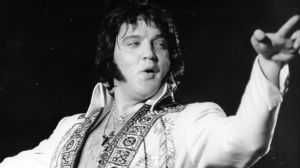
UNSPECIFIED – CIRCA 1977: Elvis Presley in concert circa 1977. (Photo by R.D/Images Press/Getty Images) -
LONDON, ENGLAND – Jamaican-British singer Marcia Barrett, of the German vocal group Boney M., sings during a concert in London, England, December 1, 1978. (Photo by Soxphotos/Getty Images) -
LONDON, ENGLAND – Cliff Richard performs onstage during a concert at Royal Albert Hall on December 08, 2025 in London, England. (Photo by Jo Hale/Redferns) -

LOS ANGELES, CALIFORNIA – Natalie Maines of The Chicks at The Chicks concert held at Yaamava' Theater on June 12, 2026 in Los Angeles, California. (Photo by Katie Flores/Billboard via Getty Images)