
Picture it: it’s the week of September 9, 1965, and you open up your copy of Daily Variety or Hollywood Reporter and see a soon-to-be historic ad for a new musical project requiring “four insane boys age 17 to 21.”
Assuming you fit the requirements, do you respond? After all, 400 young men certainly thought it was worth it to try.
Videos by American Songwriter
A Historical Musical Ad Ran This Week in 1965
In early September 1965, both Daily Variety and Hollywood Reporter ran an ad that read: “MADNESS!! AUDITIONS Folk & Roll Musicians-Singers for acting roles in new TV series. Running parts for 4 insane boys, age 17-21. Want spirited Ben Frank’s types. Have courage to work. Must come down for interview.”
Over 400 men responded to the somewhat vague advertisement calling for hip-looking young guys with “courage to work.” This swarm of hopeful performers descended upon the offices of Bob Rafelson and Bert Schneider. Shortly after that, NBC gave the producers the greenlight for the program they were auditioning young Californians for: a television show following the lives of a fictional band called The Monkees.
Rafelson and Schneider were looking to recreate the buzz around Beatles films like “A Hard Day’s Night” that feature a band playing music and being regular, goofy, relatable guys when they’re off-stage. The starring men needed to be undiscovered to keep up the façade of being a real band and not a group of actors. They had to be unattractive enough to seem believable but attractive enough for television.
Simply put, there was a narrow margin for someone to be the “perfect” candidate for the upcoming show. More seasoned musicians were turned away because of their built-in ubiquity. Other artists, like Stephen Stills, were rejected because they didn’t have the right look. (For the future folk-rock icon, it was his hair and teeth that kept him from landing the gig.)
Ultimately, producers chose Micky Dolenz, Davy Jones, Michael Nesmith, and Peter Tork as their new Monkees.
Soon, the Monkees Started Outselling the Beatles
It doesn’t take a music historian to clock the similarities between The Monkees and The Beatles. Their animalistic names are the biggest clue, of course. But even The Monkees’ physical appearance of smart jackets and mops of long hair were clearly an homage to the Fab Four across the pond. Just like The Beatles, The Monkees used their on-camera appearances to push music they also sold on vinyl. Amazingly, The Monkees started to outsell The Beatles with some of their bigger hits.
From 1966 to 1968, NBC aired The Monkees, which combined musical elements with a more typical sitcom format. Notable hits that came out of this time period include “I’m a Believer”, “Daydream Believer”, and “Last Train to Clarksville”. By the end of the decade, interpersonal disputes and a fractured creative vision led to the breakup of The Monkees. The band reunited several times from the late 1980s to as early as 2021, although the latter tour only featured Micky Dolenz and Michael Nesmith, as the other two members had died.
The Monkees are a fascinating example of breaking the fourth wall with a made-for-television band that was received well by the public both on- and off-screen. Who knows what The Monkees would have looked like—if they existed at all—had the producers not put out that fateful newspaper ad in the late summer of 1965.
Photo by Michael Ochs Archives/Getty Images
More Features
-
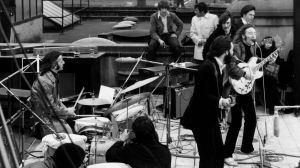
30th January 1969: British rock group the Beatles performing their last live public concert on the rooftop of the Apple Organization building for director Michael Lindsey-Hogg's film documentary, 'Let It Be,' on Savile Row, London, England. Drummer Ringo Starr sits behind his kit. Singer/songwriters Paul McCartney and John Lennon perform at their microphones, and guitarist George Harrison (1943 – 2001) stands behind them. Lennon's wife Yoko Ono sits at right. (Photo by Express/Express/Getty Images) -
MELBOURNE, AUSTRALIA – Keith Urban performs during "The Songs Of John Farnham, The Celebration Concert" at Rod Laver Arena on September 20, 2026 in Melbourne, Australia. (Photo by Graham Denholm/Getty Images) -
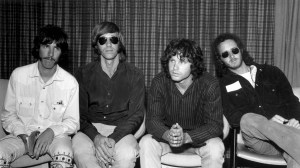
3rd September 1968: American psychedelic rock band, The Doors during a press conference at Heathrow Airport, London (left to right); drummer John Densmore, keyboard player Ray Mansarek, vocalist Jim Morrison (1943 – 1971) and guitarist Robby Krieger. (Photo by Central Press/Getty Images) -
Australian-American singer, songwriter, author, actress, and activist Helen Reddy (1941 – 2020), 1975. (Photo by Tony Russell/Redferns) -
Original Caption) : 1980-Pop singer Linda Ronstadt is shown singing on stage, holding the microphone stand. She wears a gingham shirt with a tie front and askirt with flowers on it in this waist-up portrait. (Photo by Lynn Goldsmith/Corbis/VCG via Getty Images) -
Tears for Fears – Koninklijk Circus – Brussel – Belgium – 21/04/1985 Roland Orzabal, Curt Smith Photo gie Knaeps -
The Rolling Stones at Desert Trip -
Pauk Simon 1965.© Chris Walter.