Despite popular belief that Yoko Ono chased after John Lennon, it was John Lennon who begged Ono to take him back after his year-and-a-half-long drunken bender nicknamed “The Lost Weekend.” Lennon went on this alcohol-fueled binge following his and Ono’s first breakup in 1973, which was Ono’s idea.
Ono would be the one to decide when the pair reunited in early 1975, inviting Lennon to come back home after raising hell in California with the likes of Harry Nilsson, Keith Moon, and other colleagues. The former Beatle had also been having a short-lived affair with his assistant, May Pang—an extra-marital stint that was, once again (and shockingly so), Ono’s idea.
Videos by American Songwriter
Yoko Ono Was The First To Decide The Pair Needed A Break
Amidst John Lennon and Yoko Ono’s tumultuous legal battle of the early 1970s, during which both musicians faced deportation from the United States, the couple’s relationship deteriorated. Fed up with their constant arguing, Ono kicked Lennon out of their home. Then, in what many would consider quite an unusual turn of events, Ono asked Lennon’s assistant, May Pang, to start seeing the ex-Beatle.
“[Ono] did not realize it was going to turn into such a big love affair,” Pang later recalled in the 2023 documentary The Lost Weekend: A Love Story (via People). “She thought it would be two weeks, gone, goodbye.” But perhaps to Ono’s credit, Lennon had far less romantic notions of his separation from his second wife. In a 1980 Playboy interview, Lennon described Ono’s decision differently: “She kicked me out. I was on a raft alone in the middle of the universe.”
“At first, I thought, ‘Whoopee, whoopee!’ You know, bachelor life,” Lennon continued. “Whoopee! And then I woke up one day, and I thought, ‘What is this? I want to go home! But she wouldn’t let me come home. That’s why it was 18 months apart instead of six months. We were talking all the time on the phone, and I would say, ‘I don’t like this. I’m getting in trouble, and I’d like to come home, please.’ And she would say, ‘You’re not ready to come home.’ So, what do you say? Ok, back to the bottle.”
Why Yoko Ono Decided To Take John Lennon Back 18 Months Later
In their 1980 Playboy interview, Ono described the ways in which the public’s perception of her—a “dragon lady” who manipulated Lennon and stole him away from the Beatles—affected her psyche. As an artist who had been pursuing her career long before meeting Lennon, the vitriol affected her self-esteem both personally and professionally. Although interpersonal conflict was the final nail in the coffin with the couple’s first split, there was a part of Ono that needed to regain her independence, too.
Months after Lennon and Pang had been dating, Pang recalled Ono reaching out to say, “I’m thinking of taking John back. I said, ‘What?’ And she said, ‘I think it’s time.” As Ono told writer David Sheff, “It slowly started to dawn on me that John was not the trouble at all. John was a fine person. It was society that had become too much. We laugh about it now, but we started dating again. I wanted to be sure. He was intelligent enough to know this was the only way that we could save our marriage, not because we didn’t love each other but because it was getting too much for me. Nothing would have changed if I had come back as Mrs. Lennon.”
Following their reunion and 1975 vow renewal, the dynamics of John and Yoko’s relationship changed. Whereas Ono handled most business affairs, Lennon stayed home tending the house and baby. “We learned that it’s better for the family if we are both working for the family, she doing the business and me playing mother and wife,” Lennon told Sheff. “The number one priority is her and the family. Everything else revolves around that.”
Photo by Jack Kay/Daily Express/Getty Images
More Did You Know
-
Willie Mae “Big Mama” Thornton performing, Photo by GBH Archives/YouTube -
The Rolling Stones in concert, Tour of Europe '76, Earls Court Arena – Mick Jagger and Keith Richards (Photo by Graham Wiltshire/Shutterstock) -
Rock band: The Rolling Stones: – Mick Jagger, Keith Richards (Photo by Roger Bamber/Shutterstock) -
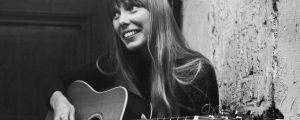
Despite its fantastical origin story of surviving a shrapnel attack in the Vietnamese jungle, the D-28 met its demise on a flight to Hawaii. Not only did the turbulent flight damage the instrument in storage; someone later stole the guitar from the luggage carousel. Mitchell was never able to find her long-lost instrument, something she’s lamented for years. Aside from the sentimental connection guitarists typically have to their first ax, Mitchell was particularly fond of her Martin for functional reasons. After a bout of childhood polio affected Mitchell’s ability to form chord shapes in standard tuning, the singer-songwriter had to adapt with eccentric tunings that allowed her to create rich harmonic structure with limited mobility. Whether open, an octave below, or otherwise, Mitchell’s unique tunings placed stress on the guitar neck that it wasn’t originally made to endure. Moreover, to ensure the dissonance within her tunings was purposeful and not merely off-pitch, Mitchell needed a guitar with pristine intonation—something she frequently lauded the D-28 for having. “I need really good intonation,” she explained to Acoustic Guitar. “One of the signs of really good intonation is how flashy the harmonics are with a light touch. You should be able to get them to bloom like jewels.” While Mitchell has found other guitars that come close in that department, as she put it in her 1996 magazine interview, “I’ve never found an acoustic that could compare with it.” Photo by Central Press/Hulton Archive/Getty Images -

Drummer Ringo Starr of English rock band the Beatles during a reception at the London home of the group's manager Brian Epstein, 20th May 1967. The Beatles' song 'A Day In The Life' had recently been banned by the BBC for its references to drug-taking. (Photo by John Pratt/Keystone/Hulton Archive/Getty Images) -
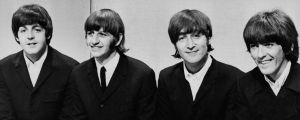
English rock band the Beatles at the BBC television studios in London before leaving for a concert tour of Germany, and afterwards Japan, 16th June 1966. From left to right, they are Paul McCartney, Ringo Starr, John Lennon and George Harrison. (Photo by Central Press/Hulton Archive/Getty Images) -
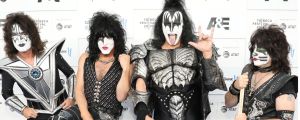
NEW YORK, NEW YORK – JUNE 11: (L-R) Tommy Thayer, Paul Stanley, Gene Simmons, and Eric Singer of KISS attend the 2021 Tribeca Festival screening of "Biography: KISStory" at The Battery on June 11, 2021 in New York City. (Photo by Monica Schipper/Getty Images)