There are plenty of instances where popular movies were followed by sequels continuing or adding new chapters to the story told in the original film. Some of these sequels were just as successful and popular as the movies they followed up—think The Godfather and The Godfather Part II.
Although not as common, the same phenomenon has occurred in the music world, with artists writing and recording songs that revisit characters from their earlier tunes.
Videos by American Songwriter
[RELATED: Behind The Song: David Bowie, “Ashes To Ashes”]
Here are four examples of well-known artists that have created songs that were sequels to previous tunes they released:
“Johnny B. Goode” (1958) and “Bye Bye Johnny” (1960) – Chuck Berry
“Johnny B. Goode” is one of the most famous and influential early rock ‘n’ roll songs of all time. Released by Chuck Berry in 1958, the joyous tune peaked at No. 8 on the Billboard Hot 100.
“Johnny B. Goode” tells the story of a country boy from Louisiana who wowed people with his amazing guitar skills. In the last verse, Johnny’s mother tells him that one day he will lead his own band and his name will be in lights.
Berry wrote a sequel to “Johnny B. Goode” called “Bye Bye Johnny” that was featured on his 1960 album Rockin’ at the Hops. In the follow-up tune, Johnny’s mom buys him a bus ticket so he can go to Hollywood and follow his dream of being a star.
As Johnny’s mother kisses him goodbye, she remembers buying him his first guitar with money she made picking crops.
In the final verse, Johnny sends his mom a letter. In the letter he tells her he’d fallen in love and planned to marry soon. He also says he planned to bring his bride home and build a mansion. The house would sit by the railroad track where he used to play his guitar.
“Space Oddity” (1969) and “Ashes to Ashes” (1980) – David Bowie
David Bowie released his breakthrough hit “Space Oddity” in 1969. Partly inspired by the 1968 Stanley Kubrick film 2001: A Space Odyssey, the song tells the story of the fictional astronaut Major Tom, who journeys into outer space and gets stranded there.
The song initially peaked at No. 5 on the U.K. singles chart, then later hit No. 1 when it was reissued in Bowie’s home country in 1975. In the U.S., “Space Oddity” reached No. 15 on the Billboard Hot 100 in 1973, becoming Bowie’s first Top-40 hit in the States.
In 1980, Bowie revisited the Major Tom character in his song “Ashes to Ashes.” In the tune, which appeared on Bowie’s 1980 album Scary Monsters (and Super Creeps), Major Tom is still floating in space and has become a drug addict. Many fans believe that the song was inspired by Bowie’s own struggle to get clean of drugs.
Bowie shot a surreal video for “Ashes to Ashes.” The video includes scenes of him depicted as a clown, in a padded room, and as a sullen and aging Major Tom attached to several cables.
“Ashes to Ashes” became Bowie’s second No. 1 hit in the U.K., after “Space Oddity.”
“Taxi” (1972) and “Sequel” (1980) – Harry Chapin
Late singer/songwriter Harry Chapin was a great storyteller, as evidenced by his popular songs “Taxi” and “Cats in the Cradle.” “Taxi” was Chapin’s first hit in 1972, reaching No. 24 on the Hot 100.
The song told the story of a cab driver, Harry, who picks up a fare who turns out to be a former lover, Sue. We learn that they ended their relationship when she went off to follow her dream of becoming an actress and he went to pursue a career as a pilot.
Neither achieved their goal, or at least not in the way they’d planned, with Sue now in an apparently unfulfilling marriage and Harry driving a cab. As Chapin sings at the end of the song, “And here she’s acting happy, inside her handsome home / And me, I’m flying in my taxi, taking tips and getting stoned.”
The Song’s Unhappy and Unresolved Ending Likely Inspired Chapin to Write a Sequel
The tune, appropriately titled “Sequel,” was released in 1980 and became Chapin’s last hit, reaching No. 23 on the Hot 100.
In “Sequel,” it’s 10 years later, and Harry has become a successful musician. He decides to visit Sue at the house where he dropped her off years earlier, but he discovers that she no longer lives there. The butler at the house helpfully gives him her new address, though.
Harry tracks Sue down at an apartment and they talk through the afternoon. He discovers that she’s now happy, even though she gave up her dream of being an actress. He invites her to come to his concert that night, but she tells him she has to work that night.
The song ends ambiguously. Chapin sings, “Don’t ask me if I made love to her / Or which one of us started to cry / Don’t ask me why she wouldn’t take the money that I left / If I answered at all I’d lie.”
“Judy Is a Punk” (1976) and “The Return of Jackie and Judy” (1980) – The Ramones
“Judy Is a Punk” is a song that appeared on legendary New York punk band the Ramones’ self-titled debut album. The tune tells the story of two teenage woman, Jackie and Judy, who go on a couple of adventures together. First, they go to Berlin and join the Ice Capades. Then, they go to San Francisco and join the militant leftist organization the SLA.
The SLA is short for the Symbionese Liberation Army. It was the short-lived terrorist group that infamously kidnapped publishing heiress Patty Hearst in 1974.
At the end of each verse, frontman Joey Ramone ponders why Jackie and Judy would want to join the Ice Capades or the SLA, then muses, “Perhaps they’ll die.”
In 1980, the Ramones released a sequel to “Judy Is a Punk.” The track, called “The Return of Jackie and Judy,” appeared on the band’s End of the Century album.
In the follow-up song, Jackie and Judy are involved in a variety of misadventures. They go to the punk venue the Mudd Club, and get drunk. The two pals attend a Ramones show in New York. They get kicked out because they don’t have a backstage pass. The duo also get caught cutting class and have to go to summer school.
More The List
-
American country singer Bill Anderson on stage, USA, circa 1970-1980. (Photo by David Redfern/Redferns/Getty Images) -
UNSPECIFIED – JANUARY 01: Photo of Phil COLLINS (Photo by Ian Dickson/Redferns) -

UNITED KINGDOM – NOVEMBER 16: WEMBLEY ARENA Photo of RADIOHEAD and Thom YORKE, Thom Yorke performing live onstage (Photo by Patrick Ford/Redferns) -
Photo by Michael Putland/Getty Images -
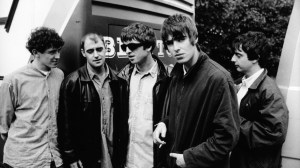
NETHERLANDS – JANUARY 01: NETHERLANDS Photo of Liam GALLAGHER and Noel GALLAGHER and OASIS, L-R:Tony McCarroll, Paul 'Bonehead' Arthurs, Noel Gallagher, Liam Gallagher, Paul 'Guigsy' McGuigan – posed, group shot (Photo by Michel Linssen/Redferns) NETHERLANDS – JANUARY 01: NETHERLANDS Photo of Liam GALLAGHER and Noel GALLAGHER and OASIS, L-R:Tony McCarroll, Paul 'Bonehead' Arthurs, Noel Gallagher, Liam Gallagher, Paul 'Guigsy' McGuigan – posed, group shot (Photo by Michel Linssen/Redferns) -

LOS ANGELES – JUNE 12: Rock band Radiohead (Thom Yorke 2nd from left) poses for a portrait at Capitol Records during the release of their album OK Computer in Los Angeles, California on June 12, 1997. (Photo by Jim Steinfeldt/Michael Ochs Archives/Getty Images) -
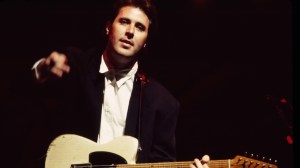
American Country musician Vince Gill plays electric guitar as he performs onstage at the Beacon Theatre, New York, New York, May 15, 1991. (Photo by Gary Gershoff/Getty Images)