Your cart is currently empty!



Whitney Tai Finds Beauty in All the Mess on Third Album ‘American Wasteland’
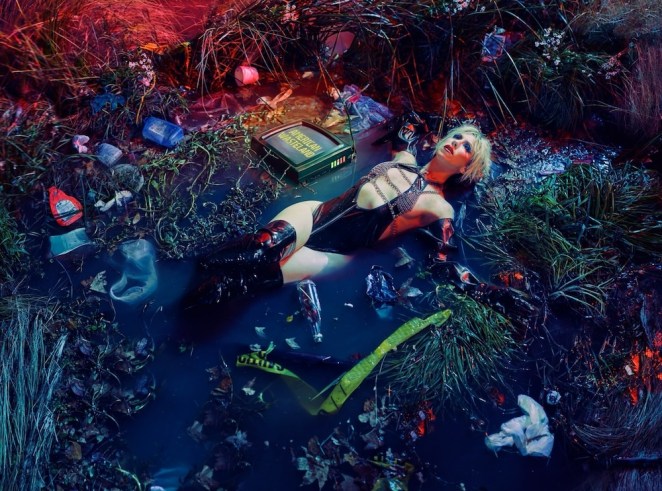
Some of the most beautiful things often come out of chaos. For Whitney Tai, tangles of loss, grief, and healing, as well as self-discovery, led her in and out of her third album, American Wasteland. For the Los Angeles-based singer and songwriter, American Wasteland is woven underneath the surface of all the personal or socio-political messes.
“When we think about the ways that human beings are manipulated, abused in a grander sense, and also in a personal sense, in our day-to-day lives,” says Tai, “the lyrics and the journeys that I was taking through each song were macro cosmic and micro cosmic all at once.”
Co-written with producer Tommy Hatz, American Wasteland opens up on the sprawling and heart-bursting ballad, “Perfect Storm.” Initially, when the two began working together, there was no intention for an album until they wrote the opening track. “It was because of that track that we decided to do an entire full-length record together,” says Tai.
Working with Hatz kept everything Tai needed to release, figuratively and lyrically, aligned. “We were both in the same place,” says Tai. “He’s amazing to work with as s producer and as a songwriter, because he thinks about the bigger picture. It felt kismet the way our writing process evolved.”
The final track Tai and Hatz worked on, “American Wasteland,” developed into the core of the album. “I had arrived lyrically at a place where I was starting to see the running tie and themes that were moving through all the songs, and a lot of it had to do with personal and societal collapse at large,” says Tai of the album and title track, which finds her maneuvering around “personas”—I’m a bastard I’m a freak / I’m a vampire / I’m a creep / I’m the break in the chain that you couldn’t contain / Led to slaughter like the sheep—and how some individuals become a byproduct of their surroundings.
“‘American Wasteland’ was indicative of a much larger problem that’s happening around us,” says Tai, “which is that we are being fed information about the way we are supposed to perceive the world or perceive one another, or we are being manipulated into perceiving things when the truth and the beauty and the answer has been within us or around us all along, but our eyes are just kind of glazed over with like this sense of death.”
It’s like a “death of the ego,” in a sense, adds Tai, with a boom in narcissism, abuse, and dark triad behaviors. “People are starting to become aware of the fact that we’re going through another renaissance of thought,” she says. “We have so much information at our fingertips that the only place we can be forced to go is consciousness, at least an elevated form of consciousness, and that can also be a double-edged sword, because to know too much, but then to still have to try to survive, it does feel like a proverbial wasteland.”
Videos by American Songwriter
She continues, “Can you see the forest for the trees? Can you see the trees for the contamination that is all around you? Because it’s hard to recognize the abuse and the disease when you are in it. It’s when you are so deep in it, you have to kind of pull yourself from within to find that answer, which is that I am the light. When we get back to that basic recognition, that’s the birth of ‘American Wasteland,’ that moment of realization that we are not just a product of our surroundings. We are the heartbeat under all that keeps trying, even when we get lost.”
All of Tai’s points pulse, throughout the album, from “Slumber Party,” navigating the removal of past traumas and taking “control of the wheel,” regardless of the antagonists—government, friends, partners—while lead single “Rhea,” is framed around loss, of innocence and her dreams, after Tai, then 10, lost her mother—Somеthings calling me inside / Just like thе ocean calls the tide / Surely I’ll find you someday Rhea.
The celestial “Aura,” with a rap break by Nahhdahh, recognizes the true color of a former love, while an interlude, midway in, “2 the End / King of Wands,” features an answering machine message from Tai’s late father, who passed away from a heart attack while she was finishing up the album in 2024.
Songs are like prophecies.
Whitney Tai
“I had a lot of voicemails that I kept from my father because my dad was an emotionally abusive, alcoholic, narcissistic personality, and at the same time a very talented man,” shares Tai. “He loved me very much, he just didn’t have the capacity to be emotionally available. … In that voicemail, it’s a little piece of guilt-tripping that my dad would always do to me, saying, ‘I hope you remember the guy that brought you into this world.’”
Tai’s relationship with her father and the death of her mother, and becoming a “parent” to her younger sister and herself at a young age are all laced into American Wasteland.
“He cared more about the fact that he lost a wife, and he couldn’t empathize from our point of view,” says Tai of her father. “So it was a very lonely childhood to navigate. Putting that voicemail in there was a closure for me, because my dad and I were never going to have the conversation about how he harmed me and how he caused me so much distress in my life, but at the same time, I love him, because if he didn’t push me into music, I would have never known is as my my path.”
Toward the end, Tai stays true to the more alt-rock heartbeat of the album and transports back into a cover of Alice in Chains’ “Brother” from the band’s 1992 album Dirt & Sap. “The original version is a lot darker, but we tried to give it an air of hope in memory of Layne [Staley],” says Tai of the band’s late frontman. “Layne is my biggest vocal inspiration ever.”
More bolts of perseverance rise on “Already on My Way” and “Towerfall,” before the closing drift of “Sequoias.”
“Songs are like prophecies,” says Tai of the final track. “It’s about the circle of life, and ‘Perfect Storm’ and ‘Sequoias’ are the bookends,” says Tai. A follower of astrology, Tai, a Capricorn, Pisces rising, says the tracks fit into her two signs of Earth and Water. “Then there’s the dreaminess and the etherealism of those bookends,” she adds. “Tommy and I felt that with ‘Perfect Storm’ and ‘Sequoias’ you get that lightning and thunder of the storm, and then you have the resolve, the peace, and calmness of going back to the roots of the trees, and you are new again. The wasteland has been restored.”
A follow-up since Tai’s second album, Apogee, in 2000, American Wasteland brings the ugly to the surface, then flushes it out. Tai considers the songs “little lifelines” that helped guide her during difficult times. “I was going through a very difficult relationship with someone I had been with for many years, and I did not realize that I was at the brunt of a very toxic relationship,” says Tai. “My body could feel that there was a lot of danger and there was something wrong, but because of how much I cared about this person, how much history was there, I was torn.”
She adds that it was also similar to having cognitive dissonance, which is one way she also describes the album. “It’s how your intuition and your gut are always working for you and never against you,” says Tai. “At the end of making this and even now, if I didn’t have my nervous system and my intuition ebbing and flowing and revealing to me what was going on in my personal life, I don’t think I could have reached that moment when my logical brain was putting all the pieces together of what I was experiencing.”
American Wasteland untangles the trauma and is ultimately about the release for Tai. “It’s been a long, many years trying to make this realized and birth it into the universe, but it’s some of my favorite things that I’ve ever made, and they are just very special to me,” she says. “They feel like extensions.”
Tai continues, “‘American Wasteland’ feels different for me, like a warm hug from a little version of me—little Whitney—the 10-year-old Whitney. It’s that hug I’ve been needing for a long time.”
_____
On January 10, 2026, cocktail company Art & Rev will sponsor Tai’s release party at Licorice Pizza Records in Los Angeles, along with Schecter Guitar Research, which will give away a custom American Wasteland Guitar during the event.
Photos: Joseph Cultice


Leave a Reply
Only members can comment. Become a member. Already a member? Log in.