Your cart is currently empty!



How Decades of Songwriting and Self-Reflection Led Jeff Tweedy to True Creative Autonomy
Today, words like “legendary” and “iconic” are used in just about every other sentence. But while we may feel surrounded by all-time cultural figures now, do we ever stop to ask the question: What’s the point of being a legend?
Videos by American Songwriter
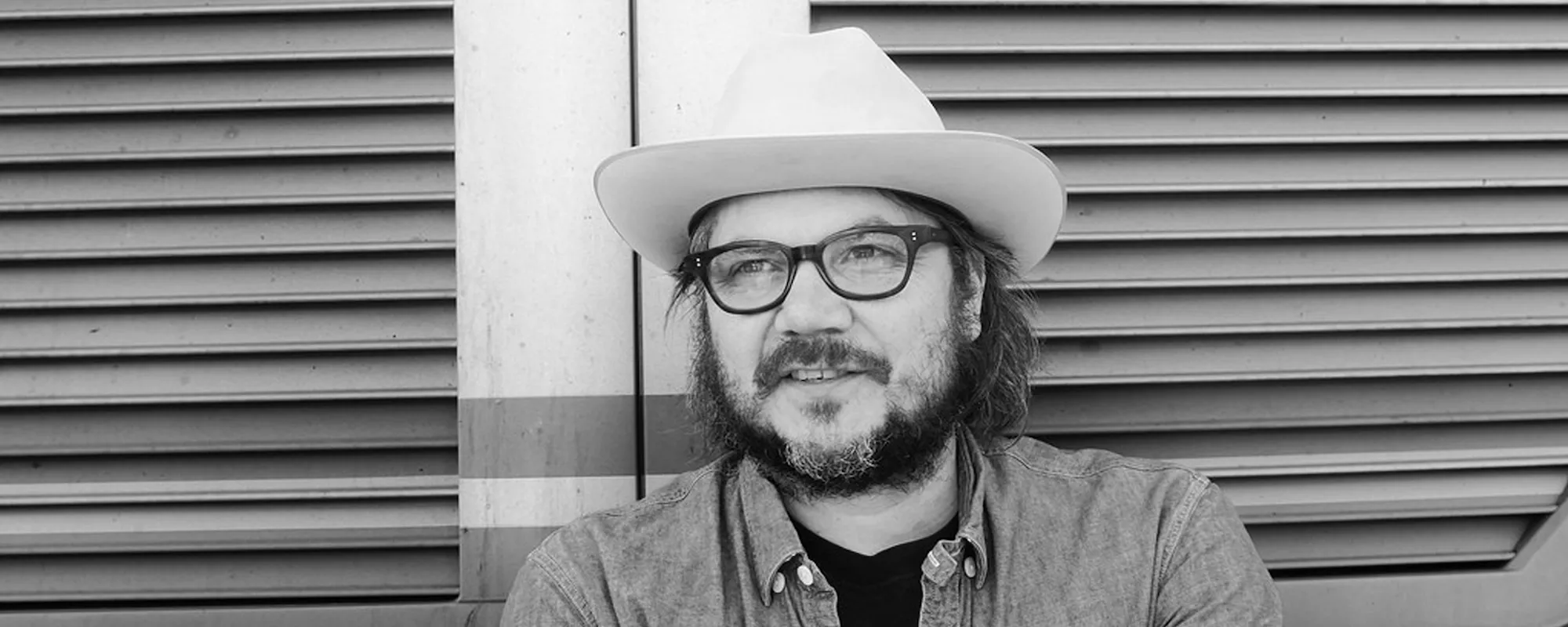
Answers vary depending on the responder. For Jeff Tweedy, decades of making music and releasing written work have given him a real sense of creative autonomy. But it’s also allowed him to do something else. “I grew a band,” he tells American Songwriter.
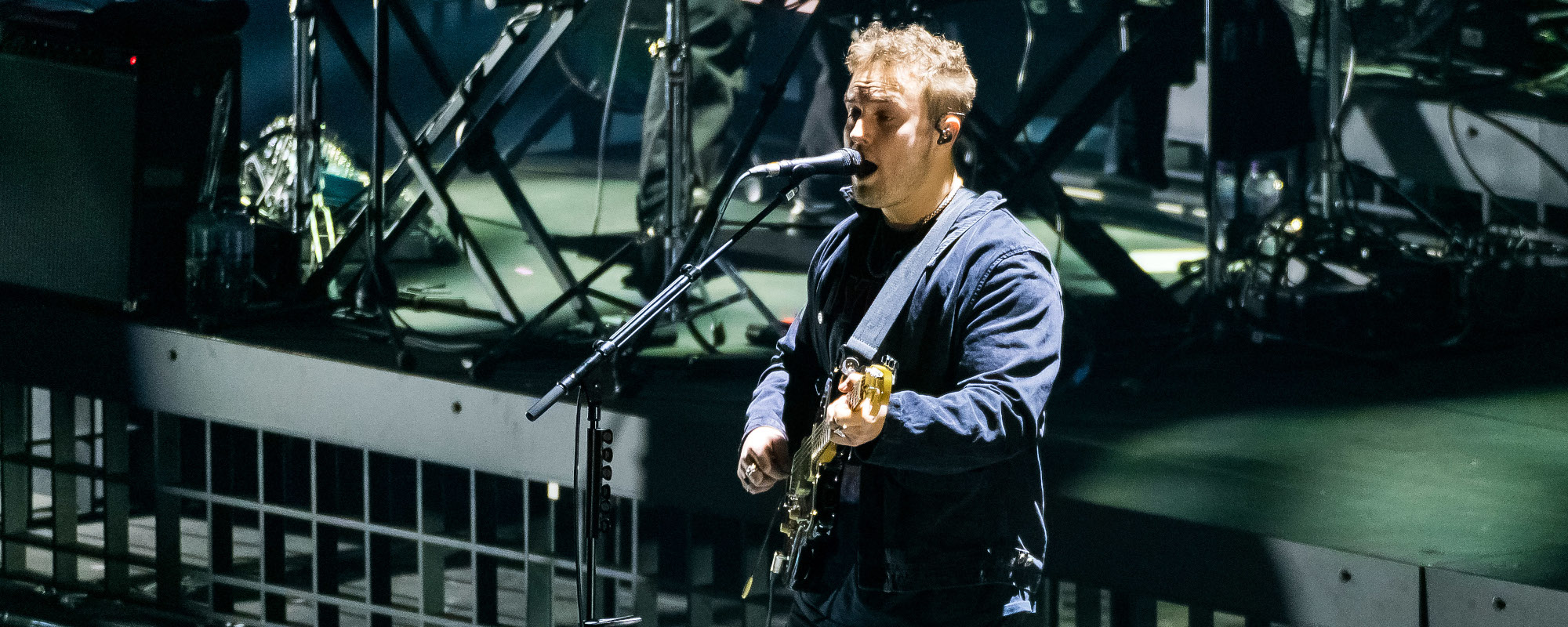
Tweedy makes the statement with a smile, though his salt-and-pepper facial hair does its best to hide it. What the Grammy Award-winning songwriter means is that, at the time of our conversation, he is preparing to head out on the road and play shows with his band—a group comprised of his sons and their friends. “I’ve known [everyone] since they were little,” Tweedy says, like a proud musical papa.
[RELATED 5 Must-Hear Tracks From Jeff Tweedy’s Epic Triple Album ‘Twilight Override’]
It’s funny—the idea of raising your future backing band. But it’s also a very real thing. Tweedy, who released his first record with Uncle Tupelo in 1990 and his first album with Wilco in 1995, has been impacting and influencing mainstream and underground music for more than three decades. But it takes a special kind of person to do so.
“My mom always used to say that I would stand and point at the stereo until she would put a record on,” Tweedy says. “Before I could even walk.”
The frontman says his parents’ record collection left little to be desired—some of the albums may have come with the purchase of the large piece of furniture that was the record player—but they did the trick, nevertheless. Even from diapers, Tweedy was drawn to creative pursuits. Today, he says, writing allows him to better understand himself. “I think that it’s a really amazing tool for finding out what’s inside of you,” he says.

In fact, more than any album or book, what’s important for Tweedy is the actof creativity. He advocates for others to spend even five minutes a day drawing or writing. The effects of that can be enormous on a person’s brain, just allowing it to wander.
“I have to admit it’s much easier as I’ve gotten older, because of the way my life has been organized around it, versus maybe someone who doesn’t have this as a profession,” Tweedy says. “But I do think a little bit goes a long way.”
Making something is hard. There’s a severe degree of difficulty in putting anything of value out to the world. At times, Tweedy says, he’s felt an inner tension or disconnect about his job as a performer. Often, he feels like a shy or self-conscious person. “It’s not like I have imposter syndrome,” he says. “I don’t beat myself feeling I don’t belong.” But he also does feel aware of the tropes of performance, like the awkwardness of stage banter or how rote it can be to introduce another new song. And yet he continues to return to the gig.
“Part of me craves that attention,” Tweedy says. “I felt electrified by it the first time I ever walked on stage or had a guitar in my hand in front of an audience.”
For Tweedy, performance was a way to liberate himself from those very same feelings of awkwardness—from that “internal struggle to feel comfortable in my skin,” he says. But thanks to the benefit of years, he says he feels very comfortable on stage. “I’m 58 years old,” he says. “I’ve been in a band literally most of my life. I get reinvigorated by it every time I go out on tour.”
In recent years, the songwriter says, he’s noticed a shift in the mood of the audience. He notices that he feels there’s an even deeper connection these days. “The audiences I’ve been playing in front of with Wilco or on this [solo] tour seem to really need something that, for whatever reason, I feel equipped to provide.”
It began post-pandemic, Tweedy notes. In an age of artificial intelligence, social media-led isolation, and an increasingly harsh political climate, sometimes it just feels good to be around people listening to music and watching someone perform. “It feels profound to see real people on stage making mistakes,” Tweedy says, with a laugh.
Imperfection might be the perfect modern-day salve.
Tweedy recalls during those scary years in 2020 and 2021 when he started to post home shows from his wife’s Instagram account. Social media can create spite and distance, but paradoxically, there are occasions when it can bring people together in a good way. Tweedy and his family did over 100 shows in a row and about 200 in total. Fans loved it.
“More than anything I’ve ever done in my life,” he says, “people come up to me and thank me for that. I think a lot of people felt less alone.”
A handful of years removed from those dark times, Tweedy has released his latest work, a triple-album called Twilight Override, which he unveiled in September. To accompany the music, Tweedy recorded a two-hour video for YouTube of himself driving around and listening to every song. Fans of the artist got to see a bit of his surroundings in Illinois and how he takes in his own recordings, both critiquing and enjoying them.
“I want to make a record that I feel like listening to, and I don’t already have,” Tweedy says. “That’s the primary goal.”
[RELATED: Wilco Announces U.S. Tour Dates for Spring 2026]
In so doing, he has garnered great renown. He’s also forged some fine friendships, including one with fellow legend Mavis Staples. Since 2010, the two have collaborated on a number of albums. “She has the ability to make a friend out of almost anybody,” Tweedy says. “She’s made me feel very special. My family has embraced her—she calls [my sons] Spencer and Sammy her grandchildren.”
Another all-timer Tweedy has embraced, creatively speaking, is Woody Guthrie. In 1998, Wilco and Billy Bragg wrote music and even some lyrics for the album Mermaid Avenue, which was inspired by previously unheard lyrics by the musical folk hero. This summer, Wilco will host the biannual Solid Sound Festival, which will include the band and Bragg performing together on the first night of the fest for their first-ever full concert of songs from the 1998 LP.
“It’s hard to explain the impact of Woody Guthrie not just on my psyche,” Tweedy says, “but the notion of being an American songwriter, I think, is pretty hard to discuss without Woody Guthrie coming up.”
Tweedy remembers the feeling of being able to hold and examine Guthrie’s writing up close. He saw someone who didn’t self-censor—at least not at first. The experience, he says, taught him a great deal about the work. Guthrie, Tweedy says, wrote about everything in his life. “He obviously wrote every day,” he says. “About anything that crossed his mind. He didn’t have an internal editor on what to put on the page. There were songs about sex, flowers, and songs about Hitler. Songs about his landlord, Fred Trump.”
Thinking about his own process, Tweedy offers a tip. “I have a rule,” he says. “If it comes to me, I should finish it.”
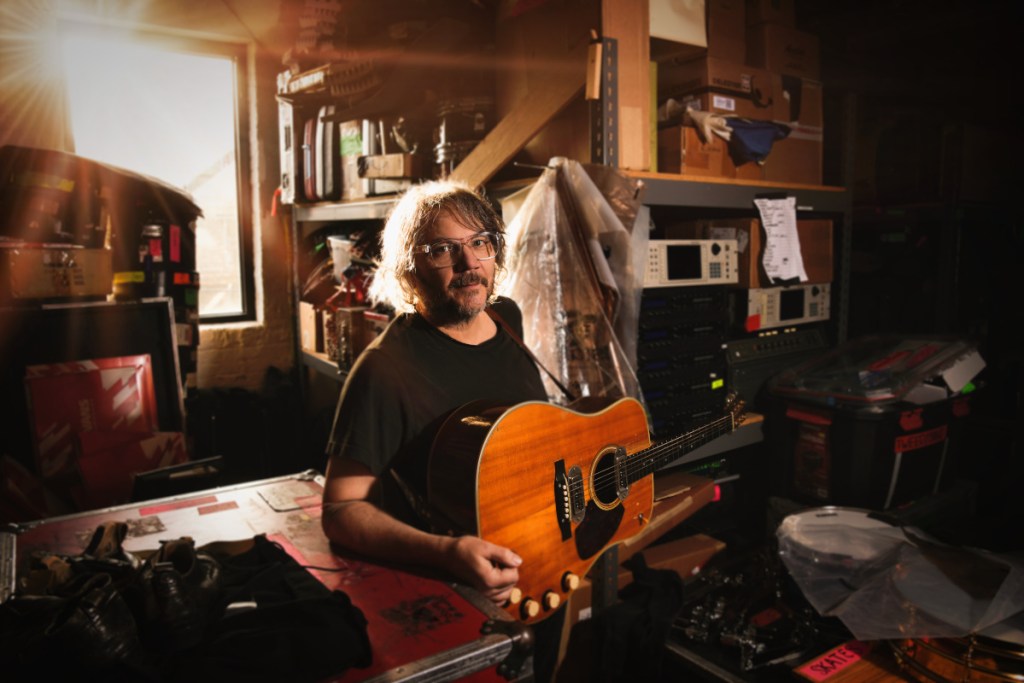
Looking at his own career, Tweedy almost shakes his head in bewilderment. He says he never could have planned the past several decades. “I don’t know if you would make a career like this, intentionally,” he says. But what it has allowed him to do is lead a professional life that has strode toward autonomy.
He owns his own studio and has his own label. He gets to work independently and in ways that make him feel proud. More than any headlining show, more than any big payday, that has been the carrot dangling in front of Tweedy throughout his life. And somehow, someway, the best-selling author and award-winning musician has grasped it.
“That’s required a healthy amount of luck,” he acknowledges. “But if your goal is to do this, I think the decision should always be made not about what makes the most money or gets you the most attention right away, but what gets you to be able to do it again tomorrow.” He adds: “I don’t want to lose this thing I cherish.”
Here’s what he means. When Tweedy came into the music business in the 1990s, he remembers getting some pretty healthy advances. Not Madonna-level, he jokes, but sizable, nonetheless. But instead of using that money on the most expensive engineers or highest-priced studios, Tweedy would squirrel some of it away and buy equipment. Doing that every time helped him to build the studio he records out of today.
First, he built a studio. Then he built a band.
But here’s the kicker: You can, too.
“I know it feels like you don’t have any energy when you come home from work at the end of the day,” Tweedy says. “But I do think there are things within your grasp that can restore that energy—like just being reminded how vast your internal life is.”
Leave a Reply
Only members can comment. Become a member. Already a member? Log in.