Initially referred to as “hillbilly music,” country music’s influence exploded following the radio’s invention in the 1920s. In May 1924, Vernon Dalhart scored the first nationwide country hit with “Wreck of the Old ’97”. Another artist to emerge during this decade was Carson Robison, who accompanied Dalhart on guitar, harmonica, whistling, and harmony vocals on that landmark recording.
Working continuously from 1924 to 1956, Robison is probably the most recorded singer-songwriter in country music history, according to his National Songwriters Hall of Fame biography. He was also one of the first full-time country writers.
Videos by American Songwriter
Today, we’re diving into the life and career of Carson Jay Robison, born in Oswego, Kansas, on this day (August 4) in 1890.
About Carson Robison
Growing up on a farm in Chetopa, Kansas, Carson Robison was always surrounded by music. His father was a champion fiddler; while his mother played piano and sang.
Meanwhile, Robison taught himself to play guitar, tenor banjo, harmonica and ukulele. He also mastered two-tone whistling, sounding like two people whistling in harmony.
Robison began his professional music career at age 14, playing as a backing musician for Victor Records’ Wendell Hall on the early 1920s music hall circuit.
He also worked as a singer and whistler at the Kansas City, Missouri-based radio station WDAF.
Starting Out with Vernon Dalhart
While some artists move to Nashville immediately upon receiving their high school diploma, Carson Robison didn’t begin making his name in music until he was 30 years old.
After holding various jobs as a cowboy, oilfield worker, soldier and railroad dispatcher, Robison moved to New York City in 1924 and signed a recording contract with the Victor Talking Machine Company.
Soon, he was a highly sought-after session musician, playing and whistling on records by Gene Austin, Hoagy Carmichael and others.
Ultimately, Robison teamed up with Vernon Dalhart. The two recorded and toured together from 1924 to 1928.
During this time, Robison wrote many of Dalhart’s big “event” songs, commemorating fires, train wrecks, earthquakes, and other natural or man-made disasters.
Some better-known examples include “The Wreck of the Shenandoah”, “Remember Pearl Harbor,” “The Wreck of the Number Nine”, and “The John T. Scopes Trial”, about the infamous Scopes Monkey Trial.
From 1927 and 1929, Robison also recorded with the Vernon Dalhart Trio, consisting of himself, Dalhart, and fiddler Adelyne Hood.
Despite their professional success, the men’s personal relationship left much to be desired. After Dalhart reportedly demanded one-half of Robison’s songwriting royalties, he exited the partnership.
A Master of Reinvention
Upon severing ties with Dalhart, Carson Robison teamed up with Frank Luther. From 1928 to 1931, they recorded songs and performed on WOR radio in New York City.
They scored a hit with “Barnacle Bill the Sailor” before parting amicably.
In 1932, he started his own band, Carson Robison’s Pioneers. He continued recording throughout the 1930s and ’40s, becoming of the earliest country music acts to perform overseas when he toured the United Kingdom and Ireland.
Then World War II hit, and Robison once again shifted gears. He began writing topical songs about the conflict, scoring his biggest hit with the humorous “Life Gets Tee-Jus, Don’t It” in 1948.
On March 24, 1957, Carson Robison died in Poughkeepsie, New York, at age 66.
Featured image by CBS via Getty Images
-
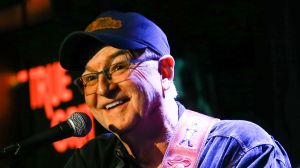
NASHVILLE, TENNESSEE – APRIL 22: Musician Carl Jackson performs during a special tribute concert in honor of Glen Campbell’s birthday at Glen Campbell Museum and Rhinestone Stage on April 22, 2021 in Nashville, Tennessee. (Photo by Terry Wyatt/Getty Images) -
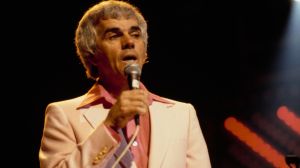
American country music singer-songwriter Roy Drusky, wearing a white suit and red shirt, performs on stage during the International Festival of Country Music held at Wembley Arena, London, April 1982. (Photo by David Redfern/Redferns/Getty Images) -
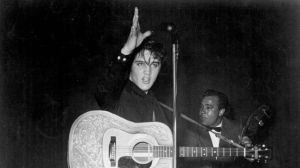
1956: Rock and roll singer Elvis Presley performs on stage with his Martin acoustic guitar with Bill Black on upright bass in 1956. (Photo by Michael Ochs Archives/Getty Images)