
Beatlemania seemed like an unstoppable behemoth in the mid-1960s. (There’s a reason why Rolling Stones frontman Mick Jagger called the band a “four-headed monster.”) But in the spring of 1966, John Lennon learned the hard way that no matter how big The Beatles became in the United States, they would never be bigger than Jesus.
Lennon made his infamously flippant remark in the March 4, 1966, issue of London Evening Standard. “Christianity will go. It will vanish and shrink. We’re more popular than Jesus now,” Lennon said. To his fellow Brits, the comment seemed like an offhand joke worth a small chuckle and little else. To conservative Americans, Lennon was spewing blasphemy.
Videos by American Songwriter
People began burning Beatles records and other merchandise. Boycotts sprang up throughout the United States, especially in the Bible Belt. Eventually, Lennon apologized, saying that he was not “anti-religion” but that “from what I’ve read, or observed, Christianity just seems to be shrinking, to be losing contact.”
Lennon wasn’t denouncing God; he was commenting on the secularization of modern society—about which he wasn’t wrong. Still, the scandal was enough to scare The Rolling Stones into tiptoeing around their American fans (or at least scare their record label).
The Rolling Stones Changed This Album Title After the Beatles Scandal
The Rolling Stones worked on their fourth album over the winter of late 1965 and early 1966. It would be the first album to feature all-original work, which included tracks like “Mother’s Little Helper”, “Lady Jane”, and the controversial “Under My Thumb”. The band wanted to name their album Could You Walk On Water? But the idea didn’t get very far.
Upon hearing the title, Decca immediately halted production. The record label refused to release an album with that title, citing its Christian implications. Decca had no interest in hopping into the pot of boiling water that John Lennon cooked up for himself in the Evening Standard at the beginning of March. It didn’t take an industry expert to know that the U.S. was in no mood for British rock bands making light of Jesus Christ, directly or indirectly.
Thus, The Rolling Stones renamed the album Aftermath. Although the band wasn’t happy to change the album title, they didn’t have much to complain about after its release. Aftermath was a huge success, riding at the top of the U.K. charts for two months straight. It also topped charts in Canada, Finland, and Germany. In the United States, Aftermath stalled out at No. 2 on the Billboard Hot 100.
Though if they had gone with their original title, it almost certainly would have been lower—if it was even on the American charts at all.
More Behind the Album
-

Photo by Ed Rode/Getty Images -
Photo by Chris Walter/WireImage -
Photo by Ed Rode/Getty Images -
Photo by Murphy/Daily Herald/Mirrorpix via Getty Images -

Def Leppard on 8/23/81 in East Troy, Wi. (Photo by Paul Natkin/WireImage) -
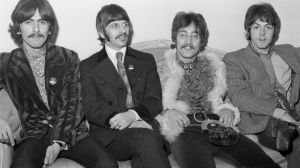
LONDON – MAY 19: (L-R) English musician, singer, songwriter and guitarist George Harrison (1943-2001), English musician, singer and drummer Ringo Starr, English singer, songwriter and guitarist John Lennon (1940-1980), and English singer, songwriter and bassist Paul McCartney of the Beatles attend a press party at the home of manager Brian Epstein supporting the release of Sgt. Pepper's Lonely Hearts Club Band, May 19, 1967 in London, United Kingdom. (Photo by Jeff Hochberg/Getty Images) -
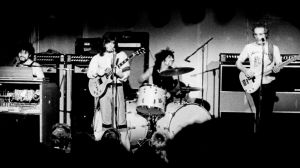
UNITED KINGDOM – JANUARY 01: MARQUEE Photo of VANILLA FUDGE, performing live onstage – L-R: Mark Stein, Vince Martell, Carmine Appice, Tim Bogert (Photo by Estate Of Keith Morris/Redferns) -
Musician Neil Young performing onstage in 1978 in Los Angeles. (Photo by Michael Ochs Archives/Getty Images)