There’s a reason that “strike while the iron is hot” is a well-worn adage. Waiting too long to capitalize on the popularity of anything runs the risk that all momentum that might have been accrued will be wasted.
Meat Loaf’s 1981 album Dead Ringer proves this point. But even if it came out in a normal interval after the smash Bat Out Of Hell, this troubled album still might not have made its mark.
Videos by American Songwriter
Vocal Issues
In 1977, Meat Loaf unleashed Bat Out Of Hell on the pop music world. The album, written and produced by Jim Steinman, Meat’s partner in gothic excess, barely made it out after everyone and their uncle passed on it. But it turned into a sensation once it arrived.
With this success in their back pockets, it seemed like a natural that Meat and Steinman would get right back to the drawing board. But part of the reason that Bat Out Of Hell made such a dent was because Meat Loaf toured it so relentlessly. Singing those operatic ballads and high-intensity rockers every night quickly took its toll.
Steinman collected material for the follow-up album, which was scheduled to be titled Renegade Angel. But Meat simply couldn’t sing the songs in the studio. Personal problems also beset the artist, causing the sessions to crumble in a heap with little completed. In 1981, Steinman released the material himself on an album called Bad For Good.
‘Ringer’ Drama
Doctors struggled to find any physical reason for Meat Loaf’s vocal issues. Eventually, he improved his physical condition. Little by little, he regained his vocal range. While upset that Steinman had moved on with the other record without him, Meat still looked to him for songs for the belated follow-up to Bat Out Of Hell.
Steinman cobbled together a few new songs for the project while reaching into his back catalog (as he often did) to repurpose his new material. Meat Loaf hired Stephan Galfas as a co-producer, although Steinman and Jimmy Iovine also eventually helped in that department.
Dead Ringer finally made it onto shelves in September 1981. Meat Loaf faced a vastly different music scene as he made his comeback. Still, with an all-star cast of guest players and a single featuring Cher as his vocal foil, the hope was high that all involved could recapture the lightning in a bottle once harnessed by Bat Out Of Hell.
Cher Can’t Save It
Dead Ringer isn’t quite the commercial flop many make it out to be. Although it’s true that it struggled to move many units in America, the album performed well in Europe. It even topped the album charts in the UK, where the Cher duet (“Dead Ringer For Love”) rose to the Top 5.
Artistically, the album doesn’t approach its predecessor, however. Bat Out Of Hell was by no means a bastion of subtlety. But it balanced that brazenness with hooks, humor, and pathos aplenty. By contrast, everything on Dead Ringer is pitched to the rafters, from the squealing production to Meat’s blustery but shaky vocals. But very little of it makes an impact.
Meat Loaf wandered through the rock wilderness for the remainder of the 80s, while Steinman offered his magic touch to other artists. In 1993, the two enjoyed a proper reunion with Bat Out Of Hell II: Back Into Hell, a dozen years after Dead Ringer first squandered the goodwill the original LP had garnered.
Photo by Sony Music Archive via Getty Images/Terry Lott
More Features
-

Singer Stevie Nicks shot in Los Angeles, California in 1982. (Photo by Aaron Rapoport/Corbis via Getty Images) -
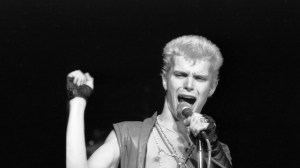
Boston, MA – August 28: Billy Idol performs live in concert at the Paradise Theater in 1982. The venue is now known as the Paradise Rock Club. (Photo by Jim Wilson/The Boston Globe via Getty Images) -
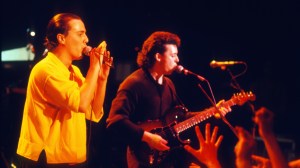
Tears for Fears – Koninklijk Circus – Brussel – Belgium – 21/04/1985 Roland Orzabal, Curt Smith Photo gie Knaeps -
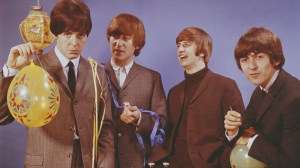
UNITED KINGDOM – 1st OCTOBER: The Beatles posed with bottles of beer and party snacks and balloons in October 1964. Left to right: Paul McCartney, John Lennon (1940-1980), Ringo Starr and George Harrison (1943-2001). The session was taken to promote the BBC World Service. (Photo by Mark Hayward Archive/Redferns) -

Alanis Morissette, Torhout/Werchter Festival, Werchter, Belgium, 7th July 1996. (Photo by Gie Knaeps/Getty Images) -
Photo by Ivan Keeman/Redferns -

Musician Bob Seger performs at the Poplar Creek Music Theater, Hoffman Estates, Illinois, July 9, 1983. (Photo by Paul Natkin/Getty Images)