
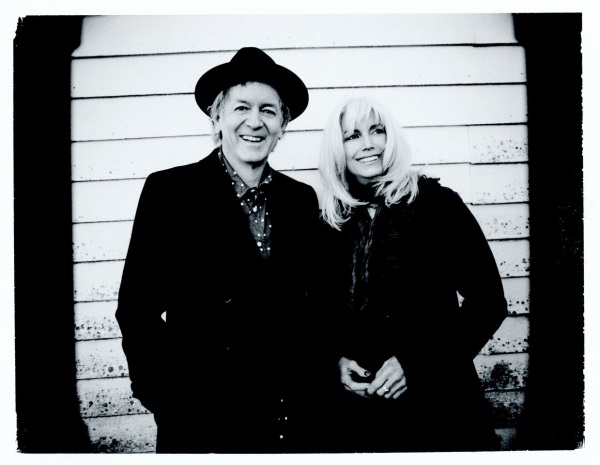
Folk-oriented songs were all that Harris sang in her earliest performing days. That changed when she met Gram Parsons, a scruffy West Coast visionary in need of a female harmony singer, who turned her on to hippified hardcore country in a big way. After his death cut their partnership short, she began making a series of albums in the mid-’70s that appealed to both California longhairs and country’s more traditional audience – excellent, influential, commercially successful collections that benefited greatly from her song connoisseurship.
Harris was being produced by Ahern and supported by her Hot Band, which Crowell joined after he became one of her first songwriting sources. Those guys could play a heartbroken ballad with the best of them, but they also earned their band name, expertly kicking up dancehall dust behind her spunky, sensual, rhythmically supple singing on tracks like “Two More Bottles Of Wine,” “Luxury Liner” and a cover of Chuck Berry’s “C’est La Vie (You Never Can Tell).” It’s worth revisiting her original recording of “Bluebird Wine” just to hear her lean into the line “right off the bat” with a girlish growl each time the chorus comes around. In recent decades, Harris’s albums have had a more dignified comportment, befitting a revered artist in the autumnal season of her career.
Crowell did his share of country-rocking and amped-up singing between his vitally down-to-earth, Ahern-produced debut album, the sleek and stylish approach of his subsequent projects and the taut, tuneful twang of his mainstream triumphs, beginning with Diamonds & Dirt in the late ’80s. Always a very smart and tradition-savvy songwriter, in his way, he too adopted a more serious-minded and high-concept approach to artistry this millennium, excavating the autobiographical riches of his feral Texas upbringing, taking his lyric-craftsmanship to new literary heights and serving his words with nuanced storytelling.
On Old Yellow Moon, Harris and Crowell more or less embrace the entire range of life and music they’ve experienced, from the reckless passions of youth to the reflectiveness of age, from loose-limbed hillbilly boogies to graceful balladry. As the novelist Madeline L’Engle once wrote, “If we lose any part of ourselves, we are thereby diminished. If I cannot be thirteen and sixty-one simultaneously, part of me has been taken away.” Her wise words resonate with what unfolds over these dozen tracks. Crowell and Harris aren’t acting their ages so much as inhabiting every age they’ve ever known each other to be – which is a fairly marvelous and moving thing to witness.
Harris sings lead on a couple of songs that make for an incredibly poignant contrast. One of them is “Back When We Were Beautiful,” a grandmother’s reminiscence written by Matraca Berg. Harris’s voice grows soft as a whisper at the end of pivotal phrases, making a graceful arc from savoring memories to mourning the cruelness of change. Crowell is a patient vocal companion, swooping in beneath her voice just as she reaches the point in the song when the old woman confesses her desperate need to convince the world, and herself, that she still harbors a vibrant young woman within.
The companion piece, “Spanish Dancer” – written by E Street Band member and Springsteen spouse Patty Scialfa – is a young woman’s ecstatic account of being swept up in lust and longing for the first time. That Harris is considerably further in age from this protagonist – she is, in fact, a grandmother – gave her pause, but Crowell and Ahern helped her shake off her worries about age appropriateness.
“I always wanted to record it, from the first time I heard that entire record of Patty Scialfa’s, Rumble Doll,” she says. “I mean, it’s just a masterpiece of writing, of female angst, that whole thing … But that particular song, as the years went by, I thought, ‘I don’t know. Is it believable for me to sing it where I am now in my life?’ Then, with the support of Rodney and Brian, who really wanted me to sing it, I said, ‘You know, it’s true. We’ll never stop being girls at heart. We’ll always have that feminine mystique in us.’ My mother has it at 91. And I was just so happy to have that support from them, that, ‘Yes, it’s okay for you to go ahead and record that song.’”
Despite what some of the coverage of Old Yellow Moon has suggested – for instance, the melancholic bent of the NPR headline “Staying Low” – not all the tracks traffic in heavy emotions. Often, the energy and fun quotient run pretty darn high, and it couldn’t have hurt that Ahern had Harris and Crowell working up the songs in such an informal setting. Said Ahern, via e-mail, “I found the longer I kept them at that big table, the more they would ‘leave themselves,’ listening to each other and asking to do it ‘one more time.’ As they did this, the carefully constructed vocal identities of the last thirty years seemed to slip away.”
The honky-tonk album opener “Hanging Up My Heart” was written by one-time Hot Band steel guitarist Hank DeVito. Harris gives the song a pleasingly punchy reading, and Crowell is right there with her. He takes the lead during the rollicking, latter-day Kris Kristofferson cover, “Chase The Feeling,” wickedly cataloguing hedonistic pleasures, and she’s a fitting foil, a sensual tease with smartly clipped phrasing. “The fans were going to know that everybody who recorded through the seventies had some party time,” wrote Ahern. “Rather than avoid it, I felt ‘Chase The Feeling’ would embrace it with raunchy poetry.”