
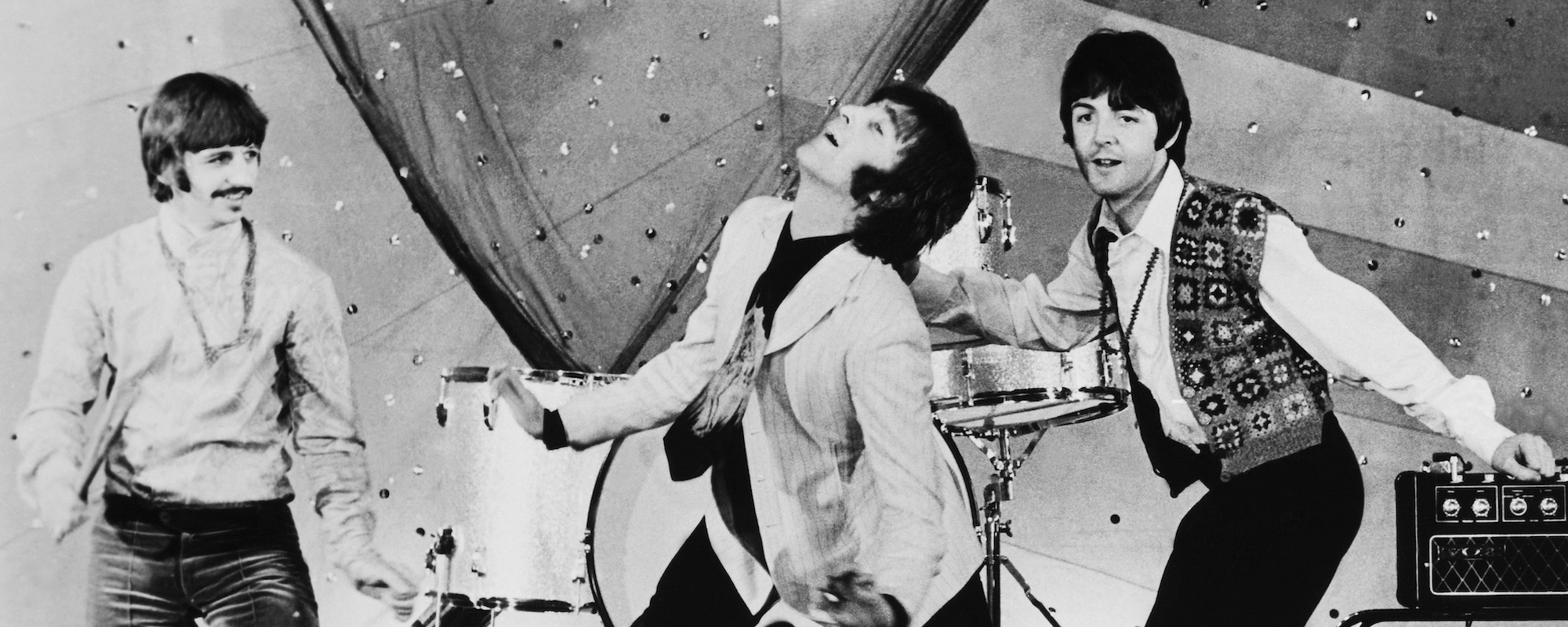
Country music, no matter how outlaw-flavored, was still in its own world apart from rock ‘n’ roll in the mid-1960s. Although the two genres would blend much more tangibly in the years to follow, the fact that Waylon Jennings was covering a Beatles track for his 1966 album, Nashville Rebel, was still a novelty. Jennings later credited the idea to his guitarist, Chet Atkins. But there was an even deeper connection linking Jennings and The Beatles—one that dated back to the 50s.
Videos by American Songwriter
In his eponymous autobiography, Jennings recalled Atkins suggesting they cut a version of “Norwegian Wood (This Bird Has Flown)”. This was around February 1966, which would have been two months after The Beatles released it on their December 1965, so-called “pot” album, Rubber Soul. Even before their full-blown LSD phase, The Beatles were taking an obvious turn toward the psychedelic and liberal-minded. These were still faraway, frowned-upon concepts in country music.
The fact that Atkins would suggest one of the more obviously “hippie dippie” tracks on Rubber Soul was part of the reason why Jennings enjoyed working with him. “It was this kind of unpredictability that endeared Chet to me,” Jennings said.
Blending Country and Psychedelia in This Way Was Unusual
It was technically Chet Atkins who suggested Waylon Jennings cover The Beatles’ “Norwegian Wood (This Bird Has Flown)”. But it wouldn’t have taken much for Jennings to come up with the idea on his own. “[Chet] loved those Beatles tunes, and I did, too,” Jennings wrote in his autobiography. “After all, The Beatles were indirectly named after Buddy Holly’s Crickets. I think I had probably done the song a few times at J.D.’s. John Cash remembers me singing it there.”
The Beatles’ namesake bit was true. John Lennon famously idolized Buddy Holly, for everything from his music to his glasses. In fact, “The Crickets” was one of the first band names Lennon presented to his bandmates. Paul McCartney vetoed it because of Holly’s group. The Beatles still referenced Holly with its insect reference. Additionally, the pun of making it “beatles” instead of “beetles” was a testament to the Liverpudlians’ wit and humor. And in this way, The Beatles were connected to Jennings long before the country star covered their Rubber Soul track.
The Beatles and Waylon Jennings Were Linked Long Before 1966
Waylon Jennings began playing guitar in Buddy Holly’s backing band in the late 1950s. The Crickets had technically disbanded, with Holly’s two bandmates returning to their hometown of Lubbock, Texas, after Holly moved to New York City to get ahead in his career. Jennings was playing with Holly during the Winter Dance Party Tour, which was abruptly cut short by the plane crash that took the lives of Holly, J.P. “The Big Bopper” Richardson, and Ritchie Valens.
In an uncanny twist of fate, Jennings was actually supposed to be on that plane. He gave up his seat to Richardson, who had the flu, and took a bus instead. In Falling Stars: Air Crashes That Filled Rock and Roll Heaven, Jennings recounted a bone-chilling conversation between him and Holly pre-flight. The two men were razzing one another, with Holly joking that he hoped Jennings’ “ol’ bus freezes up.” Jennings replied, “Well, I hope your ol’ plane crashes.” It was a comment he would always regret after February 3, 1959, became the day the music died.
Photo by Michael Ochs Archives/Getty Images

Leave a Reply
Only members can comment. Become a member. Already a member? Log in.