
We often assume musical supergroups effortlessly fall into place because of the sheer talent and starpower involved. But more often than not, these are the exact reasons why they don’t. Coordinating schedules, balancing egos, entertaining all creative input while remaining cohesive—these obstacles can make or break an album in an instant. And in the case of two iconic country albums from 1987 and 1999, these obstacles won out twice.
When rumors about a potential collaboration between Dolly Parton, Emmylou Harris, and Ronstadt, the musical world, as Parton put it to Cash Box, “got bent out of shape over it.” And with good reason. All three singers were superstars in their own right. It felt like women’s response to The Highwaymen, the successful supergroup composed of Johnny Cash, Willie Nelson, Kris Kristofferson, and Waylon Jennings. Who wouldn’t want to hear three uniquely talented voices like Parton, Harris, and Ronstadt join musical forces?
Videos by American Songwriter
But as the three women soon found out, not even the initial excitement of their collaboration was enough to send them to the recording studio when they first floated the idea in the 1970s. Instead, the journey to their iconic collabs would be long and protracted (and nearly abandoned more than once).
It Took Time to Get The Trio Together
Considering all of the hurdles Dolly Parton, Emmylou Harris, and Linda Ronstadt had to overcome to become The Trio, it’s honestly a wonder that they managed to put out any albums at all, let alone two. All three singers had tremendous careers in their own right, and finding enough downtime to get in the studio and work on another project seemed virtually impossible. They managed to find a ten-day window to get together and record, but this early endeavor proved more trouble than it was worth.
“We tried to make an album in ten days, and you can’t do that,” Ronstadt told Cash Box. “But we did. We finished the record by killing ourselves. We felt the quality just wasn’t up there. Our voices were ragged. We hadn’t thought out clearly enough what we wanted the album to be.”
So, the musicians shelved the collaborative album, opting instead to include songs from those 1970s sessions on various solo albums. The group finally reconvened in the mid-1980s, recording a series of traditional, cover, and some original material, including Dolly Parton and Porter Wagoner’s “The Pain Of Loving You”, Phil Spector’s “To Know Him Is To Love Him”, and the traditional song, “Rosewood Casket”. But not even these sessions were painless.
Why Dolly Called Herself, Emmylou, and Linda “The Three Tempers”
Besides coordinating schedules, balancing egos and differing workflows is probably the most difficult aspect of putting together a musical supergroup. When each member is a star with their preferred way of working, the band dynamic can quickly grow tense and unproductive. Such was the case for the mid-80s recording sessions of Dolly Parton, Emmylou Harris, and Linda Ronstadt, which Parton later told Ladies’ Home Journal could have been called the “Three Tempers.” Parton was a no-nonsense, get-it-done kind of worker bee. Harris was a perfectionist. Ronstadt liked to “live in the studio” and take things slow. Unsurprisingly, tensions rose as their work styles clashed.
Nevertheless, The Trio pushed forward, recording a follow-up to their eponymous debut in 1994. But after Parton unsuccessfully tried to delay the album’s release to separate it from an ongoing solo promotional run, the entire project was canned. Emotions were obviously fresh when Parton spoke to Ladies’ Home Journal the following year, calling the album’s abortion “a sin and a shame” and “a stupid decision.”
“I realized we’re now just a bunch of old, crotchety, cranky women, set in our ways and getting up there ‘round fifty, goin’ through change-of-life mood swings. You never know a true feeling from a hot flash. I thought, ‘I don’t need this.’”
Fortunately, the group was able to reconvene several years later and release Trio II in 1999, another fantastic collection of traditional, cover, and original material. The Trio’s time together, though woefully short-lived, is a beautiful testament to the fact that, although putting a supergroup together can be difficult, it can also be well worth the effort.
Photo by Paul Harris/Getty Images
More Behind the Album
-

Photo by Ed Rode/Getty Images -
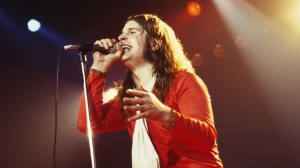
Photo by Chris Walter/WireImage -
Photo by Ed Rode/Getty Images -
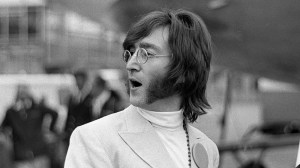
Photo by Murphy/Daily Herald/Mirrorpix via Getty Images -

Def Leppard on 8/23/81 in East Troy, Wi. (Photo by Paul Natkin/WireImage) -
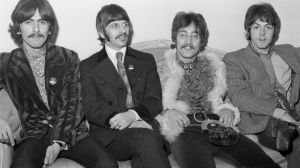
LONDON – MAY 19: (L-R) English musician, singer, songwriter and guitarist George Harrison (1943-2001), English musician, singer and drummer Ringo Starr, English singer, songwriter and guitarist John Lennon (1940-1980), and English singer, songwriter and bassist Paul McCartney of the Beatles attend a press party at the home of manager Brian Epstein supporting the release of Sgt. Pepper's Lonely Hearts Club Band, May 19, 1967 in London, United Kingdom. (Photo by Jeff Hochberg/Getty Images) -
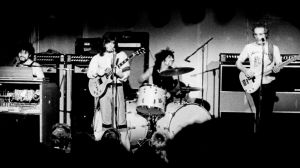
UNITED KINGDOM – JANUARY 01: MARQUEE Photo of VANILLA FUDGE, performing live onstage – L-R: Mark Stein, Vince Martell, Carmine Appice, Tim Bogert (Photo by Estate Of Keith Morris/Redferns) -
CIRCA 1966: Singer Mick Jagger of the rock and roll band "The Rolling Stones" performs onstage in circa 1966. (Photo by Michael Ochs Archives/Getty Images)