Your cart is currently empty!

Geckos Formed Unexpectedly Around a Wedding Gig Then Released a Self-Titled Debut
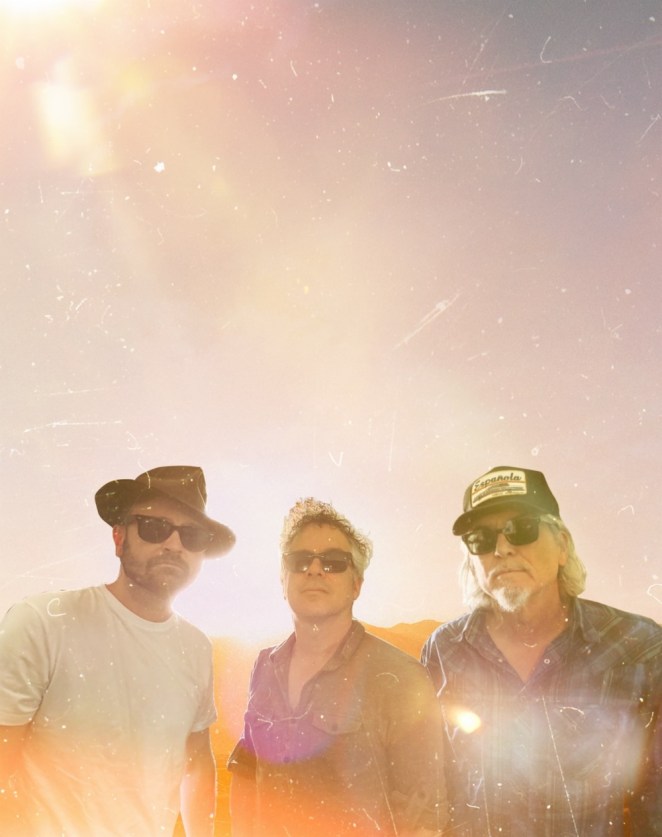
“What year is it now?” asks Howe Gelb, semi-jokingly. The Giant Sand singer and songwriter is trying to remember when he unexpectedly performed at a friend’s wedding in Tucson, Arizona, alongside M. Ward (She & Him, Monsters of Folk) and Irish multi-instrumentalist McKowski (Mark McCausland). At the time, Gelb and McKowski were tasked with coming up with a special waltz for the occasion, then Ward joined in to help. Gelb lands on “sometime in” 2024.
“It all happened very fast,” Gelb adds, landing on “sometime in 2024” for their collaboration. “Like a sonic harvest waiting to bloom, or a litter of lil lizards ready to hatch.”
After their unplanned wedding gig, the three reconvened, exchanging song ideas between their respective home bases with Ward in Portland, Oregon, McKowski in Omagh, Ireland, and Gelb in Tucson. Then, they eventually called themselves Geckos. The lizards symbolize adaptability, transformation, and renewal, an apt moniker for the trio who had collaborated on one another’s projects separately in the past, and still hatched something new together.
Recorded by Gabe Sullivan in Tucson, with additional recording in Ireland, and mixed by John Parish (PJ Harvey, Tracy Chapman), the band’s debut, GECKØS, was written and produced by Ward, Gelb, and McKowski, partly remotely and during the trio’s post-wedding jam sessions—and some musical compostions McKowski had brewing—kicking off with what turned into the trio’s lo-fi anthem.
“’Dance of the Gecko’ shouldn’t exist, but it does,” shared McKowski of the track. “The result of what happened when we all found ourselves in the same room at the same time. Something caught fire, and the song wrote itself in front of us, completely by accident. Luckily, Gabe Sullivan was there to press the record button and bottle the magic.”
He added, “The song has since become our calling card. The seed that Geckøs grew from.”
Videos by American Songwriter
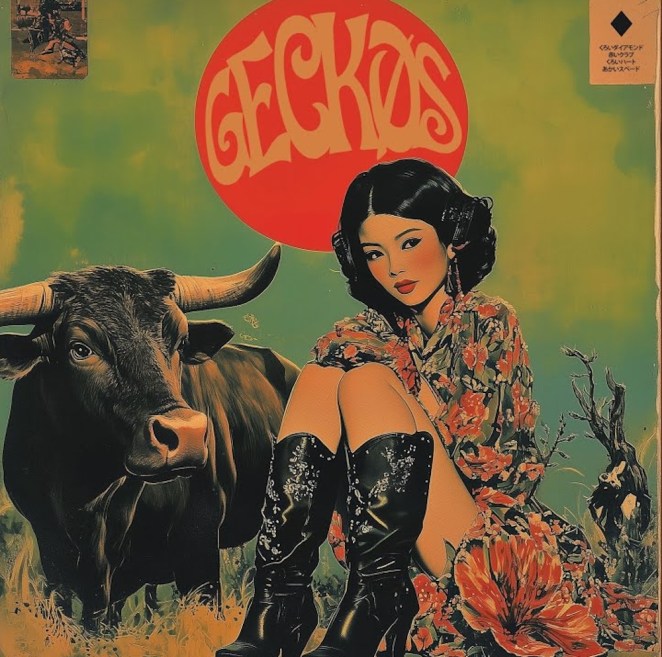
Remembering their recent roots, Geckos opens on the desert ballad they ended up writing during that first gig together, “Wedding Waltz.” GECKØS continues on into the band’s Southwestern and Spanish dance through some dusty and dreamy territories with “Lo Hice” (“I Did It”), highlighting Gelb and Ward’s slippery harmonies, and the latter taking lead vocals, in Spanish, on “El Techno.”
More Spanish influences resurface in the syncopation, McKowski’s guitar work, and floating stories of “Botas Negras” (“Black Boots”) and “Equilibrio” (“Balance”) before wandering off on one of the shorter tracks on the album, “Red Spade.”
After playing select dates across Spain in May and a five-night residency at Café Carlyle in New York City in September, Gelb and Ward weighed in on the magic behind the formation of Geckos and where the three plan to drift next.
Outside of your initial collaboration, “Wedding Waltz,” how did “Dance of the Gecko” come together? Was it another track that McKowski had already had in the works?
Howe Gelb: Think of it as a swirl of possible song bubbles all clamoring to burst forth. “Dance of the Geckos” just effervescenced first. Yes, Mark [McKowski] had a bevy of alluring, wordless tunes ready and beckoning for involvement.
Let’s go through the formation of Geckos and how some of the songs started piecing together between the three of you, who were working out of two countries and three different locations.
HG: Like most trips, the view is a little blurry out the window. There was an instigation between Mark and me somewhere beside Belfast that he arranged some sketchery with his U2 engineer friend. It yielded “Blame it on the Ocean,” and some other pieces not quite available for plucking.
After that, Mark would send me a new song he’d recorded (in Ireland) and upon immediate listening on my way out of the house, I shut the front door instead and quickly recorded a vocal on it of spontaneous imagery for what became “Black Diamond,” [named after], a dangerous railroad bridge we hung out on as teens in Pennsylvania
Mark’s music has a strong effect on me. Some time afterwards, we invited Pieta Brown into the mix wth a stunning waltz of Mark’s that she added lyrics and vocals to. Then, she suggested we give one of her dad’s songs a go that he wrote with her grandmother’s poetry, but we were recording in three different time zones in three different formats, and it proved more confusing than if we could’ve been in a room together.
Then came our friend’s wedding, filmmaker Geogg Marslett—we’d worked up some music for his film Quantum Cowboys (2022), starring Lily Gladstone. We were all there at the wedding at Che’s Lounge in Tucson. Yes, the wedding was at a bar, but hey, it’s a very special bar for most of us in Tucson.
Basically, Mark and I were asked to provide some music for the reception in my backyard, but our tunes were minor-keyed bummers until Matt [M. Ward] showed up and immediately brought the sparkle of light, love, and melody into the fold. So Mark grabbed some instant studio time in between everything from Buddy Gabrierl Sullivan’s studio Dust & Stone, and as he laid down some tracks, then Matt and I would swing by for a minute and have at it.
It was all done that fast, but it was also at that point whereby the record, as you hear it now, started to gain a momentum all its own. Mark and Matt were able to follow up in London and tackle a slew of other tunes he had brewing. The Pieta tunes are ending up in other releases, too. Then, old pal John Paris gave it a twirl on his mixer in Bristol, [England].
From “Wedding Waltz” and “El Techno” down to “Red Spade,” was there something tying these songs together by the end?
HG: I believe threads are in the ears of the beholder. Each of us sees different patterns in random occurrences like clouds or stars. It just speaks for itself, doesn’t it? The mood is self-evident upon listening.
M. Ward: I would say the thread is Mark’s rhythm guitars, the chords, and tempo choices. Howe and I brought layers, but the foundation is Mark’s guitar playing.
What made you land on the band name Geckøs?
HG: I refuse to ask myself that question, but it didn’t come from this corner of the field.
MW: It’s a fascinating otherworldly creature, the gecko. And the more you know, the more you like.
Were there any tracks that transformed as you fleshed them out more?
MW: When I wrote the lyrics for “El Techno,” I thought it would be taken as a moment of comic levity on the record, but the response has been more weighty.
HG: These songs have a lot of soul. Songs, kind of like prayers, tend to come true with repetitive harmonics of human utterance.
When you think back on some of your other projects along the way, and collaborations with other artists, how has songwriting shifted for you both during this time?
MW: I wanted to write free from the English language for some reason—something about Mark’s demos, I guess, was asking for it. My grandparents were born in Mexico, and my mom speaks Spanish, so that upbringing supplied me with a love for those sounds and syllables.
HG: Songwriting changes for me with aging. I used to believe the songs were already in us, waiting to emerge, and so now they flow with or without routine. Matt and Mark spark an available inspiration of forthcoming inclusion and cherished deployment.
What’s your relationship now with some of the older songs you’ve written?
HG: We have some talks. Oftentimes, Thøger Lund (Giant Sand bassist) will cover over and reintroduce me to the construction of my older material. I sit there charmed, like it wasn’t me who had done them.
What’s next for Geckøs?
HG: Since we didn’t plan it, to begin with, we’ll wait until it notifies us what’s next. Songs know best.
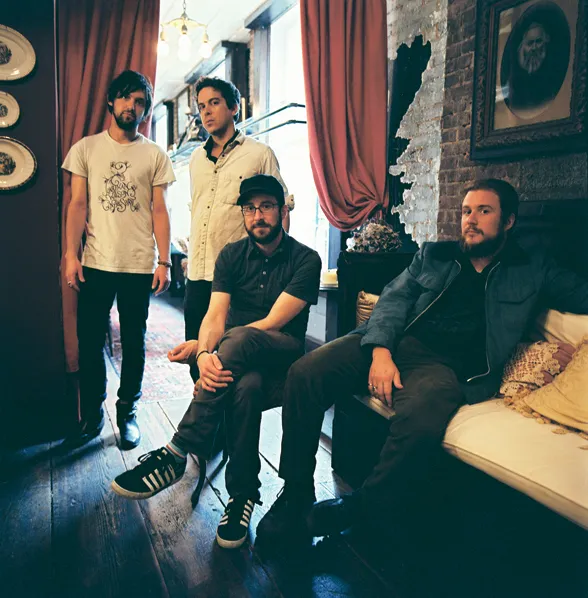
Photo: Courtesy of Geckos


Leave a Reply
Only members can comment. Become a member. Already a member? Log in.