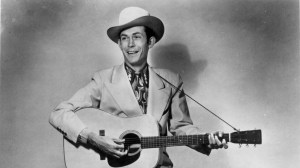
In a different life, he could have been the next major star for the Philadelphia Phillies. But Harold Lloyd Jenkins chose country music, and the genre is undoubtedly better for it. With a career spanning five decades and more than 50 number-one hits, his presence looms large over Nashville even now, 33 years after his untimely death at age 59. Today we’re taking a trip through the life and career of the man fans knew and loved as Conway Twitty, born in Friars Point, Mississippi, on this day (September 1) in 1933.
Before He Was Conway Twitty
Harold Jenkins learned guitar from his father, a riverboat captain. He made his radio debut at age 10, shortly after the family moved from his Mississippi hometown to Helena, Arkansas.
Videos by American Songwriter
Two years later, he formed his first musical group, the Phillips County Ramblers. They landed their own Saturday morning show on a local radio station.
Despite showing clear signs of musical talent, Jenkins set his early sights on the baseball diamond rather than the Grand Ole Opry stage. After graduating from Tallulah High School in Tallulah, Louisiana, the Philadelphia Phillies offered him a contract.
However, the U.S. Army took precedence when it drafted Jenkins during the Korean War. He continued pursuing both passions while stationed in Japan, playing on the Army baseball team and organizing a band, the Cimmarons, to entertain his fellow soldiers.
The Phillies were still waiting after Jenkins’ discharge. However, a brand-new artist named Elvis Presley was on the rise by that time. Jenkins saw his fellow Mississippian commanding screaming crowds from the stage and said to himself, “I think I can do that.”
In 1957, he looked at a map and spotted the towns of Conway, Arkansas, and Twitty, Texas. Thus, Conway Twitty was born.
His Rockabilly Beginnings
The newly christened Conway Twitty headed to Sun Records in Memphis. None of his recordings on Elvis Presley’s label ever saw the light of day, although Roy Orbison did record his composition “Rockhouse”.
Initially signing with Mercury Records, Twitty saw little success there. After leaving Mercury, he recorded a song called “It’s Only Make Believe”, which he’d written with his drummer, Jack Nance.
“I was sure it was a hit,” Twitty later recalled, per the New York Times. “But the record had been out for weeks and hadn’t done anything. Actually, they were pushing the flip side, ‘I’ll Try’. Anyway, I had a call from a disk jockey in Columbus, Ohio. He told me I had a smash in that town.”
Within several months, “It’s Only Make Believe” sat atop the pop charts, having sold millions of copies.
The Switch to Country Stardom
Suddenly, Conway Twitty was everywhere — a bona fide teen idol. By the mid-1960s, however, he felt himself growing disillusioned with rock and roll and drawn to country music — where his heart had always lie.
At songwriter Harlan Howard’s urging, legendary producer Owen Bradley signed Twitty to Decca Records in 1965.
His rockabilly background worked against him at first, with many radio stations refusing to play his songs. However, “The Image of Me” managed to crack the top five, and its follow-up, “Next in Line”, climbed still higher to number one.
From there, Conway Twitty seldom missed. His throaty vocals enhanced songs with lyrics both sentimental (“Hello Darlin’”; 1970) and steamy (“You’ve Never Been This Far Before”; 1973).
With Loretta Lynn, he also made up one of country music’s most beloved pairings of all time, taking home Vocal Duo of the Year honors from the Country Music Association four years in a row.
[RELATED: 3 of Conway Twitty’s Best Duets That Weren’t With Loretta Lynn]
With 56 chart-toppers, Twitty held the record for most number-one country songs until George Strait tied him in 2007 with “Wrapped”.
On June 4, 1993, Conway Twitty collapsed on his tour bus following a show in Branson, Missouri.
The following morning, he died of a stomach aneurysm at Cox South Hospital in Springfield, Missouri, at the age of 59.
Featured image by Disney General Entertainment Content via Getty Images
-
CHICAGO, ILLINOIS – American country and pop musician Crystal Gayle performs onstage at the Ivanhoe Theater, Chicago, Illinois, August 26, 1977. (Photo by Paul Natkin/Getty Images) -
NOTODDEN, NORWAY – AUGUST 02: Tony Leone (L) and Fred Tackett from Little Feat perform on stage at the Notodden Blues Festival on August 02, 2025 in Notodden, Norway. (Photo by Per Ole Hagen/Redferns) -
NASHVILLE, TN – Hoot Hester, Dawn Sears, and Vince Gill perform with The Time Jumpers at 3rd and Lindsley on October 21, 2013 in Nashville, Tennesse. (Photo by Beth Gwinn/Getty Images) -
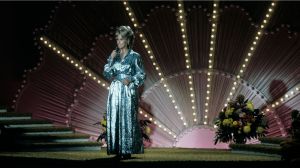
THE JOHNNY CASH SHOW – "History of Country Music" – Airdate: January 21, 1971. (Photo by ABC Photo Archives/Disney General Entertainment Content via Getty Images)LYNN ANDERSON -
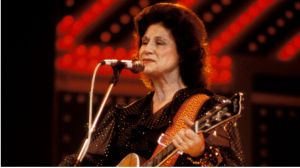
UNSPECIFIED – JANUARY 01: Photo of Kitty WELLS (Photo by David Redfern/Redferns) -
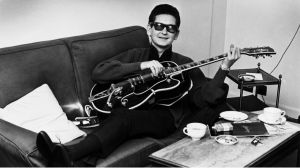
Roy Orbison. (Photo by © Hulton-Deutsch Collection/CORBIS/Corbis via Getty Images) -
LONDON, UK – MARCH 6: Rockabilly artist Charlie Feathers performs at The Royalty, on March 6, 1980 in Southgate, London, England. (Photo by Charles Paul Harris/Michael Ochs Archives/Getty Images)