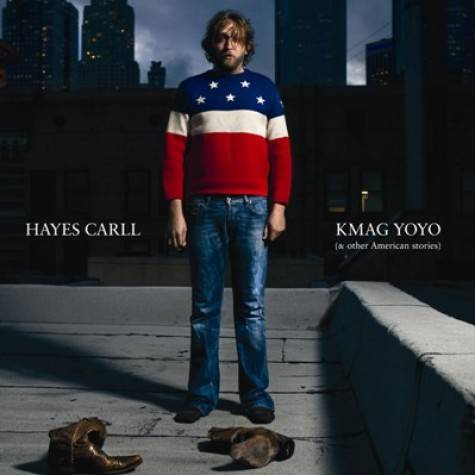
Hayes Carll
KMAG YOYO (and Other American Stories)
(Lost Highway)
[Rating: 4 stars]
To write a story song about a teenaged G.I. that’s not the least bit romanticized or callous and stands a reasonable chance of being funny to peaceniks and hawks alike takes deft, down-to-earth wit. Hayes Carll has it, and he’s penned just such a story song: the talking garage blues title track of his new album, KMAG YOYO (and Other American Stories), a name borrowed from a military acronym for a decidedly down-to-earth expression (“Kiss My Ass Guys, You’re On Your Own.”) This young soldier of Carll’s has no money, no prospects and no other choice but to enlist. But he gets a lot more than he bargained for in the process, finding himself drugged up and strapped into an experimental rocket, courtesy of the Pentagon.
Carll’s a tall, thirtysomething guy working in the tall shadow of the Texas songwriting tradition, though the word’s already spread outside the Lone Star State that he can hold his own as a writer, and that he’s got a way with humor. It wasn’t for nothing that he had a Ray Wylie Hubbard co-write on his last album and a Guy Clark co-write on the album before that. Or that Todd Snider – who’s not a Texan per se, but stands in the writerly lineage of Jerry Jeff Walker, who is one – takes a verse during the shambling hobo ballad “Bottle In My Hand.” Carll is proving more and more that his name belongs with the heavyweights.
Even though he’s put his own twisted twist on themes like the war in Afghanistan and religious devotion – the latter serving as grist for the irreverent mill in “She Left Me For Jesus,” the funniest number on 2008’s Trouble In Mind – he’s not a topical songwriter so much as a character-driven one. The characters – who can’t always be told apart from Carll’s rambling, guitar-toting, barroom poet persona – tend to be blue collar slouches or spitfires, self-deprecating, brokenhearted boozers and worldly-wise guys who live out their lives on the road.
Carll’s fourth album doesn’t alter the cast of characters all that much. In the droll, tumbledown duet “Another Like You,” he plays the part of a smart-assed Democrat drinking himself into a stupor. He meets his match in Cary Ann Hearst’s pickled-drunk, big-mouthed Republican. They’re strangely attracted to each other – for one night. It’s the sharp, peculiar detail in Carll’s one-liners that makes the song; for that matter, that’s what makes a lot of his songs. Each verse of this one is a rhyming ping pong match of trash talk. One stingingly funny exchange goes like this: “Shouldn’t you be purging?/Well you’re prob’ly still a virgin.”
What’s different about KMAG YOYO is that Carll’s now a singing, songwriting leader of a band – The Poor Choices – as opposed to a guy mostly used to playing alone. While his songs have tended to be showcases for clever lyric writing, some of these new ones came out music-first, right there in the studio, with his band. That may explain why the album opens with some feral British Invasion rock in “Stomp and Holler” and arrives a few tracks later at the amiable AM pop of “Grand Parade.” Both of those tracks are at least as much about feel as the words.
Just before “Grand Parade” comes “Chances Are,” the finest true-blue country ballad in Carll’s catalog to date. With mournful steel guitar backing him up, his antihero pines for a woman so close and yet so out of reach; the hurt is that much worse because he’s sabotaged himself. George Strait Carll is not, but the way his frayed drawl catches on the notes really drives home the heartbreak.
It’s when he reaches the affectingly simple final track, “Hide Me Babe,” that his road-worn bravado completely melts away. He sounds like he’s reached his limit and had a “come to Jesus” moment, wearily, earnestly swearing off hard-living ways with a thrumming, sympathetic gospel choir and fluent Wurlitzer behind him. Between “Stomp and Holler” and here, he and his American stories have covered a lot of ground.
(This review is featured in our March/April issue)
More Reviews
-
Lower Town Arts and Music Festival, 2026 (Photo by Paducah Convention and Visitors Bureau) -

John Oates performs with The Good Road Band on March 15, 2026, at The Cabaret Theatre at Mohegan Sun in Uncasville, Connecticut (Photo by Khoi Ton/Courtesy of Mohegan Sun)