
“They are made of truth,” says Nero Kane of the nine songs on his fourth album, For the Love, the Death and the Poetry (Subsound Records), another elevation into darkened musical fields for the Italian singer-songwriter and guitarist, and his partner and collaborator, Samantha Stella.
Whereas Kane’s 2018 debut Love in a Dying World was a desert-scape of discovery, For the Love, the Death and the Poetry (Subsound Records), extends several more noches. Kane’s fourth installment is a collection of more spiritual spells between the known and more of the unknown levitated by splendid arrangements saturated in dark, western, folk, goth, psychedelia, and other experimental nuances.
Coproduced with Matt Bordin and written entirely by Kane, except “The World Heedless of our Pain,” co-written with Stella, For the Love, the Death and the Poetry is a sermon of the souls from the ringing in of the chanted “As an Angel’s Voice” and hypnotic “My Pain Will Come Back to You” torugh the twilight-ridden balladry of “There is No End” and more spiritual “Unto Thee Oh Lord” through the closing drone of “Until the Light of Heaven Comes.”
Attached to some of their musical sermons are some experimental visuals, including a short film around “As an Angel’s Voice,” directed by Stella, and centered around the symbols and objects—past and present—that have helped shape Kane’s artistic journey. “A desert of the soul,” is how Kane described the track and accompanying visuals in a previous statement, adding, “The love we were never given, a flutter of wings, the fall into the end. The eternal.”
Videos by American Songwriter
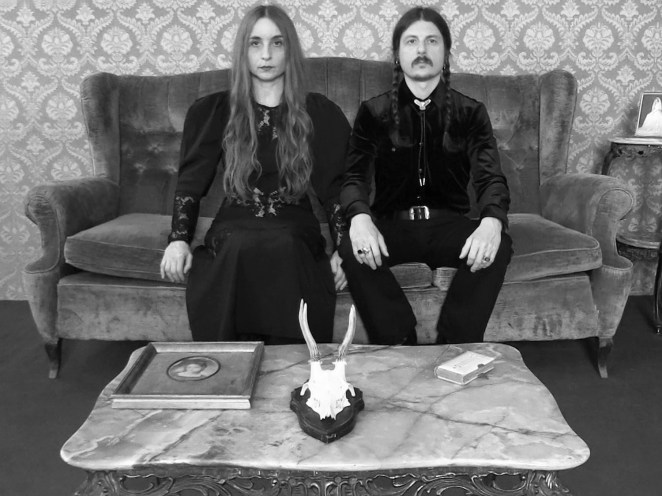
The film was also featured in Stella’s anthological exhibition in October 2025 at the MAIIIM center for contemporary arts in Genoa, Italy, spanning her 20 years of work in visual art, performance, dance, filmmaking, singing, set and costume design, and writing. Stella, who was also in residence at NYU, Tisch School of the Arts, Dance Department in New York City for a year earlier, said the film for “As an Angel’s Voice” unravels “As if Bela Tarr and Sergei Parajanov found themselves with Alejandro Jodorowsky in the American desert.”
Kane and Stella recently spoke to American Songwriter about their visual, musical, and lyrical journey inside love, death, and poetry on the new album.
[RELATED: Nero Kane Examine Good Versus Evil on ‘Tales of Faith and Lunacy’]
Was there a particular song that led you into For the Love, the Death and the Poetry since the release of Of Knowledge And Revelation (2022)?
Nero Kane: Honestly, I don’t remember exactly how it came together, but I think everything started to merge after I wrote “As an Angel’s Voice.” This song, which also became the lead single and video for the album, marked an important step in the visionary mood of the whole work. For the other songs, I just collected ideas and lyrics that I had previously written or recorded, or I wrote them anew. When I start putting together an album, there’s something like an inner click in my mind that I still find hard to recognize. But at a certain point, everything starts to speak and take its own direction. For this record, I definitely decided to work with a really stripped-down mood, trying to reach the deep essence of the songs.
Were there some older songs that you were still working through for the album?
NK: “Mountain of Sin” is one of the oldest, because I think I had the lyrics for one or two years, but I hadn’t found the right music for them yet. Also, the songs where Samantha sings have older lyrics. But all the other material is new, as it’s closely connected to what happened in my life during this last period. From a certain point of view, this is a very autobiographical album.
Individually, love, death, and poetry are all powerful states. Why did you end up christening the album For the Love, the Death and the Poetry?
NK: I think this title fits the album and its artwork very well. My music has always been connected to these three main aspects—love, death, and poetry—as they truly represent an important part of my inner world. I believe deeply in the power of art and beauty above all, and after three albums, this title seemed to gather everything I’ve done before, like a summary of my artistic path and also a statement.
Samantha Stella: The title intended to be a sort of synthesis of the themes touched upon in previous records: Love In A Dying World (2018), the Los Angeles debut produced by Joe Cardamone, Mike Lanegan’s latest collaborator, a lonely and melancholic journey in search of love through the Californian deserts; Tales of Faith and Lunacy (2020), a meditation on death through the blurred boundary between faith and madness; Of Knowledge and Revelation (2022), inspired by the poem par excellence, Dante’s Divine Comedy, in a vortex of emotions between hell, purgatory, and heaven.
As you’ve spent more time with these songs, what have some of them started revealing?
NK: I really love these new songs. I find a powerful meaning in them, and when I play them, I feel deeply connected to what I’m trying to express. Their stripped-down mood, acoustic touches, and spoken-word elements truly reflect who Nero Kane is at this moment in his life. Working on the live set for the tour made me realize even more their beauty. They speak with truth, and for me, truth in music is very important. They represent me in every single aspect. I feel that all nine songs are closely bonded together, creating a balanced whole. At the same time, all my previous work can also be seen as concept albums.
I think they will always keep the same essence, the same purity, because … they are made of truth.
Sonically, what did you want to capture on For the Love, the Death and the Poetry?
NK: I wanted to take a more stripped-down approach, and that continued throughout the studio production. I aimed to go further than Of Knowledge and Revelation, while also revisiting the desert/gothic western atmosphere of Tales of Faith and Lunacy. I was drawn to the acoustic guitar, wanting to create a small homage to Johnny Cash’s American Recordings style. In this album, I tried to focus on the essence of classical songwriting, merging it with the darker, ambient side that has always been part of my music.
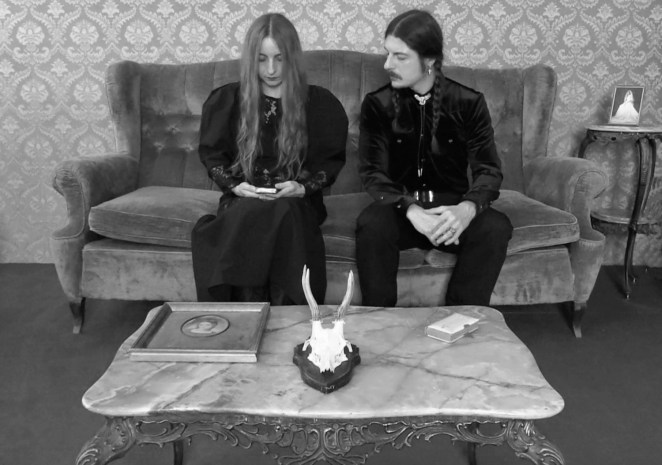
SS: In a certain sense, the new album presents the blues, folk, and southern gothic influences already present in the three previous albums, through a stripping down of the sound. A sort of ritual minimalism that winds its way through even more skeletal deserts and dilated guitar riffs accompanied by Nero’s monotonous, shamanic vocals. … I think the song that best represents the spirit of this new album is “The World Heedless of our Pain,” with its reference to the eternal force of art and love (with my unusual choir in Italian language that recalls the classical opera tradition—I lived for Art / I lived for Love—in contrast to the ephemeral vanity of existence: All is vanity, Nero keeps repeating above my words).
There’s also been a deeper visual journey from Love In A Dying World and now with “As an Angel’s Voice.” How have the films complemented the music throughout the years and vice versa?
SS: I have just presented an anthological exhibition in my hometown, Genoa, [featuring] 20 years of my artistic projects in visual art, dance/performance, and music, and I was able to retrace the themes and aesthetic symbols that have always been part of my journey. I think Nero Kane’s poetics have merged with my artistic vision. Our imagery is very similar, especially when it comes to a certain fascination with religious aesthetics. This has resulted in experimental films directed by me (one shot entirely in the Californian deserts), starring Nero and me, with no dialogue but edited to our songs, which accompanied the launch of each album and have been shown mainly in museums, galleries, and art centers.
The most recent short for “As an Angel’s Voice,” the black-and-white gothic western atmospheres of the film recall the overturning of life and death roles in Alejandro Amenábar’s [2001 film] The Others.
It’s been nearly a decade since Love in a Dying World. How has songwriting changed for you in the years since then?
SS: The sound inevitably became darker when I joined Nero Kane’s project with my vocals and mellotron/electric organ, starting with the songs on the second album. On the first one, I had only taken care of the aesthetic side, even though we had immediately started playing as a duo during live performances. Nero Kane continues to be a solo project, but let’s say it is supported by my now long-standing collaboration. He is recognized as an obscure, existentialist singer-songwriter with a poetic soul, and over the years, we’ve built a unique and personal style which combines a certain American imagery with European philosophical and cultural roots. Something cathartic, ritualistic, and psychedelic that has captured attention in very different contexts, including dark folk, goth, metal, experimental, and pure songwriting.
NK: I think it has slowly developed over the years, becoming more refined, more balanced, and more focused. It grew as I got older; it followed my life day by day, step by step, and I hope it will continue to stay by my side for the rest of my life. I just wish to carry on with my artistic path as purely as I can, and to find comfort in it, even if it’s often a struggling affair.
Photos: Manuele Scalia



Leave a Reply
Only members can comment. Become a member. Already a member? Log in.