The Beatles often got by with a little help from their friend—that friend being LSD, on more than one occasion. Iconic songs like “Lucy in the Sky With Diamonds” and “Getting Better” were birthed during the Fab Four’s “experiments.” On this day (April 1) in 1966—accompanied by Paul McCartney—John Lennon walked into London’s Indica Books & Gallery with a mission. While he didn’t get what he came for, Beatles fans got the groundbreaking Revolver track “Tomorrow Never Knows”. Sounds like a win to us.
John Lennon Was Looking For Something Else Entirely That Day
Indica Books & Gallery opened in March 1966 with a little help from Paul McCartney, who poured 5,000 pounds into what he hoped would become a hub for the city’s contemporary underground literary and art scene.
Videos by American Songwriter
On that particular day 60 years ago, John Lennon had set out to find a copy of The Portable Nietzsche. Instead, he left with The Psychedelic Experience: A Manual Based On The Tibetan Book Of The Dead by Timothy Leary, Richard Alpert, and Ralph Metzner.
Lennon had barely made it past the book’s introduction when a line jumped out at him: “When in doubt, relax, turn off your mind, float downstream.” Those are the words you hear him utter in the introduction to the closing track of their 1966 album Revolver.
“Leary was the one who was going round saying, ‘Take it, take it, take it,’ and we followed his instructions in The Book of the Dead, his how-to-take-a-trip book,” Lennon told Hunter Davies in his 1968 authorized biography.
He continued, “I did it just like he said in the book, and then I wrote ‘Tomorrow Never Knows,’ which is almost the first acid song, ‘Lay down all thought, surrender to the void’.”
How “Tomorrow Never Knows” Pushed the Limits
While undoubtedly fantastic musicians and songwriters, a large part of the Beatles’ legacy lies in their ability to push the boundaries of what was possible in the studio. “Tomorrow Never Knows”, with its reverse guitar melody and absolutely zero chord changes, is perhaps the finest example of that.
Wanting his vocals to sound like a Tibetan monk chanting from a mountaintop, John Lennon initially suggested his bandmates suspend him from a rope in the middle of the studio ceiling and a mike in the middle of the floor, allowing him to sing as he spun in circles.
Instead, they used a Leslie speaker cabinet, a large wooden box that contained an amp and two sets of revolving speakers.
“Through the glass we could see John begin smiling,” recalled junior engineer Geoff Emerick. “At the end of the first verse, he gave an exuberant thumbs-up and McCartney and Harrison began slapping each other on the back.”
Featured image by G Greenwell and A MacDonald /Daily Mirror/Mirrorpix via Getty Images
-
Photo by Michael Ochs Archives/Getty Images -
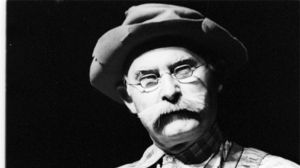
UNSPECIFIED – CIRCA 1950: Photo of Grandpa Jones Photo by Tom Copi/Michael Ochs Archives/Getty Images -

Luke Combs had a huge hit with his cover of Tracy Chapman's "Fast Car"